
Playing with Fire: a New Look at Joint and Several Liability
When facing a tangled web of blame and the complexity of responsibility
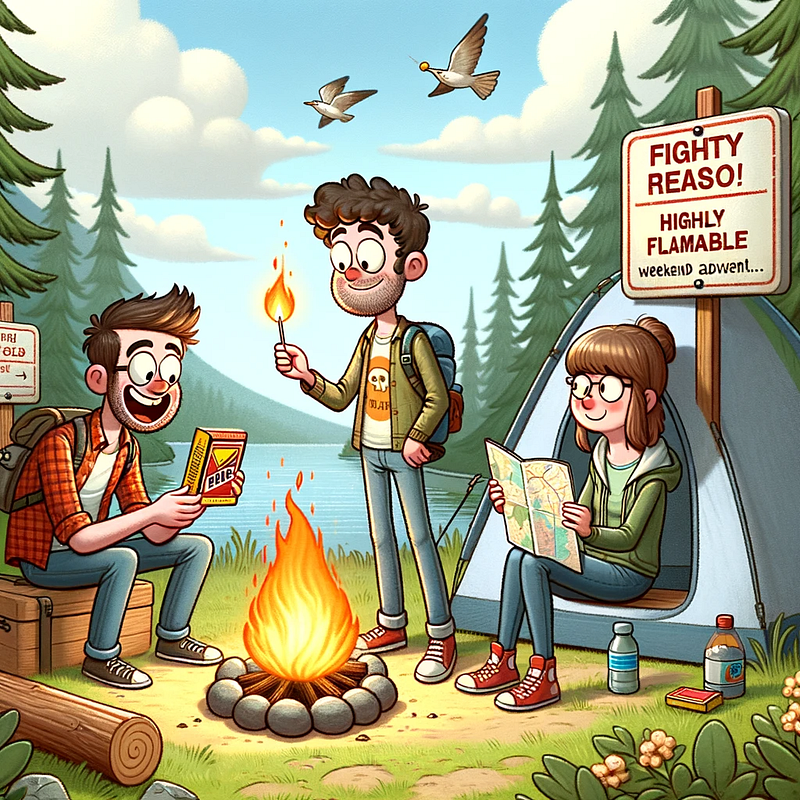
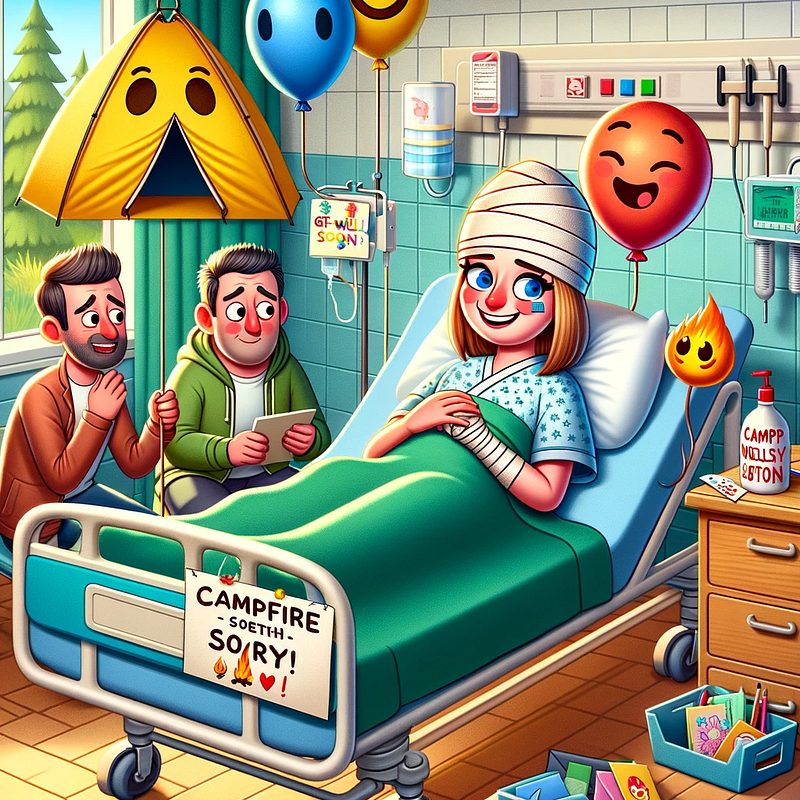
The concept of joint and several liability addresses situations where multiple parties are responsible for someone’s injury. It tries to figure out who pays when all parties share some fault. Consider a situation where three friends — Kevin, Joe, and Rachel — are on a weekend hiking adventure. Kevin, an enthusiastic and careless adventurer, decides to light a campfire. Joe, equally careless, brings a flammable tent. Meanwhile, Rachel sleeps peacefully in her own tent, unaware of the risks. In an unfortunate turn of events, Kevin’s fire gets out of control and Joe’s flammable tent catches fire, spreading the fire to the next tent and seriously injuring Rachel.
From torts law perspective, this situation raises some good questions: Who is responsible for Rachel’s injuries? Is it Kevin, whose fire started the mess, or Joe, whose tent material fueled the flames? Or perhaps both?
All About Injuries
Divisible Injuries
Now imagine, while they are camping, Kevin accidentally causes a minor burn to Rachel with a spark from the campfire, and later Joe’s flammable tent catches fire, resulting in a separate burn to Rachel. In this case, Rachel suffers two separate injuries: a burn from Kevin’s spark (assume the damage is estimated at $50,000) and another from Joe’s tent fire ($200,000).
Legally, this situation is a “divisible injury”. Rachel can seek compensation for the burn caused by Kevin’s spark independently of the compensation for the burn caused by Joe’s tent fire. Each friend is responsible only for the specific injury they directly caused: Kevin pays $50,000, and Joe — $200,000.
Indivisible Injuries
However, the situation becomes more complex with “indivisible injuries.” Imagine that Kevin’s initial fire spreads uncontrollably due to the presence of Joe’s flammable tent, resulting in a larger fire that causes multiple, serious injuries to Rachel. Now it’s difficult to separate the injuries caused by Kevin’s fire from those exacerbated by Joe’s flammable tent.
Rachel’s injuries are the collective result of both Kevin’s and Joe’s actions, making it difficult to attribute specific harm to each individual. This could result in both Kevin and Joe being held jointly and severally liable. Rachel could potentially seek full compensation for all of her injuries from either Kevin, Joe, or both, due to the intertwined nature of their actions in causing her harm.
Meet the Liability Twins
Several Liability
Now let’s discuss several liability using our camping story as a reference. According to the Third Restatement of Torts, in the case of several liability, an injured party can only recover damages equal to each defendant’s share of responsibility.
Rachel sues both Kevin and Joe for her injuries after the fire incident. Let’s say the court finds that Kevin is 50% responsible for the accident due to his initial act of starting the fire, Joe is 40% responsible for exacerbating the situation with his flammable tent, and Rachel herself bears 10% of the responsibility for choosing to camp in close proximity to a fire.
If the total damage is estimated at $250,000, each person’s share of liability would be calculated accordingly: Kevin would owe $125,000, Joe $100,000, and Rachel’s own liability negates her claim by $25,000. But let’s say Kevin can only pay $100,000, part of his share. Under several liability, Rachel cannot look to Joe to cover Kevin’s shortfall. She can only claim the amount equal to each person’s assigned percentage of responsibility. In this case, Rachel would only be able to recover a total of $200,000 — $100,000 from Kevin and $100,000 from Joe, regardless of the total damages awarded.
Joint and Several Liability
When we shift our focus to joint and several liability, the situation takes a different course. According to the same Third Restatement of Torts, under joint and several liability, an injured party like Rachel has the option of recovering the full amount of damages from any or all of the liable parties.
The total damages suffered by Rachel are estimated same at $250,000. Based on the court’s assessment, Kevin is responsible for 50% ($125,000), Joe is responsible for 40% ($100,000), and Rachel herself is responsible for 10%($25,000). But we know that Kevin is only able to pay $100,000, not his full share.
Here, Rachel can go after Joe to cover not only his $100,000 share, but also the $25,000 shortfall from Kevin’s share. In fact, she could seek the entire $225,000 (the total less her own share) from either Kevin or Joe. This means that even if one defendant can’t pay his full share, the other can be forced to make up the difference, ensuring that Rachel can potentially recover the full amount she is owed, minus her own liability.
Contribution
In some states, if a jointly and severally liable defendant ends up paying more than its fair share of damages, it has the right to seek reimbursement from the other liable parties. This process is known as “contribution”.
If Kevin ends up paying $150,000 (which is $25,000 more than his share) because Joe couldn’t pay his full amount, Kevin can go after Joe for that excess $25,000. This ensures that Kevin can try to balance the scales by getting Joe to pay his fair share of damages. Of course, Kevin cannot recover the whole amount that represents his own share of the liability, because the law is designed to spread the financial burden of damages more equitably among the responsible parties and to prevent any one party from shouldering more than its fair share of liability.
Indemnity
Indemnity allows a defendant who has paid damages to recover the full amount from another party who is actually responsible for the loss. How does it work? To illustrate this with our camping case, suppose the National Park Service , which is responsible for the safety of the camp, is held liable for the injuries Rachel suffered as a result of the actions of Kevin and Joe. If the National Park Service pays Rachel $250,000 in damages, it can then turn around and sue Kevin and Joe to recover the full amount it paid to Rachel, since they were the primary cause of the incident.
Now let’s look at a situation where a defendant is vicariously liable (we discussed this type of liability in one of our previous stories — link below) for the actions of another person simply because of their relationship, like an employment. In such case, the vicarious liable party — the National Park Service (an employer) — would be responsible for all damages associated with the primary tortfeasors — Kevin and Joe (assume for a moment that they are employed by the National Park Service), regardless of whether the rule is joint and several or several liability. At the later stage, the National Park Service has the right to seek indemnification from Kevin and Joe, i.e., it can sue Kevin and Joe to recover the amount it paid on their behalf.
Rachel’s Fault
We remember that Rachel was partially responsible for her injuries — perhaps she chose to sleep near a poorly constructed fire pit. In a “comparative fault” system (like in New York, California or Florida), Rachel’s recovery would be reduced by the percentage of fault attributed to her. As already mentioned above, if she is found to be 10% responsible for her injuries and the total damages are $250,000, she would only recover 90% of that amount, or $225,000.

However, if we apply a “modified comparative fault” rule (available in Georgia, Hawaii, Idaho, Colorado and some other states) and Rachel’s fault exceeds 50%, say 51%, she would not be able to recover any damages at all. This threshold is key in determining whether a plaintiff like Rachel can recover.
In a “contributory negligence” system, the rules are even stricter (works only in Alabama, District of Columbia, Maryland, North Carolina and Virginia). If Rachel is found to have contributed in any way to her own injuries, no matter how small, she could be barred from recovering any damages at all. This system is less forgiving and can completely negate a plaintiff’s claim if they are found to be even slightly responsible for their injuries.
It’s important to remember that no matter how many people Rachel can sue for her injuries (like Kevin and Joe), she is only entitled to one full recovery. This means that even if she sues multiple parties, she can only recover the full amount of her damages once. The law ensures that a plaintiff cannot profit from her injury by receiving more than the total amount of her damages.
Reflections
The doctrine of joint and several liability represents our society’s quest for fairness and justice in the face of complexity and uncertainty. It recognizes that life, much like our camping story with Kevin, Joe and Rachel, isn’t always just black or white. Unfortunately, injuries and harms are often the result of a tangled web of actions, and dissecting these threads to assign precise blame is not always feasible.
This doctrine attempts to serve as a balancing act. It seeks to ensure that victims like Rachel are not left without recourse due to the difficulties of apportioning blame. At the same time, it provides a framework for equitable burden-sharing among those responsible, avoiding the undue hardship that might result if one party were to bear the full burden of liability. In this balance, however, lies a profound reflection of our personal values. The law, in its wisdom, recognizes the collective responsibility we share for each other’s well-being. When our actions inadvertently intertwine to cause harm, the concept of joint and several liability kicks in, not only as a legal rule, but also as a reminder, albeit an unusual one, of our interconnectedness.
Disclaimer
The information provided in this article is for informational and educational purposes only and is not intended to serve as legal advice or as a substitute for legal counsel. While efforts have been made to ensure the accuracy and completeness of the content herein, it is important to note that legal principles and regulations can vary significantly based on jurisdiction and specific circumstances. Therefore, this article should not be used as a definitive legal resource or as a basis for making legal decisions. Readers are strongly advised to consult with a qualified attorney for advice on legal issues or matters, as each individual case may require detailed and personalized legal analysis.
Reliance solely on the information provided in this article without seeking professional advice from an attorney may lead to unintended legal consequences or misinterpretation. The author or publisher of this article do not accept responsibility for any potential errors or omissions, nor will they be responsible for any losses, injuries, or damages arising from its display or use. The information provided here does not create an attorney-client relationship between the reader and the author or publisher.