
Plato’s Realm Of Forms Tells Us Nothing About Mathematics
We’ve all heard of Plato’s Realm of Forms. Unfortunately it tells us nothing about mathematics (or anything else).
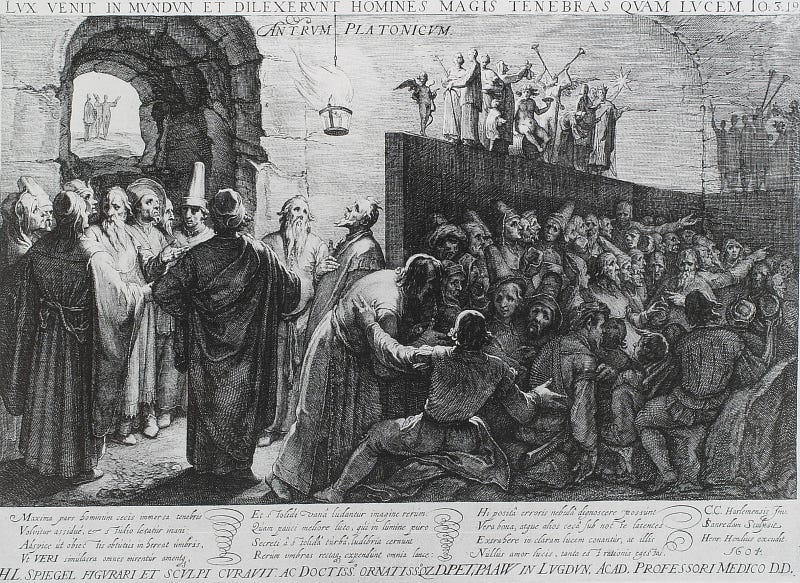
What is the Realm of Forms?
The realm of forms is something Socrates exposits in Plato’s writings. For those who don’t know, Plato didn’t directly write his thoughts, instead he wrote discussions in which other people debated and reasoned.
The forms, he argues, are like when a prisoner in a cave sees the reflection of an object from the outside. You learn something of it, but it never compares to seeing the object itself.
If you want to hear from the horse’s mouth, see this section from The Republic.
This sort of thing is a big deal, because it remains a mystery what abstract concepts like numbers are. If there were no humans, would numbers exist? In what sense do they exist? (The phrase ‘in what sense’ is quite illuminating, as we shall see that Plato merely packages up our existing ambiguity and tries to link it to our senses)
P.S. it is contested whether Plato himself believed the Realm of Forms existed.
P.P.S I think Plato’s dialogues are a very fun read. I think my favourites were Phaedrus and The Symposium, both of which are quite raunchy (surprisingly for a Philosophy book!). In fact, the Victorians had an absolute nightmare editing out all the homoerotic undertones and overtones.
Why it tells us nothing
Let’s think for a second about what it says.
There is some abstract realm, in which things like numbers exist.
Um, okay. But we have no detail on what this ‘place’ is like.
In fact, imagine you didn’t possess this innate knowledge of the form of a number. Then clearly this means nothing to you. If I said to a deaf person, there is a place where sound ‘exists’, they have learned nothing about sound. I have told them ‘hypothetical objects which you do not know exists in place I can tell you nothing about’.
So it basically assumes you know what these objects are.
Let’s run with him for a second. There’s some abstract idea of a number all other things are imperfect copies or statements of. Then what has he added? There’s a place for these numbers?
But this isn’t a place in any usual definition — it has no defined location, space, time, interaction with people. We don’t have any observable Platonic Particles drifting down with special mind dust.
So it boils down to: concept which you think exists, it exists, and let’s say it exists in a place because we say other things exist in a place.
Not. Very. Helpful.
The author is an Economics undergraduate student at Cambridge. His passions are Mathematics, Philosophy, music composition, and attempts at humor writing. He also enjoys writing flattering bios of himself in the third person.


