
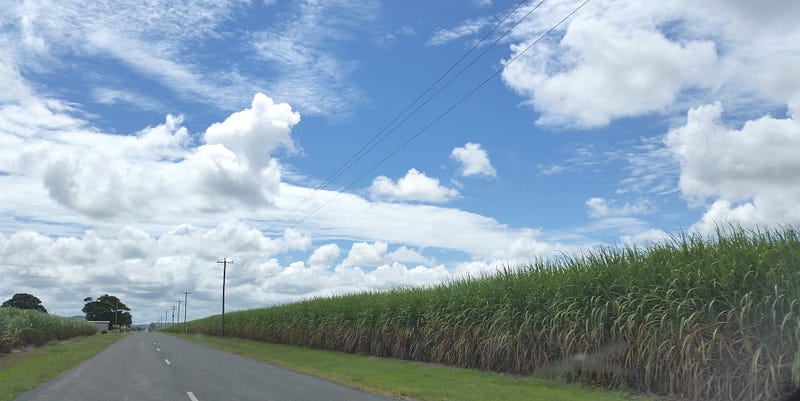
Planting Sugar Cane
A profoundly back-breaking honeymoon
At the age of 28 one of my biggest goals in life was to move to Santa Fe, New Mexico. It was my personal El Dorado. I got married that year and my goal became “our goal.” (I was a good salesman back then.) We were married in Texas where I was working at a tie-wearing indoor corporate job. The first couple of months of the marriage we saved money to move to Santa Fe but before moving there we decided that we first needed a honeymoon.
The honeymoon was a bit belated but it lasted for six weeks. I joyfully quit my job and we went to the bayou country of Southern Louisiana where my new mother-in-law was living at the time. Visiting a mother-in-law is not a normal way to spend a honeymoon but for us it was fine. She was by no means a typical mother-in-law. She and I had been good friends for six years before I ever married her daughter. Choosing Southern Louisiana as a honeymoon destination gave my new bride a chance to be with her mother for a while before moving far away and it gave me a chance to visit with a friend. It was a cheap honeymoon because we had a place to stay for free while we went sight-seeing and did honeymoon-type things.
But only two of those six weeks could really be called a honeymoon.
After those two first weeks in bayou country we realized that we needed to earn some more money if we were ever going to make it to Santa Fe. So I looked for some temporary work. I quickly found out that there were absolutely no local jobs available that I was qualified for.
But we were on an adventure so I opened myself up to thoroughly new possibilities. Even at that young age I had already worked many different kinds of jobs. I was willing to push the envelope and try something completely outside of my experience.
I soon learned that we were in Southern Louisiana right at sugar cane planting time. I had never worked as a migrant farm worker before but there is a first time for everything, right?
My new mother-in-law knew someone who knew someone who knew someone. In just a day and a half I somehow managed to be hired onto a crew of sugar cane planters. There were twenty-six humans on the crew. Twenty-four of them were male and two were female. Twenty-five of them were black and I was the only white guy.
When I showed up for work on the first day the entire crew looked at me and laughed. I immediately got a nickname, ‘white city boy.’ I’m not sure but they were probably taking bets to see how long I would last.
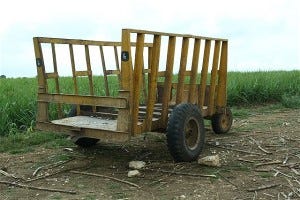
It did not take long to learn how sugar cane is planted. The fields (and they were very large fields) had been plowed and furrowed. Tractors pulled large wagons full of freshly cut sugar cane plants that were each eight to ten feet in length. As the tractors moved across the fields there were two workers at the back of each wagon. They would pull a couple of sugar cane plants off the wagon and then bend down and place them just right into a furrow. (They would later be covered with soil by a separate tractor. From each joint in the sugar cane plant a new plant would emerge so every cane we planted yielded about 8 to 10 new plants.)
The tractors pulling the wagons did not slow down and they certainly did not stop. So the two workers walking behind the wagons had to pull the canes off the wagons, bend down and place them in the furrows then stand back up to grab a couple of more canes then bend back down to plant them; all while walking behind the wagon at the pace decided on by the driver of the tractor.
It was monumentally back-breaking work. It was pulling then bending down then standing back up then pulling then bending back down — all while walking and keeping up with the speed of the tractor. Over the course of a day we bent our backs down then up again hundreds if not thousands of time.
And it was all done while we were walking through mud. October, I learned, is the rainy month in Southern Louisiana — and we did not stop working because of rain. It was not until the fields were completely under water that we had to stop. At the end of the day I was covered with mud from head to toe. Somehow, there was mud in every crack and orifice of my body.
I had never worked so hard in my entire life. But I did not give up.
One of the two black female workers on the cane-planting crew was pregnant — about six or seven months. I could not believe that she was doing such back-breaking physical work in that stage of pregnancy. But she kept up with everyone else. And she made me look like some white city boy wimp!
She became my hero. If I felt like I was about to collapse from exhaustion I merely had to look across the field at her to be inspired. She just kept planting and planting like some kind of machine — or some kind of Wonder Woman. She freaked me out. But I was determined to at least keep up with her and it was not easy. My respect for women intensified.
There were two things that I really liked about that job. The first thing was the crew. I may have started out as a wimpy white city boy but I never gave up. None of those guys won their bets. I slowly earned their respect as well as their friendship.
At the end of every week the crew would throw a late night party. There was plenty of booze, plenty of zydeco music and plenty of dancing. My newlywed bride and I were the only white folk at those parties but it didn’t seem to matter one iota what the color of our skin was. Everyone was family.
The other thing I liked was the food. When lunch time came after a long, long morning of planting cane the foreman would yell out, “Lunchtime!” and the tractors would stop and the workers would immediately stop their work and everyone would pile onto the back of one of the cane trucks and we would all be driven to Mama Red’s house.
Mama Red was an old black woman who always wore a red bandana over her head. I guessed that is why they called her, Mama Red. She lived in an old pink clapboard house way out in the middle of the bayou. The house had a long wooden porch and at lunch time this long wooden porch turned into a cafeteria line. She spent the entire morning cooking utterly delicious Cajun food and she then set out the pots on tables on her porch.
When the crew arrived at lunch time we would form a single line and walk across her porch. At the beginning of the line we would pick up a large bowl and then have those bowls filled with food as we progressed along the cafeteria-like line. At the end of the line was a large glass jar where we would throw money into. There were no set prices. We just threw in whatever money we could afford. This was how Mama Red made her living. Her house and her porch were an unlicensed, under the radar restaurant.
No one would tell me how old Mama Red was. She was one of the most wrinkled women I’ve ever met. I guessed she was in her eighties but who knows? I wondered how many decades she had been cooking for farm workers. However long it was, she was one hell of a cook! Her food was to die for — especially after a long, long morning of back-breaking work.
I thoroughly fell in love with Cajun food. I especially loved Mama Red’s Cajun chicken stew. Once I made the mistake of asking her for the recipe.
“You want my recipe? Fuck you! You gonna start a business and try to run me out of business? Hell no, I ain’t givin’ you no recipe. Fuck you!”
I never got the recipe but I can still taste it in my mouth now so many decades later. It’s the best chicken stew I’ve ever had in my life.
I worked for a month in those muddy cane fields. It was the most back-breaking job I’ve ever had. I truly loved it but I was also truly glad when it was over — even if I was going to miss a lot of new friends.
My wonderful bride and I finally had enough money for bus tickets to Santa Fe. It was sad leaving Bayou Country and our new friends but it was sheer euphoria finally arriving in Santa Fe, our ultimate destination.
We arrived in Santa Fe in the evening of Halloween. After checking into a hotel we took a walk around the historic plaza in downtown Santa Fe. All the people wandering the streets were in costume. It was a little bit surreal.
It got even more surreal when it suddenly started to snow. We had just come from the swamps of Louisiana where it is still hot in October to the high mountains of Northern New Mexico. We did not even have any jackets.
We arrived in Santa Fe with about four hundred bucks in our pockets. That is all we had until we could find a place to live and jobs and subsequent paychecks. We were crazy! But hey, I just spent a month planting sugar cane. I was ready to surmount any obstacle.
Luckily, I still had my ties and nice clothes and I was able to secure a job within 48 hours. It was a corporate job wearing a tie and working indoors. And I never had to bend over — at least not physically. And my salary was almost three times as much as what I made in the mud-drenched sugar cane fields.
We were so incredibly poor those first few months in Santa Fe but we were so happy and excited and full of life. It was a tremendous adventure. Sure, we went through some very tough times but every time we did I just thought of that pregnant black woman planting sugar cane back in Louisiana. If that poor woman could do that then I could do anything.
She really had become my hero!
Despite the poverty and endless challenges, that first year in Santa Fe was pure nirvana! My newlywed bride became pregnant that year and it was almost one whole year later in October that she gave birth to a little girl. While that pregnant black sugar cane planting woman back in Louisiana had become my hero, I now suddenly had two new heroes.
Copyright by White Feather. All Rights Reserved. Complete White Feather Archive Index