
Plant Immunity: The sign language between plants and pathogens
The plant's immune system consists of two defense lines: pattern-triggered immunity (PTI) and effector-triggered immunity (ETI).

What is Plant Immunity?
Unlike animals, plants are sessile and in constant exposure to microbes. These microbes act as hidden thieves that steal nutrients from plants in bulk. While phytopathogens establish an intimate relationship with plants that bring abnormalities in physiology and make them sick.
Disease: Any deviation from the normal physiological state.
Some pathogens require an alive host to feed and reproduce host tissues. Such phytopathogens are called biotrophs. Examples of these pathogens are powdery mildew fungus, viruses (obligates parasites), and rice bacterial pathogens (Xanthomonas oryzae).
Necrotrophs feed on dead host tissues and secrete such enzymes that degrade host cells to release enough amount of nutrients. An example of these pathogens is Botrytis cinerea (gray mold fungus), Erwinia carotovora (potato soft rot).
Hemibiotrophs are biotrophs during the early stages of infection but later become necrotrophic, and example is Magnaporthae Oryzae (rice blast fungus)
Therefore, in the plant’s life, there is a constant battle of survival. With the passage of time, plants have evolved themselves physically and genetically.
Plant immunity is the inherent or induced capability to ward pathogens off from themselves. The plant immune system consists of two defense lines: pattern-triggered immunity (PTI) and effector-triggered immunity (ETI).
Besides plant immune responses, plants also have evolved various structures to avoid the injures of herbivores. For example waxy cuticles of leaves, hairy growth on the lower side of leaves, and thorns at leaves in some plant species.
An image with thorny leaves is given below:


Pattern-triggered Immunity
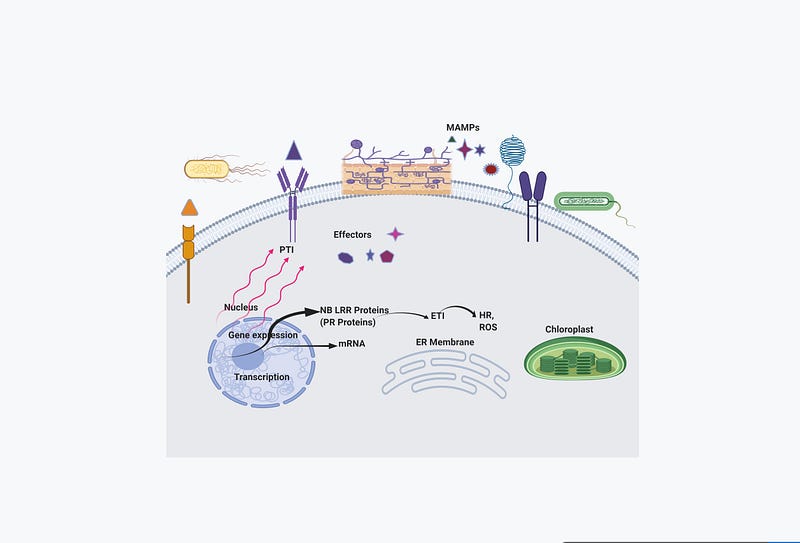
The first line of plant defense consists of receptors that are present at the plasma membrane. The cell membrane receptors recognize pathogen molecules and activate a defense response. The pathogenic molecules are pathogen-associated molecular patterns (PAMPs), conserved, and highly microbial specific molecules.
Pattern recognition receptors (PRRs) recognize PAMPs through an extracellular domain leucine-rich repeat (LRR) and an intracellular protein kinase domain.
Upon perception of PAMPs, pattern recognition receptors (PRRs) induces a downstream signaling cascade that includes the production of reactive oxygen species (ROS), induction of calcium-dependent protein kinases (CDPK), mitogen-activated protein kinase (MAPK), phytohormones, signaling hormones (Jasmonic acid, salicylic acid, ethylene).
Effector-triggered Immunity
The second line of defense is called effector-triggered immunity (ETI). Pathogens translocate effector molecules into plant cytoplasm to suppress or inhibit immune signals triggered by pattern recognition receptors.
Effector molecules interfere with pattern triggered immunity and lead to the effector-triggered susceptibility (ETS). Effectors are pathogen virulence factors that interact with plasma membrane receptors and prevent the activation of PTI.
Sometimes pathogens successfully transfer the effector molecules into the plant cell cytoplasm to intervene with mitogen-activated protein kinases (MAPKs).
Now more tactfully plants have evolved a second line of defense to surveil whether pathogen translocated effectors intracellularly. This second line of surveillance is accompanied by nucleotide-binding leucine-rich repeats (NB-LRRs) and called effector-triggered immunity (ETI).
Meanwhile, pathogen struggles to avoid ETI by eliminating or altering the effector molecule. Both defense surveillance (ETI and PTI) consist of a complex array of defense responses.
These responses include upregulation of defense genes that encode pathogenesis-related proteins (PR-Proteins), programmed death of plant cells or tissues to overcome pathogen spread, and activation of signaling pathways (jasmonic acid pathway, salicylic acid pathway) for systemic acquired resistance.
Over time, pathogens have also evolved in different ways to suppress ETI. For example bacterial pathogens of the genus Pseudomonas, Xanthomonas, and Erwinia.
Signaling Mechanisms in Plant Immunity
Reactive Oxygen Species (ROS)
Reactive oxygen species play a crucial role in plant defense mechanisms against biotic and abiotic stresses. It causes oxidative burst which kills plant cells if they have pathogen virulence factors.
It is consists of superoxide anion, hydrogen peroxide, and hydroxyl radical. At the local infection site rapid accumulation of ROS cause the destruction of pathogen and infected cells, a hypersensitive response (HR). The hypersensitive response is the sudden death of plant cells to cease pathogen spread into the plant system.
Calcium Influx
Calcium influx influences the opening of transmembranes and causes alkalinization.
Salicylic acid (SA), Jasmonic acid (JA), and Ethylene (ET)
Phytohormones also constitute in plant defense and systemic acquired resistance (SAR). Salicylic acid plays an important role against biotrophs while jasmonic acid and ethylene signaling molecules are key components against necrotrophs.
These phytohormones induce defensive genes in neighboring cells called systemic acquired resistance (SAR).
Keynotes
There is a constant battle between plants and microbes for their survival. The survival strategies have evolved both organisms.
The plant immune system consists of two lines: pattern-triggered immunity and effector-triggered immunity.
Pattern-triggered immunity recognizes PAMPs at the primary infection site by pattern recognition receptors (PRRs) and initiates a cytoplasmic cascade of molecules mainly defensive.
Effector-triggered immunity is the second layer of defense that triggers the reprogramming at the gene level. ETI caused the sudden death of plant cells at the injection sites to prevent the systemic spread of pathogens.
For the activation of neighboring defense cells, phytohormones play a key role in systemic acquired resistance in the whole plant.


