
Pixels in the Dark
Fathoming death from a distance
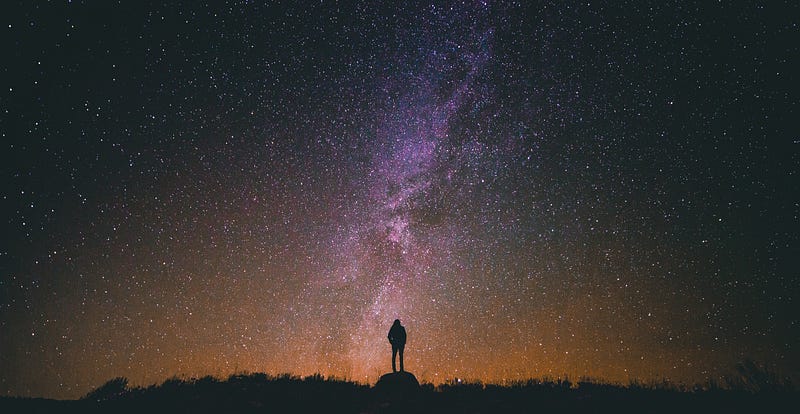
The nights are frosty lately. Black and frigid and lonely as outer space.
When I took the dogs out after dinner, I stood for a moment in the center of the fenced-in yard. My head tipped back. My lips sighed a trail of steam up toward the sky.
That is, I added a breath of mammal-heat to the atmosphere — the thin, cold layer of air that we share, between us and the void.
I could see stars, though not many. Mars shone clearly as the brightest point of light. I watched it float in silence while the dogs scrabbled around in the dark, digging at the dirt, snuffling through dry leaves.
It looked like a pixel on a screen.
This is how the whole outside world starts to look after nine months of interacting with it remotely. Your long-lost long-distance loved ones no longer feel like warm bodies. They’ve become information: data, text, distant points of light.
I shivered in the chill and tried to imagine how massive Mars really is. How large. Rock-solid. Heavy and dusty and rust-red.
Thousands and thousands of miles away from our human lives and deaths.
Thousands of people are dying every day.
I mean, thousands of people die every day, in a normal year. And thousands of infants are born and kisses are given and shouts are exclaimed. This is a planet teeming with human lives and deaths.
But as this nasty viral pandemic spreads, thousands more people are dying every day, in the worst possible ways:
Unnecessarily.
Unexpectedly.
Early.
Abruptly.
Struggling for breath, in a fog of panic, with burning bones and damp skin and nerve-ends in pain…
Alone.
Who do I know who’s died this way, of Covid?
Mercifully, so far, my own flesh-and-blood family has been spared. I haven’t asked a nurse to hold a phone to my relative’s face so I could see them one last time on a screen. I haven’t logged into a virtual funeral.
But I know people who have lost people.
My friend’s dad.
My other friend’s dad.
My sister’s friend’s dad.
My own dad’s friends, two of them.
Friends of family and family of friends.
At last count, in my homeland, over two hundred and ninety thousand.
No — I need to update this number each time I return to reread these words I’ve written, just a few times over the course of a few wintry days.
Now it is two hundred ninety-four thousand three hundred and sixty-two.
Now it is two hundred ninety-five thousand seven hundred and twelve.
If I sit quietly at home and wait a few days more, I’ll soon need to write that three hundred thousand friends and family members have died this way, of Covid.
From Earth, when we humans tip our heads back to the sky, we can each see at most about two thousand five hundred stars.
This would be on a perfectly clear night, with no obstructions, no light pollution. Picture the sort of Milky Way view that few of us ever actually see with our own eyes: a dome of space that is fully dusted, almost clouded, with starlight.
The number of stars we see on those perfect nights? A fraction of this pandemic’s human death toll. More than ten times as many individuals have died, in this land, in the last nine months, of Covid.
A friend of mine works as an emergency room doctor.
After dinner, but before I took the dogs out, I watched a video she shared of her own face, lit by her bedroom lamp, awash in tears. She describes her day. She helped resuscitate a man in Covid-induced cardiac arrest, but he wouldn’t make it through the night.
Forty-eight years old, she says.
She explains how, once it was clear that he would die, she scrambled for hydrogen peroxide to scrub blood off the floor of his hospital room. They only had a few minutes before his wife and three young children poured in to say their goodbyes. She didn’t want that to stain their final memory with him: smears of his blood drying on the tile underfoot.
Her voice grows faint toward the end.
“This is just a reminder that Covid’s real… and it doesn’t just kill old people,” she says, as fresh tears start to choke her. “It kills lots of people. People that shouldn’t die.”
I confess I wanted to look away. But I didn’t. I watched her pixelated crying on my phone screen until the end of the recording.
A few minutes later, I found myself looking up into the vastness of the night. At the pixel that is Mars — a massive reality that seems so remote to my senses, I must make an effort to convince myself it’s actually out there.
How could that possibly be real? my body insists.
That is too much. Too big, too far removed from my own skin’s experience of the world.
Planets, pandemics, people in pain — their numbers and distances — the facts of them are unfathomable.
The longer I held my gaze, the more my eyes adjusted to the darkness. More and more points of starlight materialized, slowly, while the dogs rooted around on the ground behind me.
“Unfathomable,” I murmured to myself.
The word emerged from my lips as steam and dissolved into the black, unheard by any fellow-mammals.


