avatarHistory Hub

Free AI web copilot to create summaries, insights and extended knowledge, download it at here

1448

Abstract

top canal accidents. It’s put in places near water and busy spots like the Red Light District. It is like a big metal spiral that stands up and because of this special design it is called the <a href="https://en.wikipedia.org/wiki/Pee_curl">“golden ratio”</a>. <a href="https://en.wikipedia.org/wiki/Pee_curl">There is a nice curve to it made from strong iron, so it lasts long and also gives some cover to people using it</a>. You can tell if someone’s inside because of the open bottom.</p><p id="3491">The design of the Plaskrul is pretty cool. It has legs that look like a bladder, which hints at what it’s for. On some older Plaskruls, there are cross designs. These crosses stand for Amsterdam. They also let air in and let people inside see out without being seen.</p><h1 id="443e">Why the Plaskrul Faces Extinction</h1><p id="bc94">Over the years, the Plaskrul, despite its charm and functionality, faces challenges that put its existence at risk. First, modern urban development, with its focus on sleek designs and advanced technologies, often overlooks the Plaskrul.</p><p id="acd9">New public restrooms, equipped with automatic flushing and sensor-based lighting, have become more popular. These high-tech toilets often attract more users because they provide a complete bathroom experience compared to the limited utility of the Plaskrul.</p><figure id="88fd"><img src="https://cdn-images-1.readmedium.com/v2/resize:fit:800/1*24BEinx1P

Options

ozMNmNcNb2aaQ.jpeg"><figcaption>Source: <a href="https://commons.wikimedia.org/w/index.php?search=amsterdam+urinals&amp;title=Special:MediaSearch&amp;go=Go&amp;type=image">Wikimedia Commons</a></figcaption></figure><p id="a07d">Furthermore, concerns about inclusivity and gender equality have surged. <a href="https://edition.cnn.com/style/article/amsterdam-sustainable-urinal-scli-intl/index.html">The Plaskrul mainly caters to men, leaving a large portion of the population without a similar option</a>. Activists argue for more inclusive public facilities that cater to everyone, regardless of gender or physical ability.</p><h1 id="7a9b">Eurolift</h1><p id="31a0">The Eurolift is a new kind of public toilet that comes out of the ground when it’s needed. During the day, you can’t see it because it hides underground. This way, our parks and streets look nice. But at night, it pops up for people to use. This helps because it stops folks from going pee in the wrong places.</p><p id="7ce8"><a href="https://m.facebook.com/SunriseUrology/videos/234551837477420/">What’s special about the Eurolift is that it’s made for everyone, boys and girls. It’s also good for our planet</a>. It doesn’t waste a lot of water, and it deals with waste in a smart way. Because of these things, many cities like the idea and want to use it. This new toilet, the Eurolift, could mean we won’t see the old types of public toilets much anymore.</p></article></body>

Pissing on the Streets of Amsterdam

From historic intimacy with water to modern engineering excellence

Netherlands is famous for many things: tulips, windmills, and a unique approach to managing water. But there’s another area where the Dutch stand out, and that’s their innovative approach to public urinals.

For centuries, cities like Amsterdam have faced challenges with public urination, especially due to the influx of intoxicated tourists. The combination of alcohol consumption and the lack of public urinals led to unintended accidents, some even fatal.

Instead of giving fines or putting warning signs, the Dutch saw it as a city design problem. They created special public toilets called the ‘Plaskrul’ and the ‘Eurolift’. These toilets didn’t just solve the problem but also showed how clever and practical Dutch design can be.
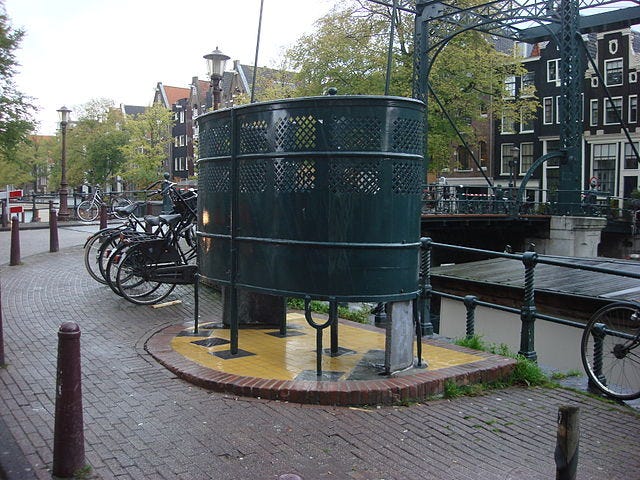
Source: Wikimedia Commons

The Birth of the Plaskrul

The Plaskrul is a special public toilet made by the Dutch to stop canal accidents. It’s put in places near water and busy spots like the Red Light District. It is like a big metal spiral that stands up and because of this special design it is called the “golden ratio”. There is a nice curve to it made from strong iron, so it lasts long and also gives some cover to people using it. You can tell if someone’s inside because of the open bottom.

The design of the Plaskrul is pretty cool. It has legs that look like a bladder, which hints at what it’s for. On some older Plaskruls, there are cross designs. These crosses stand for Amsterdam. They also let air in and let people inside see out without being seen.

Why the Plaskrul Faces Extinction

Over the years, the Plaskrul, despite its charm and functionality, faces challenges that put its existence at risk. First, modern urban development, with its focus on sleek designs and advanced technologies, often overlooks the Plaskrul.

New public restrooms, equipped with automatic flushing and sensor-based lighting, have become more popular. These high-tech toilets often attract more users because they provide a complete bathroom experience compared to the limited utility of the Plaskrul.
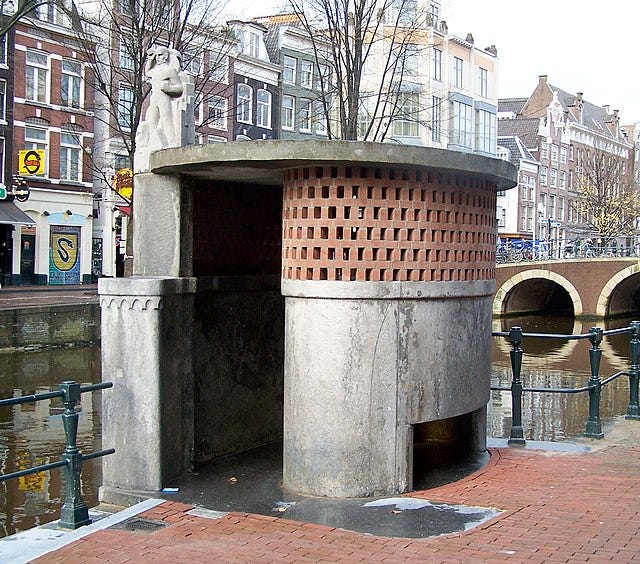
Source: Wikimedia Commons

Furthermore, concerns about inclusivity and gender equality have surged. The Plaskrul mainly caters to men, leaving a large portion of the population without a similar option. Activists argue for more inclusive public facilities that cater to everyone, regardless of gender or physical ability.

Eurolift

The Eurolift is a new kind of public toilet that comes out of the ground when it’s needed. During the day, you can’t see it because it hides underground. This way, our parks and streets look nice. But at night, it pops up for people to use. This helps because it stops folks from going pee in the wrong places.

What’s special about the Eurolift is that it’s made for everyone, boys and girls. It’s also good for our planet. It doesn’t waste a lot of water, and it deals with waste in a smart way. Because of these things, many cities like the idea and want to use it. This new toilet, the Eurolift, could mean we won’t see the old types of public toilets much anymore.

Amsterdam
Dutch
History
Public
Storytelling
Recommended from ReadMedium