
Pina
Part of a famous drink in a famous song
Today’s New York Times Spelling Bee letters:
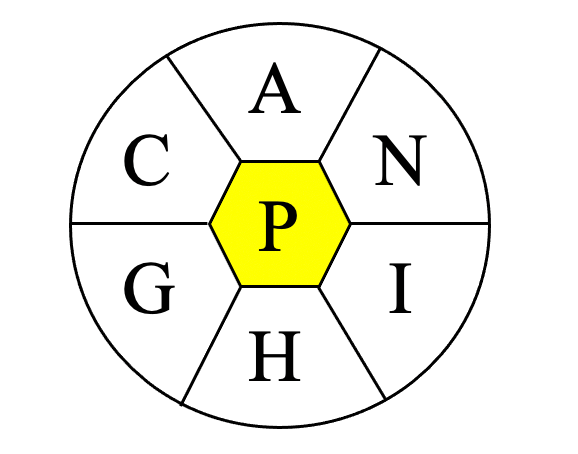
A, C, G, H, I, N, and center P (all words must include P)
Merriam-Webster says…
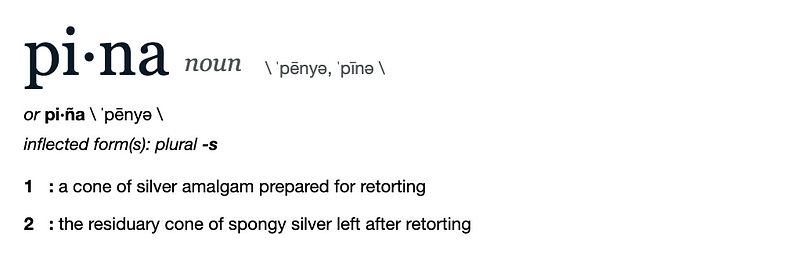
Silly little dictionary! Don’t you know that pina can’t possibly be a word if the New York Times says it ain’t?
For further fascinating facts, check out the Spelling Bee Master.
What’s your favorite dord* from today’s puzzle?
My Two Cents
Yesterday the dord* I chose to write about (démodé) had accent marks, which made me wonder if that was the reason it had been rejected by the Spelling Bee. Today I selected a word that may or may not carry a tilde (the ˜ mark that is placed over the letter n in Spanish, as in señor). I say “may or may not” because I couldn’t find any information about either of the definitions for pina presented by the dictionary.
I searched Wikipedia, the 1911 Britannica, the current online Britannica, Lexico.com (the free version of the Oxford English Dictionary), several articles about metallurgy… and nothing. I googled “silver” and “amalgam” and “retorting”. The only instances in which I found a reference to pina in relation to metallurgy all seemed to be ripoffs of Merriam-Webster’s text, sometimes verbatim.
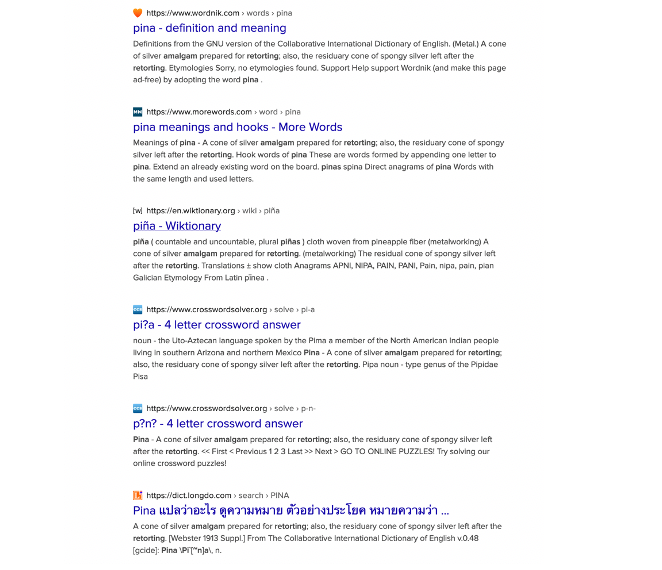
So, if any of my readers has any idea how the word pina or piña is connected with metallurgy, please enlighten all of us in the comments section.
When I searched Merriam-Webster for piña with the tilde, I got this:

This term was borrowed from Spanish, and literally means “strained pineapple”. Which brings us to…
Piña
In Spanish the word piña stands for two different things that grow on trees. One is the pineapple (Ananas comosus), and the other is the pine cone. So context is important when you’re talking about one or the other.
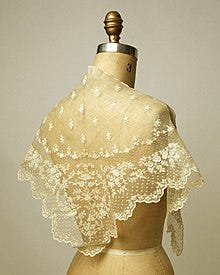
In the Philippines, however, the term piña refers to a traditional fiber made from the leaves of the pineapple plant. Although pineapples were indigenous to South America, they were brought over to the islands of the Philippines in the 1600s and widely cultivated there. The pineapple leaf is cut from the plant, after which the fiber is split away. Each strand of the piña fiber is hand scraped and knotted to others to create one continuous filament that will be handwoven. Here is an example of a 19-century cloth made from piña fiber and lace:
A song not named piña colada
The 1970s tune that everyone knows as “that piña colada song” is, in fact, called “Escape”. It formed part of the 1979 album Partners in Crime by Rupert Holmes, a British American singer-songwriter and musician. The song Escape topped the charts late that year and ended 1979 at the top of the Billboard Hot 100. After being bumped down the first week of 1980, it shot back up to the first spot again, becoming the first pop song ever to get to number one the Billboard chart in two different decades. (That is, of course, if you consider 1980 to be the first year of the 80s and not the last year of the 70s. I’ll leave you passionate decade experts to argue it out while I continue writing.)
“Escape” has a catchy tune that distracts from the funny story it tells. I spent many years hearing the song and even singing it’s chorus before realizing what the lyrics were actually about. Perhaps this happened to you with this tune or a different one. There are plenty of songs whose meanings are glossed over or misunderstood. Isa Nan just wrote about five of them a few days ago.
The reason “Escape” is better known as “the piña colada song” is because of its three choruses that mention the drink. The song tells of a man who, bored with his marriage, one day spots an ad in the newspaper from a woman seeking a man who, among other little things, must like piña coladas. Curious, he places an ad of his own and arranges to meet the woman… only to discover that the woman is actually his current partner. The dying flame of their love rekindles and they live happily ever after. Or at least, they end up drinking gallons of piña coladas.
The first chorus, which represents the ad placed by the wife, goes like this:
If you like piña coladas And gettin’ caught in the rain, If you’re not into yoga, If you have half a brain, If you like makin’ love at midnight In the dunes on the cape, Then I’m the love that you’ve looked for. Write to me and escape.
The phrase “piña coladas” appears in the other two choruses, but the rest of the words differ slightly. The second chorus is the man’s reply ad, and the third time is the speech he gives when he discovers his intended mistress is actually his wife.
You can listen to the whole story right here, with lyrics in both English and Spanish!
Interestingly, this tune could have been known as “the Humphrey Bogart song” if Holmes had stuck to his original idea. As he explains in his own words…
The original lyrics said, “If you like Humphrey Bogart and getting caught in the rain.”… As I was getting on mic I thought to myself, I’ve done so many movie references to Bogart and wide-screen cinema on my earlier albums, maybe I shouldn’t do one here. I thought, What can I substitute? Well, this woman wants an escape, like she wants to go on vacation to the islands. When you go on vacation to the islands, when you sit on the beach and someone asks you if you’d like a drink, you never order a Budweiser, you don’t have a beer. You’re on vacation, you want a drink in a hollowed-out pineapple with the flags of all nations and a parasol. If the drink is blue you’d be very happy. And a long straw. I thought, What are those escape drinks? Let’s see, there’s daiquiri, mai tai, piña colada… I wonder what a piña colada tastes like? I’ve never even had one. I thought that instead of singing, “If you like Humphrey Bogart,” with the emphasis on like, I could start it a syllable earlier and go, “If you like piña-a coladas.”
Now you know. Next time the the pina colada song is playing and your friends ask you if you ever paid attention to the words, you can reply that the lyrics talk about a man’s search for the long-lost residuary cone of spongy silver left after retorting. Your friends might think you’ve had one too many pina coladas, and the editors of the Spelling Bee will agree … because they decided that pina is a dord*.
You can check out my previous entry on another dord* here:
*What the heck is a dord, you ask? Here’s the answer: