
Pim Fortuyn, the murder that violated Dutch democracy
The awkwardness of welcoming a political murderer back into society
The months before the Dutch elections in 2002 were dominated by a single man: Pim Fortuyn.
After a major regional victory, this newcomer was slated to claim a significant number of seats in the national parliament. Some polls even suggested he had a realistic shot at becoming prime minister.
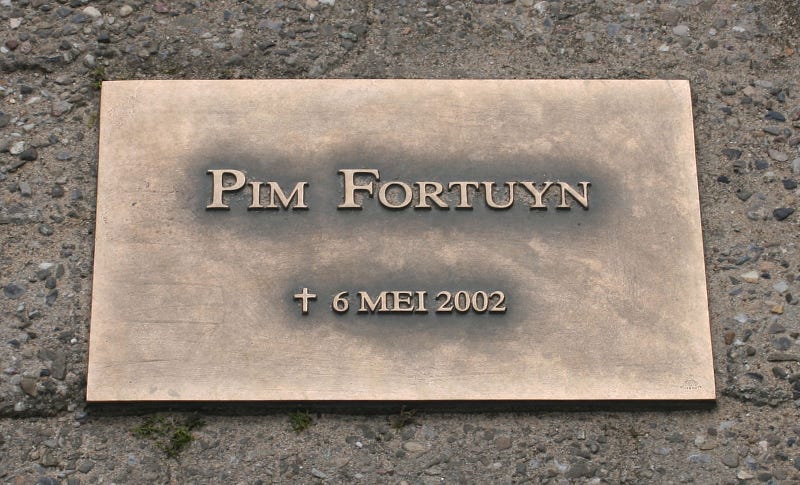
It was not to be. Just nine days before the elections, Fortuyn was shot in cold blood by an environmental activist and died on the spot.
The murderer, Volkert van der Graaf, spent only 12 years in prison and has been back in society since 2014.
With the national trauma still relatively fresh, Van der Graaf receives a government allowance, fights legal battles with the state and media, and has had several run-ins with both the public and media.
Although I was too young at the time to vote, I first became politically aware in 2002. As such, I have consciously lived through these historical events and seen live coverage.
I hope to shed some light on a political murder that might not be so well-known abroad (anymore) and provide a Dutch perspective on the rather bizarre situation of having a provocative murderer walking around.
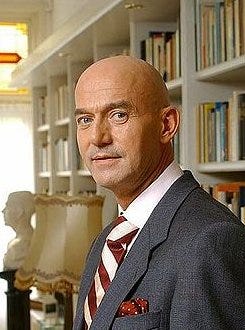

Pim Fortuyn
Pim Fortuyn was the flamboyant political leader of a party called Leefbaar Nederland (“Livable Netherlands”). He took a harsh stance towards the previous governments and was outspoken about the failures of a multicultural society.
Particularly his critical remarks about Islam resulted in a breach with his party, after which he formed his own: Lijst Pim Fortuyn (LPF).
By today’s standards, most of Fortuyn’s stances were not particularly out of the norm. Several right-wing parties have since adopted them, and even left-wing parties have taken a more evaluative approach to how the country has historically handled immigration.
At the time, however, Fortuyn faced resistance, demonstrations, and death threats from multiple directions, particularly the left-wing and Muslim communities.
It does need to be said that he was well aware that his remarks were provocative, and at times took it too far. He essentially called Islam backward, which toes the line between critical and discriminatory.
Some opposing politicians were at least equally extreme in their responses, for example by placing Fortuyn in the fascist corner or alluding to World War II. This led to a grim political climate.
On the positive side, political interest was reinvigorated like never before.
The main explanation for his popularity lies in how Fortuyn shook up traditional politics. Other politicians found it hard to deal with him verbally, and he was ahead of his time in terms of dealing with the media.
This was most exemplified by a television debate following the regional elections of March 2022, just a few months before the national elections were to take place.
Fortuyn received more than one-third of the votes in his home city of Rotterdam, which meant a complete upheaval of the socialist dominance there.
The debate kicked off around midnight, and the political leaders of the established parties were visibly grumpy and agitated. Underestimating the power of imagery, they came across as sore losers. The broadcast is still analyzed in political studies as a textbook example of what not to do.
This further cemented Fortuyn’s momentum towards the national elections, while behind the scenes he worried about how to fill up a new party with competent people in such a short timeframe.
The Murder and its Aftermath
Following a radio interview at the so-called Media Park in Hilversum on May 6, 2002, Pim Fortuyn left the studio with his driver, Hans Smolders.
Volkert van der Graaf, an environmental activist with no prior convictions, came up to Fortuyn and shot him at close range. He ran off with Smolders in pursuit, while attempts to resuscitate Fortuyn failed.
A few blocks down, Van der Graaf was arrested. As the news broke, riots ensued and blame was placed on the established political parties for how they had treated Fortuyn in the media.
The thought was that by “demonizing” him, they had created the climate in which he was assassinated.
It was decided that the national elections of May 15 would continue as planned.
The LPF, now without its leader, became the second-biggest party. Many had voted for the deceased Pim Fortuyn, while the party was scrambling to participate in the to-be-formed government.
The new government was short-lived, as the LPF was not up to the task and internal struggles led to an early disbandment.
A promising political movement was thus nipped in the bud, though the tragic incident immortalized Fortuyn in a way that would quite possibly not have happened otherwise.
The question of whether he could have kept his party in line or been prime minister will never be answered. Many of his ideas were, however, adopted by other politicians, including the traditional parties that had condemned him.
Pim Fortuyn was elected The Greatest Dutchman in a national TV poll in 2004. Volkert van der Graaf, on the other hand, that same year was chosen as the Worst Dutchman of all time by readers of a major Dutch magazine.

Limited Justice
Volkert van der Graaf’s only explanation for his deed is that he considered Fortuyn and his polarizing views a threat to society. Though he was diagnosed with OCD, he was otherwise considered of sound mind and fully aware of his actions.
Conspiracy theories aside, Van der Graaf was believed to have acted alone.
Following his trial in early 2003, he was convicted to 18 years in prison. This was on the high end under the legal norms at the time, while it is perceived as light by today’s standards.
With more emphasis placed on retribution, and national crime hardening, sentences have gone up in the decades since. The Netherlands still does not have the death penalty, but experts agree that Van der Graaf would likely receive a prison sentence of up to 30 years now.
Furthermore, the legal system at the time allowed criminals to be released on parole after serving two-thirds of their sentence, which in this case amounted to 12 years. This meant Volkert van der Graaf was released in 2014.
Though not quite a slap on the wrist, the relatively short sentence was a bitter pill to swallow for politicians and civilians alike. Van der Graaf has expressed little remorse for his actions, and Fortuyn’s relatives have questions about his motives to this day.
In the years that followed, Van der Graaf fought out various minor legal battles with the state and certain media, with varying success. These mainly had to do with the terms of his parole and coverage of him in the media.
The irony is that someone who took the life of another for having political opinions, a fundamental value in any democracy, has no issues taking every opportunity to claim the benefits of the same system for himself.
A poignant point of contention was that Van der Graaf demanded the right to emigrate to a different country. This was approved by a judge, but he never did.
As a legally free man, Volkert van der Graaf receives an allowance from the Dutch government and has been seen entering marathons. While remorse is no requirement for rejoining society after a prison term, the chance of a repeat offense is.
When recently taking the train, he called someone out on making too much noise in a silent area, which led to a conflict and his being recognized. He was quoted in a viral video as saying: “You better watch out, you know what I am capable of”.
Although I can understand Van der Graaf felt pressured in that situation, he still comes across as callous, unstable, and provocative.
One has to wonder why he has not followed through on leaving the country, both for his sake and the sake of Fortuyn’s relatives and followers.
Legally Volkert van der Graaf has the opportunity to move on, so perhaps he can afford the country the same; by no longer being visible as a painful reminder of a murder that undermined our democracy, and the subsequent failure of the judicial system to sufficiently retribute and rehabilitate.
I write about subjects that interest me personally, as I believe that is the most sincere way to add value.
If you wish to show appreciation for my stories, consider buying me a coffee. Of course, feel under no compulsion to do so, as your attention is a reward in and of itself.