
Traveling To The Hills When You Are Scared Of The COVID Outbreak — How The Two Of Us Minimised Our COVID Risk During An Outbreak
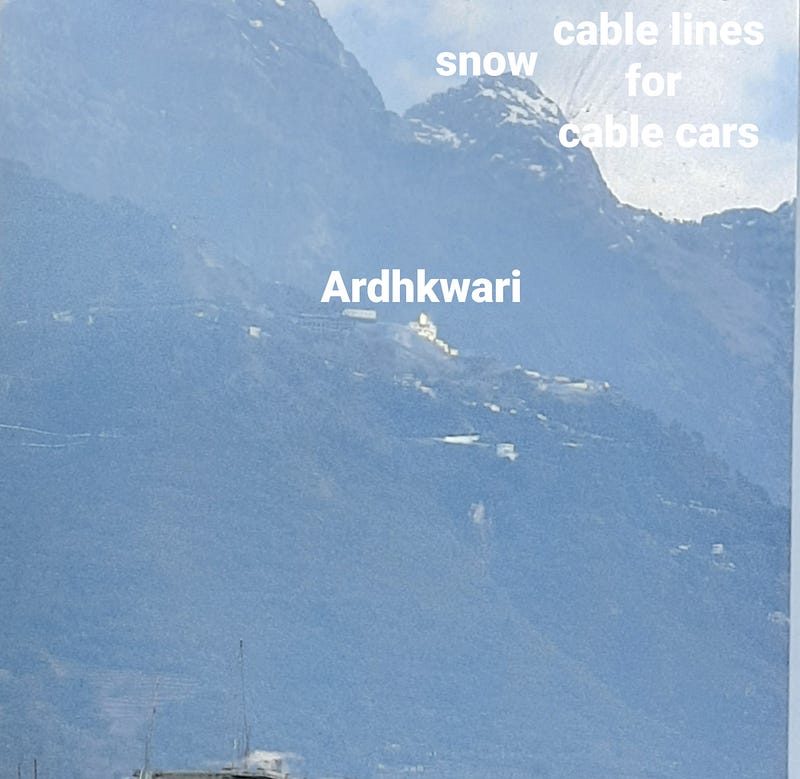
The best-kept tourist secrets in India are our pilgrim towns. Some beautiful towns from North to South India are considered pilgrimages. They consist of medieval temples(Konark), prehistoric caves(Khajuraho), early astronomy temples(Ujjain), seaside towns(Rameshwaram, Udupi), and hill towns (Tirupati, Vaishno Devi). They are usually full of queues of older people and screaming babies. (Think Disneyland Hogwarts queues but with a little more drama). Also, temples are one of the few places where female public presence is in the majority and considered very respectable.
These towns are a tourist amalgam of the whole country, and in the popular ones, you will easily hear all the 27 national languages if you pay attention. India is significantly populated, and the Pilgrim towns are where all walks of society choose to spend their free time. This means that queues, when they form, can snake up to four days long. Some towns have waiting areas for second-day and third-day devotees. Some seasons are off-seasons for pilgrimage. In general, hill towns have fewer devotees in the winter.
Covid had closed almost all these towns for approximately two years. Things have opened up over the last few months. We had booked our trip to one of the hill pilgrim towns before omicron broke.
Omicron caused us to reevaluate our plans. In the end, we decided to leave the children home and come home as early as possible (The exact timing of the trip is complex and subject to weather).
Precautions we followed
- We are both triple vaccinated.
- We wore triple layer masks throughout the trip.
- We tried our best to keep the trip as short as reasonably possible with minimal contact to others
- Unfortunately we couldn’t avoid airport queues or temple queues, but we didn’t remove our masks
- We requested vaccinated drivers and serving staff at hotels and car rentals
Bhawan, the temple for Vaishno Mata, is a hill town 12 km above the ground in Katra. Helicopter, horse, palki, and trekking 12 km on foot are the ways to reach her. Cars are not allowed on the trek. Some days battery cars with limited seats may be running half the way. The available mode of conveyance depends on the weather. This means that the time taken to reach the temple and back, also depends on the weather. For example, helicopters which take about 8 minutes, don’t run with clouds, snow, and rain. Battery cars, which take half an hour to the halfway distance, don’t run during snow or rain. Horse and palki are available all-weather.
Most people who find long-distance walking difficult choose to sit on a horse and be ‘walked’ to the Bhawan. It is a 3–4 hour walk. Palkis are used to carry the traveler on a seat by people, up to the temple. Palkis take approximately 4 to 5 hours. They are also more expensive and equally uncomfortable.
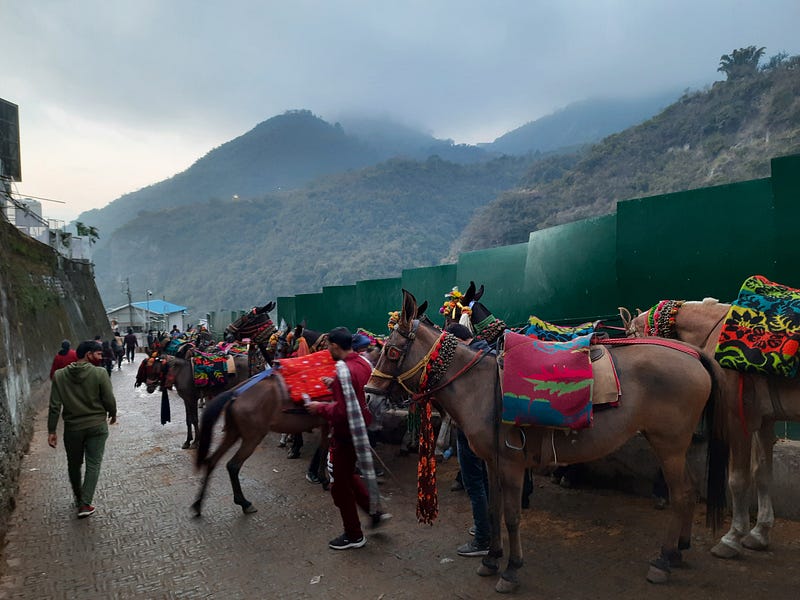
Horses waiting for travelers Photo courtesy: Author’s Camera
It was snowing in Jammu when we went. Thankfully the morning was clear of snow or rain, and the helicopter was running. We reached up to the temple by helicopter in 8 minutes.
On the way back, the weather was inclement, and we had to be “horsewalked” down.
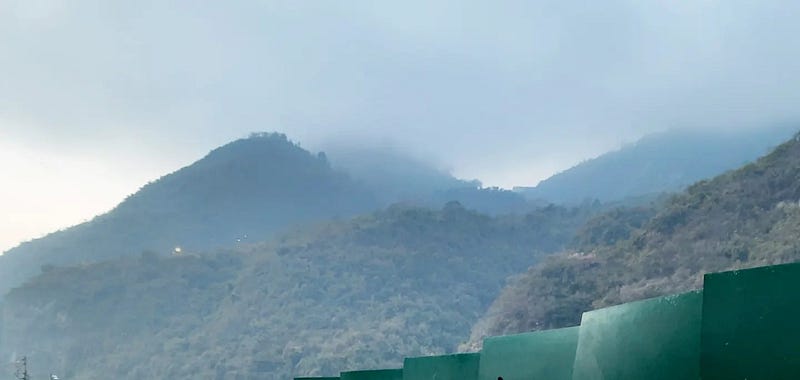
Scenic hills of Katra. Photo courtesy: Author’s Camera
The downhill trek is easier on everyone and very scenic. If time permits, most people walk down. We stopped the horse for tea at the halfway distance, and then we kept the horse walking. The young and very fit porter who walked the horse down was also tired at the end of the trip. We reached the end of thee trek, Banganga in four hours. After several such treks over the years, you would think the body would get used to 3–4 hours sitting on the horse. It seems it is still tough on the bum.
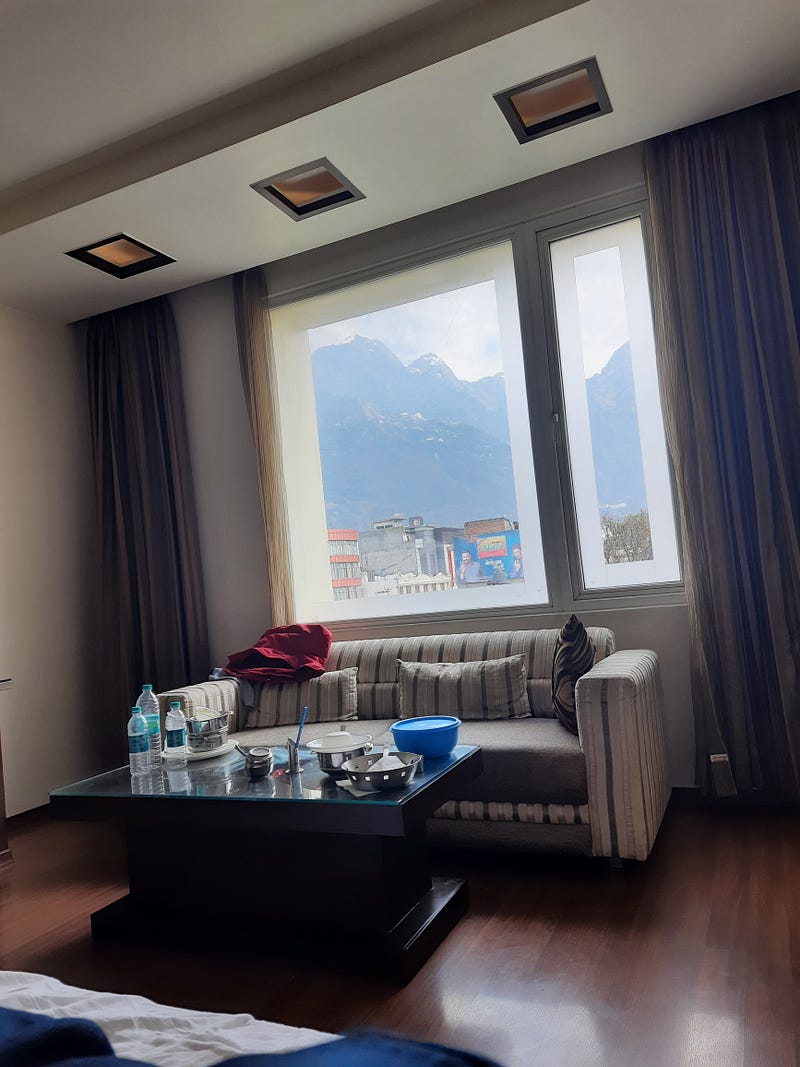
View from our Hotel room in Katra. You can see the tiffin which many Indian travellers carry in case clean food is not available or time is less. Photo courtesy:Author’s Camera
So right now, we are down the hill, back to Katra, and waiting for our flight home. This trip was our first overnight trip post covid. Hopefully, things will keep as well as they have so far. ‘Fingers crossed.’