
Pick at Tree: How To Know A Place
A place becomes a home when you put down roots. Who else does this better than trees?
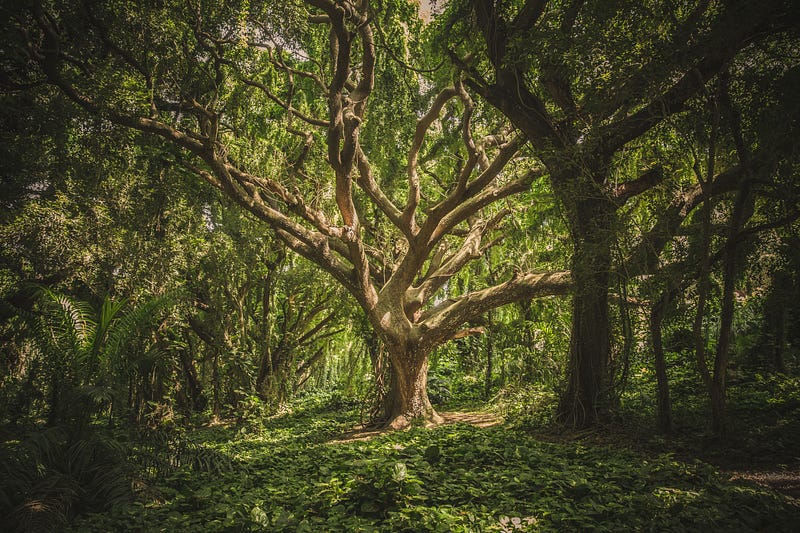
We carry mental maps of place within us. A place can be soup-thick with memory. A place can also be empty. You live there, but you have only a surface knowledge.
One way to know a place is to connect with nature. Nature shares this space with you, and nature is far better at place-knowing than you.
So, pick a tree.
Any tree will do. The tree closest to you right now. The tree in your garden, outside your house, down the street. It doesn’t matter.
Next, find out what kind of tree it is.
There are plenty of apps now that allow you to identify trees and plants. I use PlantNet. You take a close-up photo of a leaf or fruit, and it’ll give you the best guess with examples to help you.
There are also a ton of ‘tree identification’ books out there. Obviously, pick one that matches your region. I love What’s That Tree for the UK.
Find out about your tree.
Is it native, or is it bussed in from outside? It’s OK if that’s the case. I live in England, which is by nature an immigrant country. We can share that status with our trees, too.
When does it flower, if at all? Does it produce any nuts? Do you know how trees produce nuts? If it produces fruit, who eats the fruit? Squirrels, birds? Can you eat the fruit? Have you eaten the fruit?
What does the tree look like in your seasons? This takes time to find out. If you journal, you can take pictures of your tree throughout the year.
How can you know how old a tree is? Find out if you can.
Make a map.
What is the relationship between your home and the tree?
Go out a little further. Where is the tree in relation to paths? A pavement, a road, a river? Where do those paths lead to/away from?
What are the stories?
When does your tree turn up in folklore? What is the history of your tree?
Oaks are pretty famous, as are birch and yews.
Robin Wall Kimmerer, in Braiding Sweetgrass, talks about the history of the pecan nut trees, how they were named and how they traveled with the displaced Indigenous Americans.
Every tree has a story.
There’s a plum tree, a European Plum tree to be specific, in my local park.
We’ve just met. It is currently fruiting tiny plums that started as a dusky red black a few weeks ago and are now a dark purple. The local squirrels will enjoy them.
Behind the tree is a river. The river joints this tree to my house, running as it does underneath, then out to the train station where it joins up with a larger river.
To show you how little I pay attention, I have no memory of when the plum tree flowered. I assume spring, and the internet tells me this is so. Plums appear late summer, early autumn, so at least we’re on track with that.
I’ve not found the Plum tree’s story yet. But already I have a mental map of this place that includes a tree and everything that radiates out from that tree.
If you do this long enough, then you find the connections. These connections include you.
Seeing your own place within an ecosystem creates a relationship. The more you know your tree, the more you build your sense of place, the more you water the ground beneath you.
Have a go.
Pick a tree, get to know your tree; see how far that relationship can take you.