
Physicists filmed the collision of a positive lightning leader with a negative one
Geophysicists from China and India captured lightning striking a meteorological tower standing on the ground from a cloud in a video with a frequency of 380 thousand frames per second. The resulting footage showed how exactly before the main flare a single channel with ionized air is formed, in which the main discharge then occurs. The unification of two leader channels: a negative one from the cloud to the ground, and a positive one in the opposite direction, begins when the distance between their ends is about twenty meters, scientists write in Geophysical Research Letters.
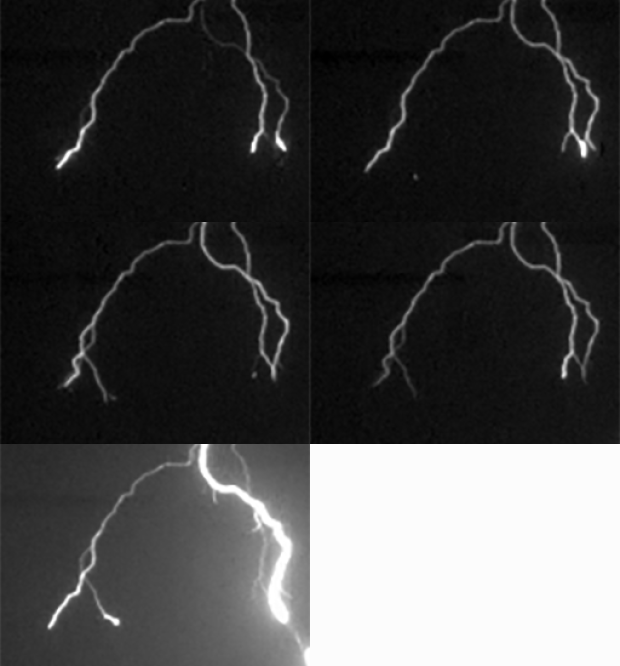
A lightning strike that strikes objects on the ground from a cloud consists of several stages. First, as a result of atmospheric convection during a thunderstorm, charge separation occurs and highly charged regions appear in the cloud. After this, streamers begin to branch from the cloud towards the ground — thin, dim, weakly conducting channels filled with ionized gas and electrons split off from atoms. When a negative streamer, growing down from the cloud, gets quite close to the ground, a response positive channel begins to grow towards it from the side of the ground. At some point, these two channels meet and merge, forming a common streamer zone. Simultaneously with the growth of streamer channels, lightning leaders — highly conductive thermally ionized channels, the current in which is about 1–2 kiloamperes — begin to spread through them in steps of several tens of meters. The whole process ends with the meeting of positive and negative leaders and the subsequent reverse discharge — the brightest discharge during lightning with a current of several tens of kiloamperes, which moves from bottom to top.
Although the general sequence of stages during a lightning strike is fairly well known, many important details are still poorly understood, primarily due to technical difficulties: a lightning strike is a very fast process that occurs over long distances, and in environments with very high temperatures, potential differences and currents. In particular, not everything is clear about the final stages of this process: when the response leader is born on the ground, at what moment a single lightning streamer zone is formed, and how exactly the collision of two leader channels occurs.
Geophysicists from China and India, led by Rubin Jiang and Abhay Srivastava from the Institute of Atmospheric Physics of the Chinese Academy of Sciences, managed to study the fine structure of streamer and leader channels during the final stages of a lightning strike. To do this, scientists filmed a lightning strike on a 235-meter meteorological tower standing on the ground in Beijing. To see the direct merger of the two streamer zones and the collision of the positive and negative leaders, which occurred at an altitude of 145 meters above the top of the tower, scientists filmed at a frequency of 380 thousand frames per second.
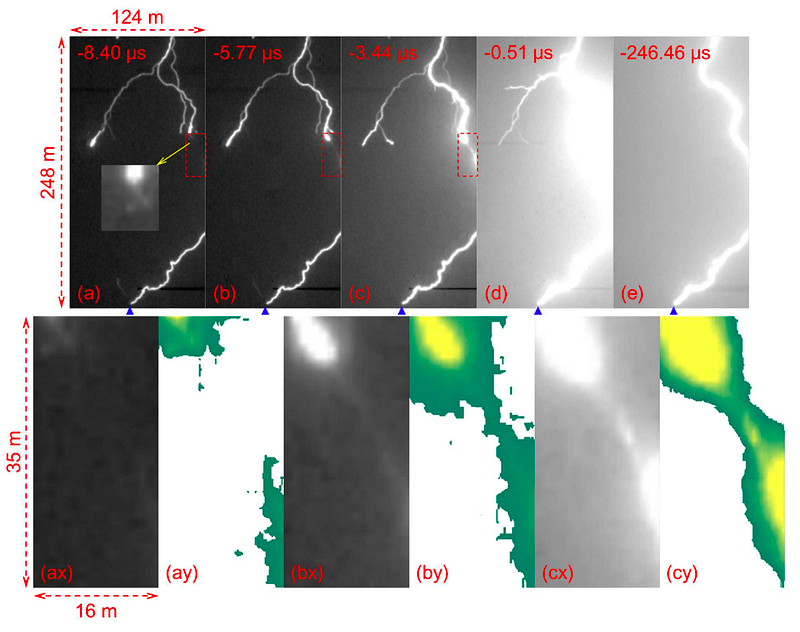
As a result, the authors of the work managed to obtain two consecutive frames, which are separated by only one 380-thousandth of a second — in the first of them, the two leaders have not yet collided, and in the second, a flash has already occurred and a reverse discharge has arisen. According to these frames, the merging of the positive and negative streamer zones and the formation of a common streamer channel occurred when the ends of the positive and negative leader channels were more than 23 meters apart.
There are two main hypotheses about how, after the formation of a common streamer zone, the breakthrough phase occurs, when the positive and negative leaders are already very close to each other. The first hypothesis assumes the emergence of several thin streamer channels connecting the positive and negative leaders, which then merge into a common channel. According to the second hypothesis, thin canaliculi begin to branch from the ends of both leader channels, two of which meet and expand, and the rest then fade.
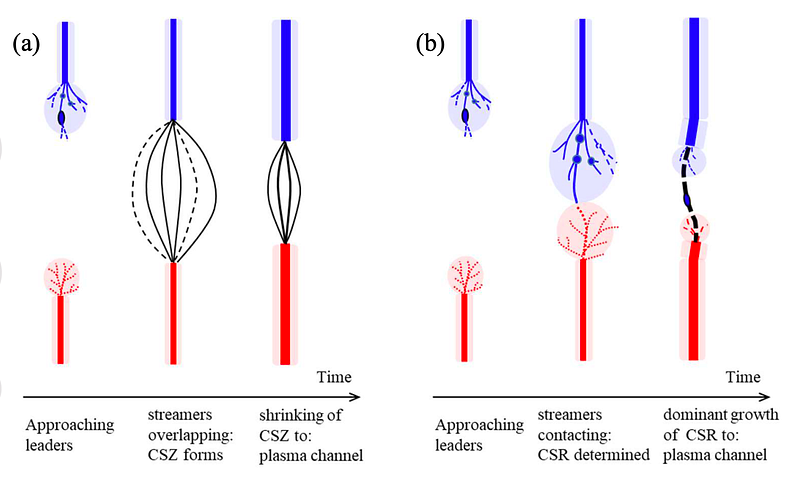
According to scientists, their survey data confirms the second scenario. In the through phase, the leader channels expanded (the expansion speed was about a thousand kilometers per second) and became much brighter. As a result, the gap between the leaders was reduced: in the last frame, preceding the flash of the reverse discharge, the ends of the two leader channels were separated by only 16 meters. Scientists believe that the trajectory of the collision of two lightning leaders was determined already at the moment when a common high-impedance streamer zone arose, and during the collision itself along the intended trajectory, a hot plasma channel was formed in this zone.
Scientists note that their results clearly demonstrate the mechanism of formation of the channel in which the main lightning discharge occurs. However, according to geophysicists, video footage alone is not enough to draw general conclusions, so further observations and experiments are needed to confirm these conclusions.
The probability of lightning strikes on objects on the surface of the earth or sea depends not only on their shape but also on the properties and composition of the air. For example, a few years ago, geophysicists discovered that due to the high concentration of aerosol particles in ship exhaust, the frequency of ocean lightning strikes is about twice as high in areas traversed by shipping lines.


