
Pharma’s Infamous Inbreeding Hiring Process

The pharmaceutical sector, a cornerstone of human health, is a massive industry, boasting a global market worth of 1.2 trillion U.S. dollars.
Naturally, anyone with an interest in science and a passion for global healthcare, myself included, aspires to contribute to this industry.
After spearheading a dietary supplement CPG company for nearly two decades, I find myself at a pivotal point, considering the sale of my brands and reassessing my career trajectory.
With a child who recently achieved remission from battling a major chronic illness, I have firsthand insight into the urgent need for life-saving drugs.
Moreover, I keenly recognize the critical shortages of these drugs and the scarcity of manufacturers and distributors on a global scale.
Hence, my initial instinct was to seek altruistic investors and launch a pharmaceutical company dedicated to researching, developing, and distributing crucial healthcare drugs — a noble aspiration that is a lofty ambition without an integral understanding of the operational details of this challenging sector.
Thus, a more pragmatic approach, for now, leads me to seek employment with a pharmaceutical company that aligns with my objectives.
Unfortunately, to my dismay, this proves easier said than done.
I had not fully anticipated the difficulty of entering this industry without prior “pharma experience,” particularly in management roles.
For decades, the pharmaceutical industry has exhibited a notorious inclination towards insider hiring, blatantly marginalizing non-pharma candidates, except for entry-level or purely technical positions.
Add to this, their recruitment process is not only painstakingly slow and tedious but sorely lacks a human touch, especially with the widespread adoption of Applicant Tracking Systems (ATS) and AI screenings.
It’s not uncommon for applicants to receive auto-generated responses to their applications, at odd hours at night, when no human sits behind a computer reviewing resumes.
What’s interesting to note is that while this industry is facing significant challenges from failed drug trials, raw material shortages, production shortfalls, and legal battles, they persist in relying on insider pharma executives to drive their operations.
As the saying goes, you can’t solve a problem with the same minds or hands that created it. One must question the wisdom of continuing to exclusively consider candidates from within the pharma circle.
It’s like hiring new faces with the same outdated ideas.
With the trials they are facing, perhaps it’s time for Pharma to broaden its horizons and embrace talent from outside the pharma sector.
Something that they are trying to do but not fast enough, notably with the ongoing frenzy of layoffs in this industry.
Trends in Pharma Recruitment and Layoffs:
According to industry reports, pharmaceutical companies have implemented thousands of layoffs in the recent post-pandemic years, based on consolidating operations or restructuring to reduce costs.
Layoffs in the pharmaceutical industry often stem from patent expirations, mergers, acquisitions, or shifts in company strategy.
With less than 10% of new drugs passing the FDA’s clearance bar, entire divisions of clinical trial teams are laid off, overnight, if the drug fails or the trial is called off. A sad fact.
In 2023, the biopharma industry faced significant setbacks, with several major players downsizing. With major mega-million blockbuster drugs encountering expiring patents (Humira), inflation, rising interest rates, and heightened FTC scrutiny, companies were urgently cutting expenses and laying off employees.
Unfortunately, the layoff trend continues in 2024 with nearly 5000 employees laid off coast to coast by major biopharma companies.
In addition, potential candidates encounter another formidable obstacle: the integration of AI (Artificial Intelligence) into pharmaceutical hiring practices.
Impact of AI (Artificial Intelligence) in their Recruitment Processes:
Increasing reliance on AI for recruitment in the pharmaceutical industry poses significant challenges.
While AI expedites resume screenings, it fails to adequately assess a candidate’s soft skills, like empathy and communication, crucial for success in pharmaceutical roles.
Moreover, AI algorithms perpetuate biases present in historical hiring practices, worsening diversity, and inclusion issues.
It’s impossible for candidates to know what algorithms are set up to rule out applicants for any open position.
For example, is the company ruling out women for upper management positions, or ignoring minority candidates based on their names and ethnicity selection? It’s hard to tell.
Add to this fact that AI simply picks specific keywords that are programmed to look for prior Pharma experience.
So, if your resume lacks buzzwords like “Specializing in market access, payer marketing, and reimbursement for pharma drugs in specialty, oncology, and rare disease areas,” your odds of being selected are slim to none.
This myopic approach reflects poorly on the company, potentially deterring top talent from entering the arena.
It’s about time that Pharma opens up to balancing scientific breakthroughs with unbiased human oversight.
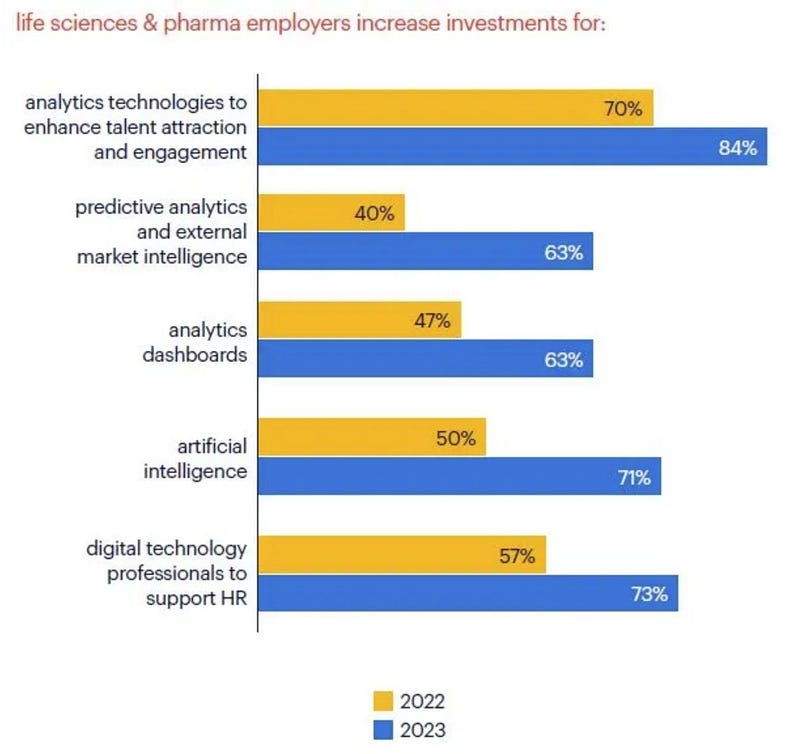
This graph from Randstad shows how Pharma has increased its investments and reliance on AI from 50% in 2022 to 71% in 2023.
They also increased the amount spent on digital technology professionals to support Human Resources (by automating hiring SOPs) from 57% to 73% in 2023.
With increased automation and AI use, it’s not uncommon to apply for Pharma jobs and receive an impersonal welcome from a Chatbot.
Their bland job application process is further dampened by the overused myworkdayjobs.com software. Thanks to this AI-rich common software platform, used by several pharma and biotech companies, be it a job at Takeda, Novartis, or AbbVie, the application process and candidate questions seem uncannily alike.
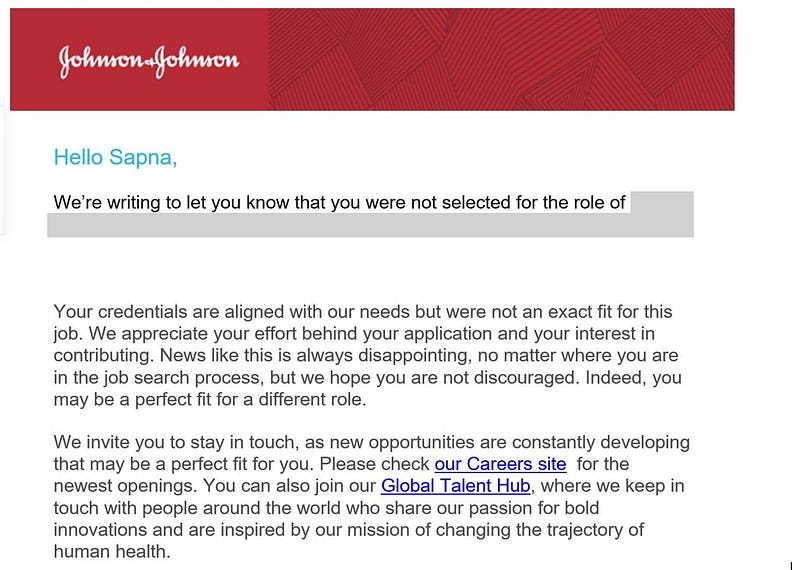
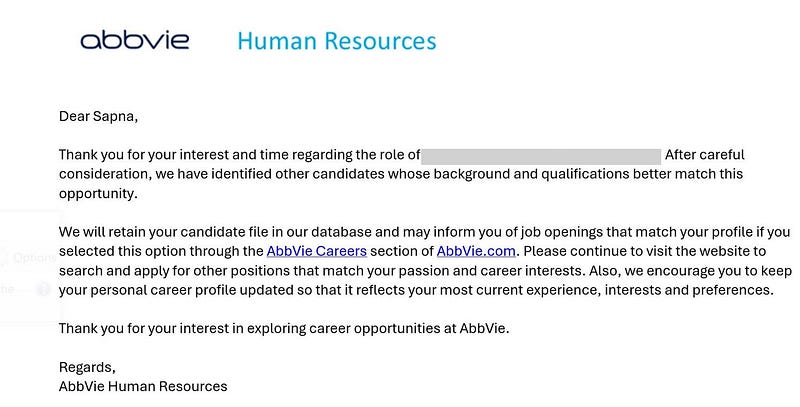
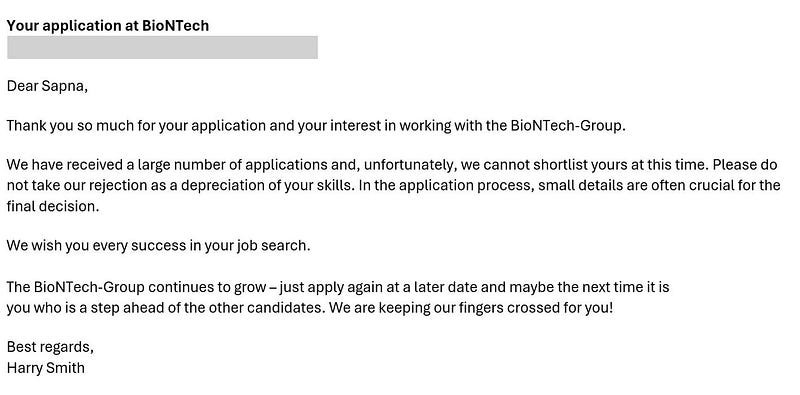
Applications are often followed by a heartfelt, albeit autogenerated “You were not selected” email, reflecting the company's work culture.
Here are some samples I received. While most use cookie-cutter language, a few make a faint attempt to add genuine AI emotions.
The Steep Price Pharma Pays for Inbreeding and Exclusion:
Inbreeding equals missed opportunities for innovation.
Outside industry talent, particularly in non-scientific roles, brings onboard fresh ideas and experiences.
A CFO from a different industry can just as effectively assess a Pharma company’s financial health and pinpoint areas that need attention.
The same goes for marketing, procurement, client services, and sales management professionals — none of whom need to have a disease-specific scientific background to support the pharma business.
Industry inbreeding perpetuates a lack of diversity in perspectives, eventually hampering growth and development.
With the pitfalls this industry is facing and the results from market surveys it’s clear that Pharma needs to rethink its hiring practices and embrace talent from outside the traditional pharma circle.
It’s time for Pharma to embrace the future and hire beyond the outdated confines.


