
Petra’s High Place of Sacrifice — Close to the Gods
Located in a wadi surrounded by tall mountains, the ancient Nabatean capital of Petra, at one time found itself at the crossroads of a flourishing and prosperous trade in luxury goods. This trade, in goods such as Frankincense and Myrrh, brought wealth and prosperity to the inhabitants of this arid region. The Nabateans built a remarkable city that became the envy of many. Then, over time, for unknown reasons, the Nabateans deserted this great city, leaving behind one of the most alluring and mysterious ruins in the world, forgotten until it was rediscovered in the nineteenth century.
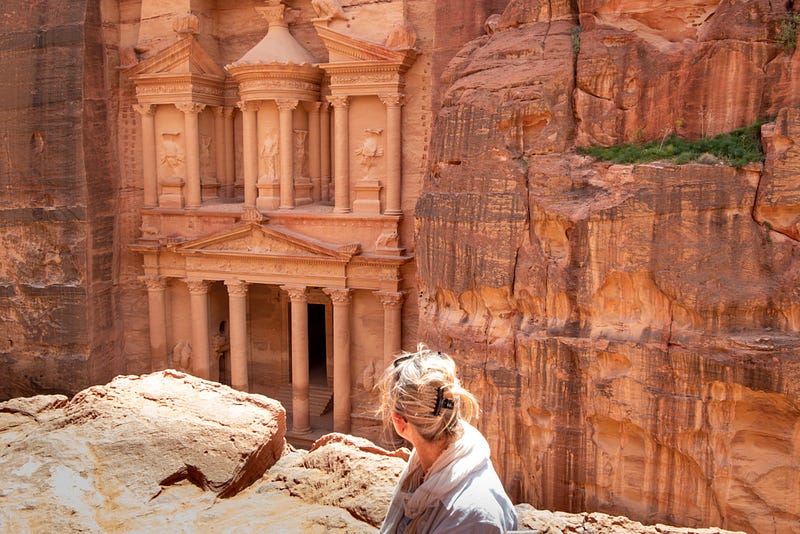
Today, Petra is famous for its enormous rock-cut tombs that the Nabateans carved into the sides of the mountains. Some of these tombs, such as the iconic Treasury, have captured the imagination of many around the world, and draw thousands of visitors to this place daily. Petra, however, has a lot more to offer than its enigmatic tombs. To the inquisitive traveler who is willing to go off the well-trodden track, there are many obscure trails that can be taken to explore some of its lesser-known treasures.
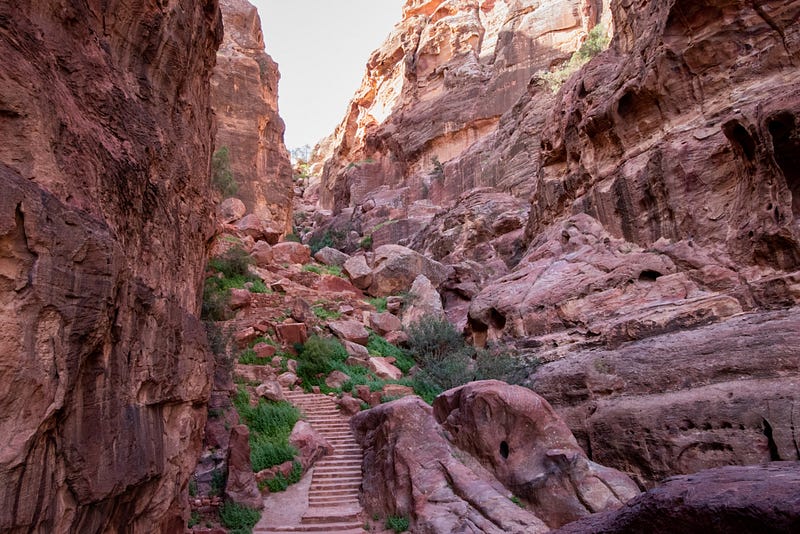
After visiting the Treasury most people tend to continue straight to Petra’s urban area. Just before the ruins of the theatre, take the inconspicuous looking stone step to the left that leads up the mountain, and soon you leave most of the crowd behind. This trail leads up to one of Petra’s many high places of sacrifice — places central to Nabatean religion and culture.
Ever since humans have gained the intelligence to question the mysteries of the universe, religion — or a faith in a higher power — has had a role to play in providing answers to some of these more vexing questions. This has led to the development of a plethora of religious beliefs and customs over the years. The study of the evolution of religion through human history is a fascinating subject and gives us an insight into the lives, hopes, and fears of people who lived and died a long time ago.
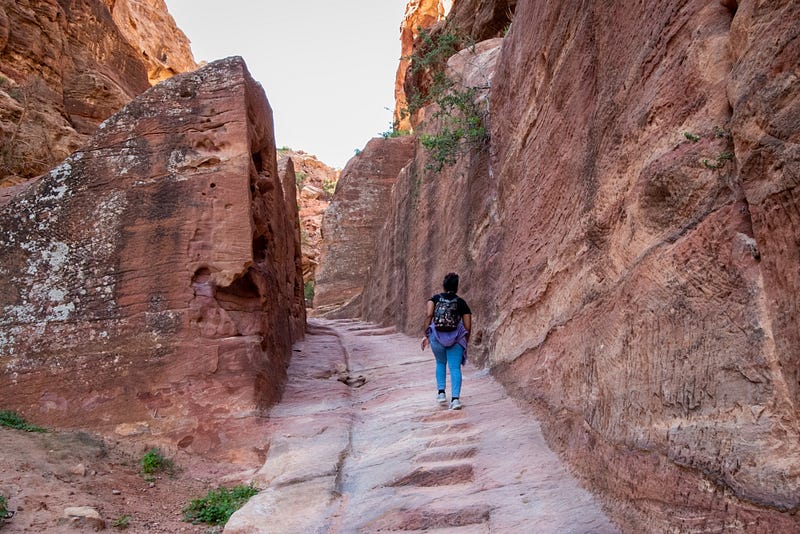
As we climbed, we imagined how two thousand years ago the pious population of Petra would have taken this very same route to offer sacrifices to their gods. The climb to the top was not easy, and at many places the steps had worn down making them smooth and slippery. We found ourselves stopping for rest quite a few times along the way. There were makeshift stalls where we could take a break from the arduous ascent and enjoy some Bedouin tea.
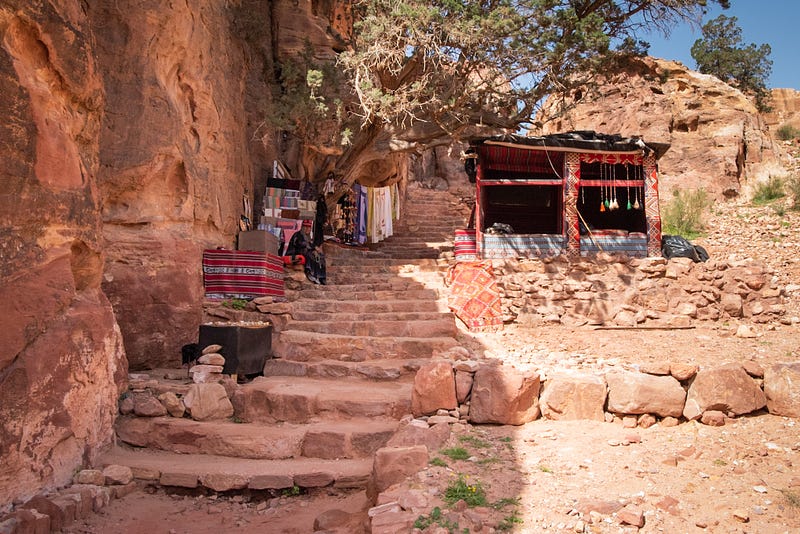
We know that Nabatean religion was polytheistic. Their pantheon included Dushara ‘Lord of the ash-Shara Mountains’ and the trio of Goddesses Allat, Manat, Al’-Uzza and several other deities assimilated from other cultures. Among these Dushara seems to have been given a privileged position. Altars at the highest points around Petra are believed to be dedicated to Dushara.
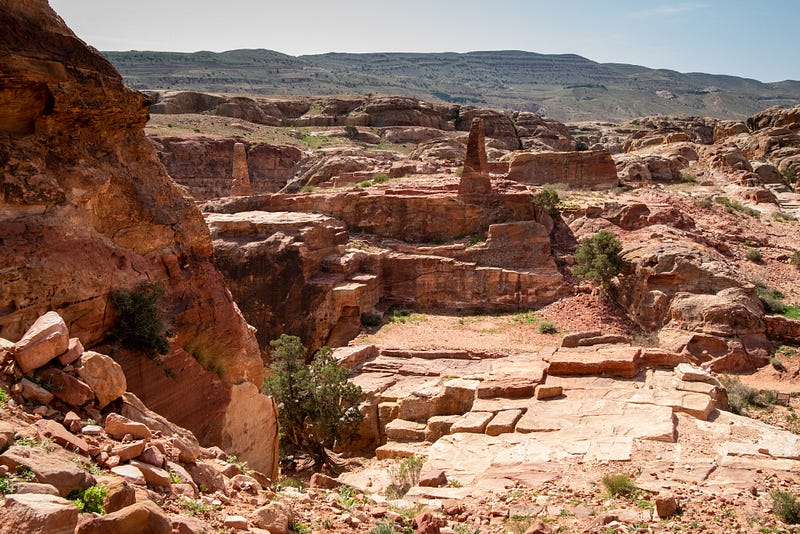
We came across two large obelisks — believed to represent Dushara and Al-Uzza — carved out of the top of the mountain. Nabatean religion was aniconic, they did not worship anthropomorphic images of Gods and Goddesses. The deity was believed to reside within betyls, pieces of rocks that were formed into various shapes. Everywhere in Petra we saw examples of these betyls carved into niches in the face of the rocks.
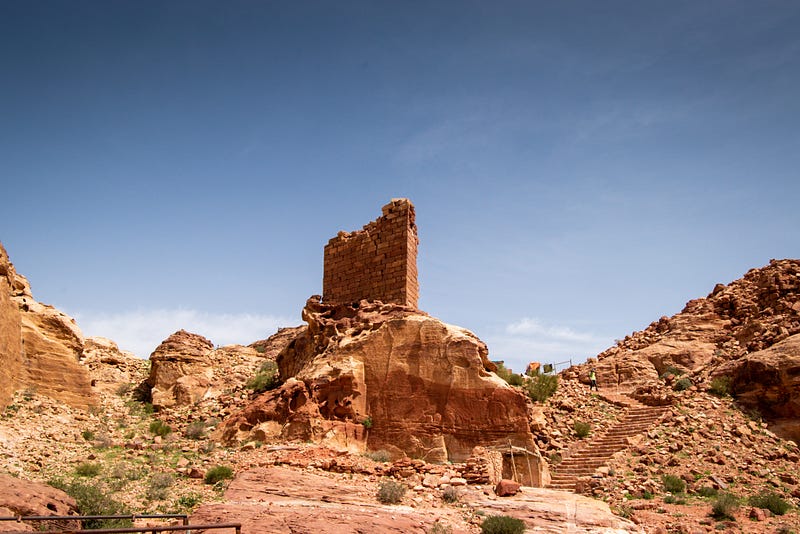
Petra had a turbulent and dynamic history. Traces of this history is visible along the trail — we came across the ruins of a tower, built by the Crusaders, standing over an old Nabatean stone quarry, its foundation believed to be from the Byzantine period. As the city evolved over time so did its religion. After the Roman Emperor Trajan annexed Petra in 106 CE, we begin to see anthropomorphic representation of Dushara and the Nabatean pantheon — most notably on the coins minted during this period. Dushara also got assimilated with Greek deities such as Zeus and Dionysius.
“They worship the sun, building an altar on the top of the house, and pouring libations on it daily and burning frankincense”. -Strabo, Greek historian.
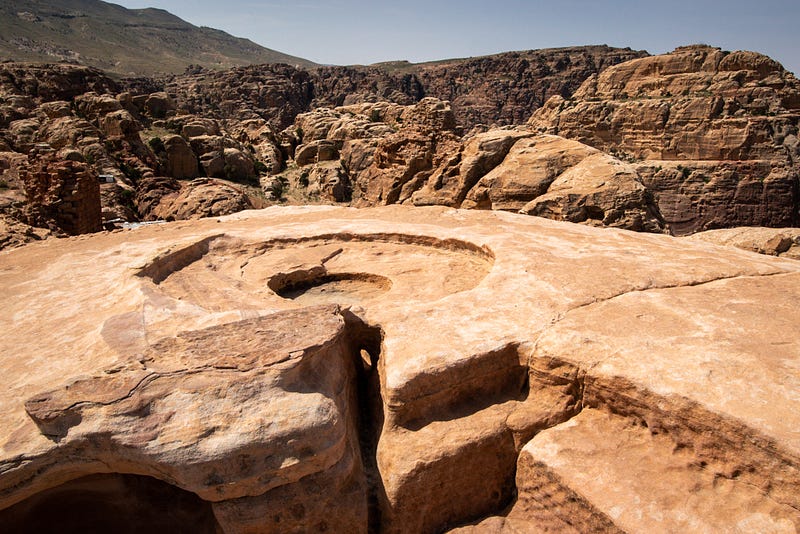
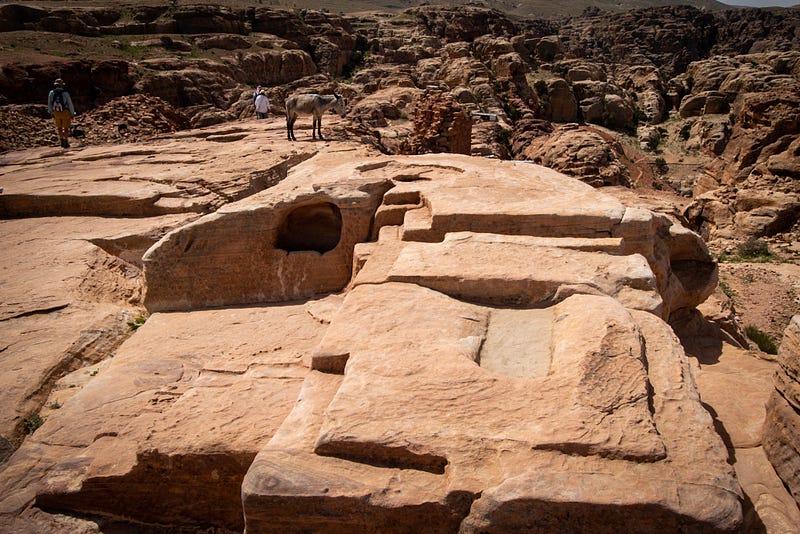
Finally, we found our way to the sacred altar on top of the mountain. It was close to noon, and there was no place to hide from the intense heat of the sun. The altar was built on a platform sculpted by cutting down the top of the mountain. A rectangular depression in the platform provided seating for the devotees on three sides; a raised altar is located on the fourth side. A crevice on top of the altar was probably where a betyl of Dushara would have been placed for veneration. To the side of the altar, steps lead to a circular sacrificial basin with grooves to drain out blood or libation.
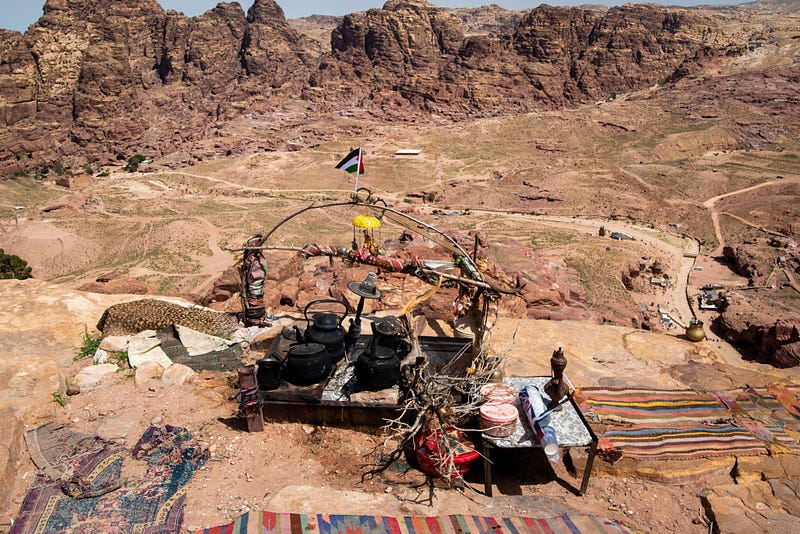
A little further is another lonely tea stall. This stall stands on a precipice with one of the most spectacular views of Petra. The massive rock cut tombs look small and distant from up here. Two thousand years ago, the now empty valley below would have been a bustling city full of people not so different from us — people looking for divine intervention to help them get through the struggles of life.
Petra is one of the most awe-inspiring places in the world. It is a humbling experience to take this pilgrimage to one of Petra’s holiest sites, and to gain a little understanding about the customs of people who lived so long ago — customs that have influenced religions to this day.
References:
“The Cult of Dushara and the Roman Annexation of Nabatea”, Stephanie Bowers Peterson
“Arabia and the Arabs — From the Bronze age to the Coming of Islam”, Robert G. Hoyland


