
Personas are only as good as the research behind them
Picture this, it’s a bright, sunny day and you are in the kickoff meeting for a new project. There are lots of unknowns. Everyone on the team is feeling excited, confused, afraid, energized. The team is unsure where to begin. Someone suggests that you start by defining personas. Sounds great right? Stop. Your next move can mean the difference between creating something great and creating something that no one actually needed in the first place.
Before we get too far, what’s a persona? Personas are fictional characters created based upon user research intended to represent the different user types that might use your product or service. The format of a persona often varies, but there are a few things they must always contain:
- Name and photo (not a drawing and not a photo of a celebrity or someone people know)
- A quote that represents that persona
- Some basic biographical and demographic info
- Behaviors and habits
- Scenarios and frustrations
- Goals and needs
*Sometimes you might include info about what devices they use, personality traits, etc, but only if they are relevant for design decisions.
Here are a few examples:
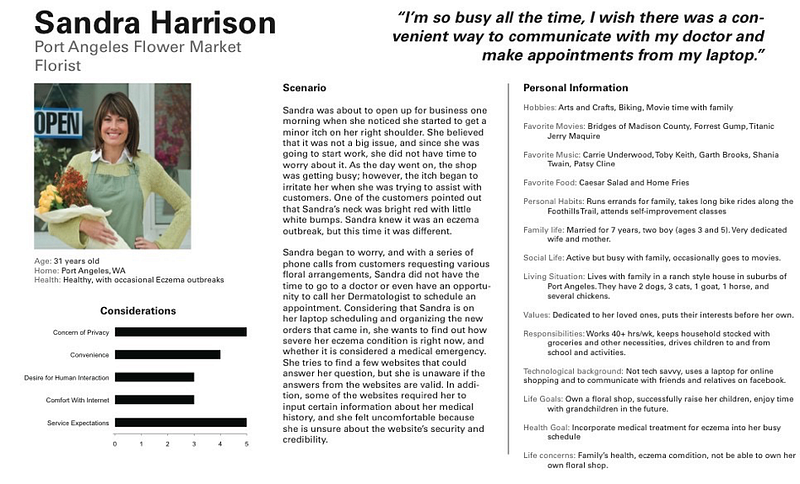
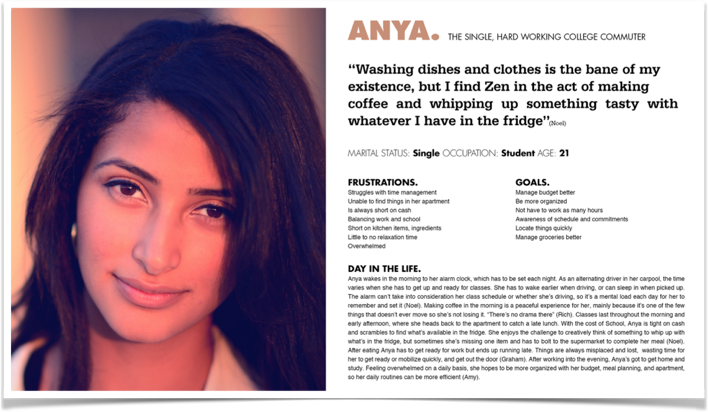
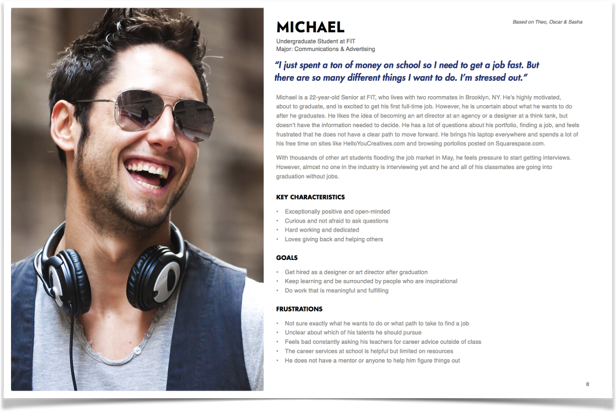
Personas can be one of the most effective tools in a design project. They can also be the most destructive.
All too often, teams will get together to “create personas” for a project. It’s often a date on a calendar or a task assigned to someone on the team or an agency. It’s fun. You get to create a person in this Weird Science sort of way. You imagine everything you want your customer or user to be and make it up as you go. You ask others on the team who our customers are and they weigh in. It’s exciting. And it’s oh so wrong! Mark Hurst put it well in his book, Customers Included when he said “Personas invented out of thin air are the embodiment of the team’s own internal assumptions and beliefs.” You may be saying to yourself “But wait, isn’t it the team’s job to know who the customer is? Aren’t they the right ones to make personas?” Yes, sort of. I’d restate it and say that it is their job to find out who the customer is and then to know, which must involve research.
Yes, research — personas are incredibly effective when they are the result of user research. Think of it this way. If you were asked to design a car, you might design a really awesome, fast car with super chargers and flux capacitors and bucket seats. But, let’s say after you designed it you learned that the group of people you were designing this car for all lived in Alaska and had an average family size of 5. Your super car is very unlikely to meet those user’s needs. So what could you have done? It’s simple. Talk to the users. Talk to the customers. Ask them questions. Understand them and identify patterns in what they say, think, do and feel. And do you know what those patterns are? They are your personas! That’s right. Your personas should come directly and only from your user research.
Personas are important because they help the team connect all the decisions they will make throughout a project to the needs of the people who will use that product or service. It’s also important to make decisions about which personas to focus on. Design is always a compromise, and if you don’t narrow down your audience it will be very hard to please anyone. Pick 2–3 personas. And don’t worry about trying to include every single detail about the group of users represented by that persona. Just include the details that are relevant to the product.
Here’s the other thing. The moment you share a persona, you create an emotional connection between the team and that persona. If those personas are based on real research of real users, then you’ve done the best possible thing you can do early on in a project — you have helped the team gain empathy for the users. Personas always have names. One of the greatest wins you can have as a product designer is when a key stakeholder refers to a persona by name. “But would Steve want this feature?”
But this can also go horribly wrong. Let’s say you’ve created a persona without any user research. You think it’s who the user is, but you don’t really know. Guess what, your key stakeholders and teammates will still go ahead and form that connection with your fabricated persona. Then, guess who you are designing for — the person who made the persona!
Keep in mind that personas do change over time because people and their situations change over time, so it is very important to continuously revisit and validate those personas.
Personas can be tricky, but when done right, they can make all the difference. Now go forth and talk to some users! Good luck!


