
Perpetrator or Victim? When Abusers Turn the Tables
Victim blaming is one of the abuser’s favorite weapons, so how do we know who is telling the truth?
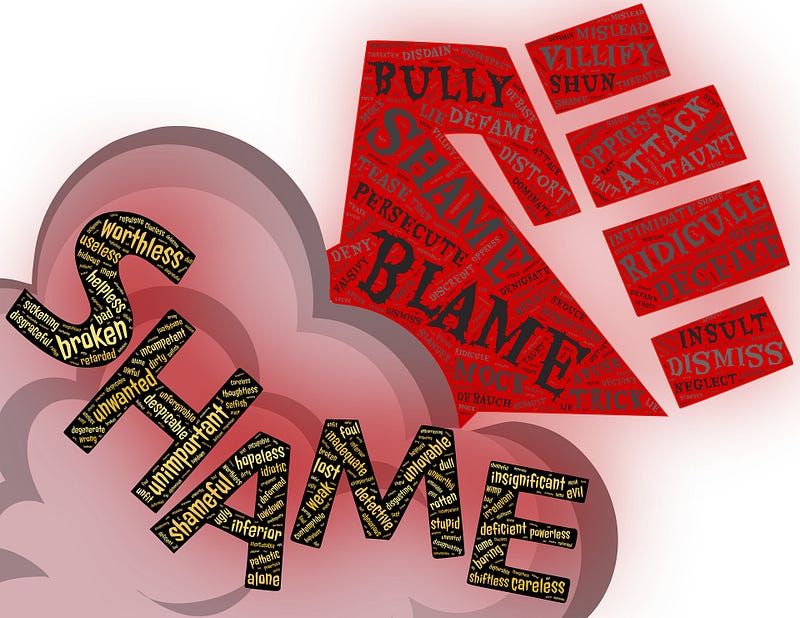
I lived in the prison that is domestic violence for most of my first marriage. Five years later, with the benefit of hindsight, I can see that the signs were there in the very early stages.
Love bombing disguised as genuine affection and sincerity. What initially felt like devotion gradually turned to monitoring my movements and controlling every aspect of my life.
In 2015 I did escape. I was free, but only physically. The abuse continued, just in a new and different way.
One of the first things my now ex-husband did after I left was join a Facebook group called Domestic Violence Against Men. It’s an open group and provides for disturbing yet insightful reading.
Here’s an example:
“Who designed the Domestic Violence laws? Those who are salty because they were unable to keep control in their own relationships”
And this
“There are many who use words of violence but would never hurt a fly, in fact it is only used as a strategy for self defense or as a coping mechanism used to justify the wrong done to them in the hope of surviving the rejection they endure or face everyday as a direct result.”
A website that is regularly shared in this group is the One in Three campaign. One in Three is a men’s rights activist group. It is run by men, angry men who are obsessed with promoting a counter-argument to the indisputable fact that the vast majority of cases domestic violence are perpetrated by men, against women.
It’s not always the case, men can be victims of abuse perpetrated by female or same-sex partners. It definitely happens.
But it is the exception rather than the rule.
One in Three uses questionable statistical data to try to convince readers that the prevention campaigns and support services for victims of domestic violence are set up to enable women to use false claims of domestic violence to bring down and hurt men.
It uses flawed definitions of abuse and statistics from surveys that were taken for entirely different purposes to attempt to bolster their false narrative.
The false narrative that one in three victims of domestic violence is male, and that one in three perpetrators is female.
They are relentless in their desire to perpetuate this lie, even going to the trouble of making a 50-page submission to the Australian Government’s Inquiry into Family, Sexual and Domestic Violence.
One can’t help but ask, why do they care so much?
Insights from an abuser
May is Domestic Violence Prevention Month in Australia. The message is everywhere, on the sides of buses, on signboards, in the media.
“To violence against women, Australia says No”
I hated May when I was still in my first marriage. If we were out driving and saw this slogan on a signboard or on the side of a bus, I knew it would be on.
It made him angry. Really angry. He would rant on and on until I agreed with him. Agreed that the domestic violence organisations were run by a bunch of man-hating lesbian feminists and that domestic violence doesn’t exist, or if it does, women cause it by pushing men too far.
And this was years before I escaped. Long before I would eventually, bravely answer his question.
Why did you leave me?
Because you abused me, emotionally, financially, sexually, and physically for the best part of two decades.
But I never hit you!
Yes, that’s true.
Twisting Statistics
“Facts are stubborn things, but statistics are pliable.” Mark Twain.
Delve just a little, into One in Three, and similar Men’s Rights movements and you will find that they rely on certain statistics to support their ideological agenda. One in Three relies heavily on a survey by the Australian Bureau of Statistics, “Personal Safety, Australia, 2016”
Then they mold the results to fit their agenda, ultimately coming up with what they consider to be evidence that supports their narrative.
But the most crucial thing about abuse victims is overlooked.
Whilst the abuse is subsisting, most victims don’t know, or acknowledge that what is happening to them is in fact abuse.
I certainly didn’t.
If I had been surveyed whilst I was still with my first husband, if I had been asked if I had experienced violence in the previous twelve months, I would have said no.
I’m not the only one.
I knew something was very wrong in my marriage. I knew I was afraid of my husband, but I couldn’t articulate why.
Despite the fact that he threw things, kicked walls, threatened self-harm (the list goes on) I would never have called it violence.
Because he never hit me.
Surveys like this one, that the Men’s Rights Movement love to quote, are not asking questions that will identify subsisting abuse. They are asking historical questions based on a narrow definition of violence.
Completely ineffective for gathering accurate data about intimate partner violence, but ideal for supporting false narratives.
Refuting the false narrative
The agenda of the people behind Facebook groups like Domestic Violence Against Men and One in Three is simple. They are advocating a different narrative, a false narrative. A belief that how men and women are represented in the victim/perpetrator ratio does not reflect reality.
What causes some men to get so riled up about movements that aim to reduce violence against women and support victims.
What makes them so angry?
I can only come up with two possibilities. Either they are genuinely a victim of domestic violence and feel abandoned in their desperate need for support. Or they are motivated, for whatever reason, to deflect attention from the devastating social issue of violence against women.
My first husband perpetrated domestic violence against me for more than 18 years. He is vehemently opposed to any suggestion that the vast majority of domestic violence is perpetrated against women by men.
I honestly believe that the vast majority of supporters of the “One in Three” and similar movements are motivated at the core by a desire to deflect attention away from male violence.
One can’t help but ask why?
Insights from a man who loves and respects women
I’m now happily married to one of the good ones. I’m very very blessed. My husband wouldn’t step on an ant let alone hurt a woman.
So I decided to ask him for his thoughts on this issue.
His insights were very interesting. I asked him this question.
Why do you think a man or group of men would start a movement trying to convince people to believe that at least one-third of victims of domestic violence are male and that many perpetrators are female.
He struggled to come up with an explanation, which is exactly what I expected. He knows these people are spreading a lie but he doesn’t understand their motivation.
Because he isn’t one of them.
My husband is a man that my ex-husband would have referred to as ‘hen-pecked’. A man who can’t keep his woman under control and has fallen for her influence.
But I see his inability to understand the motivation, his struggle to give a clear answer to the question as the clearest answer of all.
Could it be that the men behind the perpetuation of the narrative that is spread by One in Three and others like them are men who have called out for their own abusive behavior? Men who have been wounded by a woman who has found the inner strength to get away.
To get away, and then to stand up against a culture of violence against women.
But what about men who are genuine victims?
Because they do exist and they need support. I know such a man. He is a successful professional person. One day when we were having a coffee and catch up I shared with him the real reason my first marriage had ended. Then he opened up and shared with me that his first wife was extremely violent. She would hold him at knifepoint. He recalled, with clear distress, a day he called the police from his bedroom because his wife would not let him out. When the police arrived his wife was in a frenzied state and the police witnessed her threatening to kill him.
Do I believe this man would join the ranks of One in Three?
Absolutely not.
Because he is no different from every female survivor that I have met.
He is bewildered, wounded, still trying to understand what has happened to him. He is trying to remember who he is and rebuild his life after horrendous abuse. He is also embarrassed, even humiliated that this happened to him.
Just like I am.
So why are these men so passionate about their false narrative?
I believe it is because they have been called out. That their entitlement to treat women just as they want, to coerce and control them, has been challenged. That their victims have risen up and taken back their power.
It offends them.
Women who find the strength to stand up when they have been worn down, put down, held down. Who stand regardless.
Women like this offend abusive, controlling, angry men.
The guilty yell loudest
There’s a simple way to identify the truth-teller in today’s culture. We see those who chant “all lives matter” and know that they are at best missing the point, and at worst trying to deflect attention from their own ingrained prejudice.
So it is with perpetrators who play the victim.
Victims are confused and often reluctant to call what happened to them abuse. Perpetrators who are playing the victim will assert loudly, boldly, without a skerrick of doubt, that she abused him.
They are adamant that they are the victim and that she is the perpetrator.
Not an ounce of fear or confusion in sight.
Nothing but noise.
That’s how you tell.


