

Perfectionist Murders Innocent Man
The day had begun in no particularly unique way. It had, in fact, started the way every working day had started for the past ten years. Waking at 4:00 a.m., spending twenty-three minutes in the bathroom, fifteen more at the breakfast table before collecting his briefcase from the safe at the back of the store, and making his twenty-two-minute walk to the train station where he boarded the 5:05 a.m. Pullman, leaving Bradford for Euston.
There is no intoxicating success to consider while he rocks in his seat to the rhythm of the train, listening to the rasping of newspapers, and the intermittent coughing of fellow travelers. He simply absorbs himself in his usual practice of trying to ascertain what is on the minds of other commuters nearby.
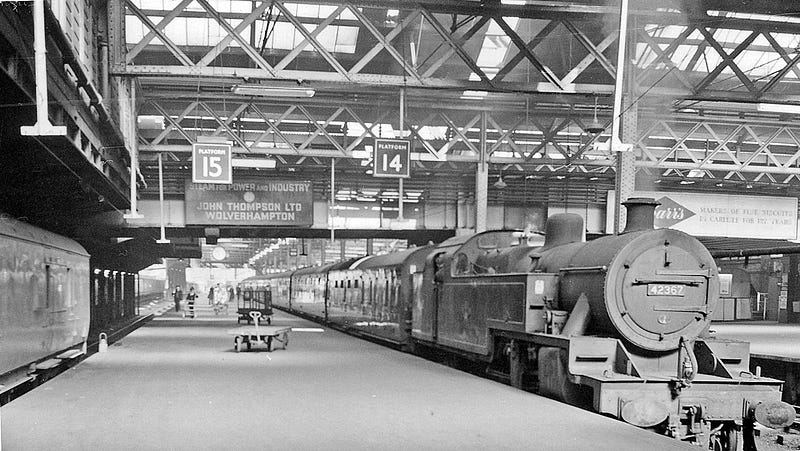
The train pulls into its final destination at 8.16. a.m., Albert checks his watch. Wearing a heavy black overcoat and carrying his briefcase, Albert is absorbed in the melee, jostled along in the wave of peevish people entering the vast city through Euston Station. The chill January air scented with Brylcreem, coffee, peppermint, and the overpowering decoction of old perfumes and aftershaves mingling with stale tobacco ash.
Albert listens to the irritated mutterings as the confraternity moves sluggishly toward the exit, where a large, florid looking man, puffy-faced with strangely colorless eyes, collects tickets. He walks briskly across the station precinct of the great hall, purposefully striding to a waiting area beneath the great clock. Albert takes a seat, checks his watch, and opens his briefcase. From it, he removes two brushes wrapped in a yellow cloth and a can of Cherry Blossom black shoe polish. He places these on the bench before bending forward to untie the shoelace of his right shoe, which he removes. He opens the can, dabs the brush precisely into the polish, and begins the ritual of cleaning his shoes.
Albert had learned that cleaning his shoes before leaving home was asking to have them trampled upon by irritable and impatient people; all trying to beat the clock in the rush hour absurdity. Wrapping up the brushes and closing the lid, he again checks his watch, 8:28 a.m. He sits a further three minutes, gathering his thoughts. With trained practice, he shuts out the noise of the rush hour. He takes another moment to enjoy the aroma’s wafting in curls through the air, singling out a smell of fried sausages being cooked over hot coals by a vendor.
At 8:31 a.m., he leaves the station precinct into the Wednesday morning air. People, he observes, move cautiously, leaning forward against the fall of fresh snow, hats held fast with gloved hands, scarves covering misting mouths. He walks upright and proud and at 8:35 a.m., collects his morning paper from a ruddy-cheeked, cloth-capped seller. He neatly folds the newspaper before opening the briefcase against his lap and places it neatly inside. The newspaper vendor cheerfully voices the opinion that such a day is not a day for the living. Albert smiles, lifts a hand saluting his departure, and continues toward the taxi rank. Albert climbs inside.
Wandsworth Prison, he instructs. The driver pulls away from the curbside. Albert opens his briefcase, removes the newspaper, and sets it next to him. He then removes a whiskey flask. After closing the briefcase, brushing the melting flakes of white from his shoulders to the floor of the cab, he turns off the screw of the flask. The sensation of taste on his tongue teases his need. He savors the warmth falling into his belly before taking another long sip. He then screws the top back before placing the flask reverently back in the briefcase, lying the newspaper flat on top and closing the briefcase.
When the cab comes to a halt, the driver turns to him. Albert pays over sixpence for the journey and steps out. He stands beneath the gate, straightening his coat beneath the notice: ‘H.M.P. Wandsworth.’ Albert checks his watch, 8:45. a.m.
Two hours later, the train rattles its way back to Bradford through the slate grey morning. Albert is sitting upright, absorbed in the game of wondering what people are thinking. An hour later, disturbed by the clattering of a train passing in the opposite direction, he stirs from a nap. He opens his briefcase, removes the chrome and leather-bound whiskey flask, and drinks the remnants. Lying flat among the shoe cleaning materials, a calf-leather strap, a white cotton hood, some government papers, and three crisp five-pound notes. He places back the empty whiskey flask before snapping shut the brass clasps.
Across the aisle, a woman is holding open the evening newspaper. The headlines are in large ominous black print.
‘Derek Bentley, hanged.’
Albert turns his stare back to the window, gazing out across the English countryside.
Postscript: 40 years later, in 1993, Derek Bentley received a ‘posthumous pardon’, and in 1998 a further campaign successfully concluded with the quashing of his murder conviction. Derek Bentley was 19 years of age, educationally deprived.
Albert Pierrepoint Hangman.
Derek Bentley Innocent