
People stopped inviting me to gatherings because my social anxiety made me a flake.
A step-by-step approach built my confidence. Now I show up and have my social life back.
Ever since I lost my father at the age of eight, I got into a habit of suppressing my emotions. I held back my tears, fears, and wishes which kept accumulating over the years and reappearing in the form of anxiety.
These symptoms started with fear and then eventually transformed into anxiety. I wouldn’t have bothered to notice them until the situation became so dreadful that people started cutting me out from their social groups. That’s because I turned down every invitation given by them which would require me to leave the comfort zone of my home.
I always had an excuse ready to help me avoid being a part of social groups or any sort of get together, whether with friends or family. All that mattered was avoiding people and social situations.
I had a certain kind of phobia that the moment I would walk into a room, people would observe me, judge me, condemn me, and even laugh at me for unknown reasons. They would laugh at the way I dressed, did my hair and makeup, the way I sat, or the way I conducted myself at the dinner table or otherwise.
I tried to convince myself that I only needed to get through a few hours of chatting and having fun, but I could never make it to any social function without episodes of needless crying or unannounced loose emotions. Also, racing heartbeats leading to palpitations and excessive sweating.
One day, as usual, I got an invite to a dinner party at a friend’s place. Because the number of guests was small, I thought I could use this opportunity to see if there was any way that could help me take charge of my situation.
I Needed to Know Where I Stood Before Preparing for the Battle
During my MBA days, I had learned about the Liebowitz Social Anxiety Scale. Our human resources professor had made us take the test in one of our classes. She insisted we take the test every three to six months to track our progress.
It takes around five minutes to complete this test. After you’re done, you have to click “Submit” to get your test scores, which look something like this:
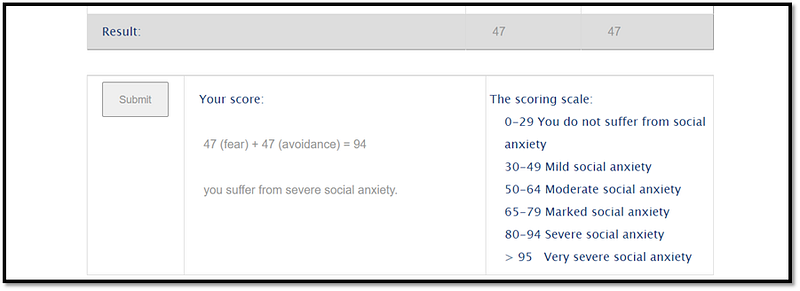
When I took this Social Anxiety test eight years ago, I had a score way above 95, which meant that I had very “Severe Social Anxiety.” I didn’t take it seriously though, as it was only a classroom exercise for me. But in 2019, when I decided to fight this anxiety disorder, I took the test again to see where I stood exactly, to help me plan a course of action.
Handling Social Anxiety in an Organized Manner
I could not fathom why others are cool with group meetings but I am not. There was something that I was definitely missing. One of my friends suggested I should sign up for counseling sessions.
When I had my first counseling session with a therapist, he explained that all the thoughts and fears suppressed as a child were now coming to the surface in the form of anxiety.
His idea, as one part of my therapy, was to tackle those feelings one at a time in order to remove the phobias from me. That way, I would have tools beyond medication and counseling.
I noticed that the intensity of my social anxiety was not the same everywhere. I was less anxious in places that were very crowded or where there were people my own age who I was sure wouldn’t judge me. In fact, I would look forward to meeting those people. Of course, a certain level of nervousness would be there, but nothing I couldn’t manage.
Once I started getting comfortable with these kinds of group events, I decided to up the game and try my hand at a higher level. Because the problem may not have been the event itself but the people who were going to be a part of that event.
So, I made a mental map of those situations and started attending more of those types of events. It was extremely difficult in the beginning but I knew it was necessary to work my way up to more difficult situations.
My Step-by-Step Guide to Tackle Social Anxiety Disorder
After observing my schedule for about a year, I noticed patterns. There were five phases before, during, and after the event where I needed to do specific forms of self-care:
- Days/weeks/months before the event
- One day before the event
- On the day of the event
- At the main event
- After the event
I had to do two steps for each phase.
The first phase applied only when the invitation was sent in advance.
In the steps noted below, I also include the results I observed for each one of them.
1. Days/Weeks/Months Before the Event
Step 1: Rehearse conversations that are bound to happen
For a family dinner, I mostly knew who was coming and what kind of questions they would normally ask. So I would rehearse some of the common questions in advance, to get a feel for it.
Here’s an example:
My relative: “Hey Bhavna how are you, my dear. How’s your work going on?”
Me: (With a confident smile) “I am good, thank you, uncle. How about you, how’s your health now?”
My relative: (Imagining he said something about old age issues.)
Me: Yes, absolutely right. I can understand that, uncle. (Wrapping it up with a smile.)
Basically, I planned to keep the conversation short and sweet. And if there’s still an awkward silence, I would make an excuse to use the restroom and move to a different corner.
The Result
Most conversations would start the way I had expected but sometimes I was asked more questions than I had anticipated, sending me into high alert.
In that case, I would answer them as calmly as possible making sure they get more than they asked for. This discouraged them to ask more questions.
And if I wasn’t confident about my answer, I would directly jump to the last part and excuse myself for the washroom break. The loop broke there and I saved myself.
The reality would be different at times. Instead of one relative, there would be many. So, the next time, I started rehearsing for several relatives, and that solved the issue for me completely.
Step 2: Being conscious about the way I SEW (Sit-Eat-Walk)
One thing that always stood out about me was how uncomfortable I felt about the way I carried myself. It felt like all eyes were on me and they were judging each and every step of mine. I often felt awkward amongst other ladies in the same room.
I started grooming myself to change my habits around these things, even when by myself at home.
- I consciously sat up straight to improve my overall posture.
- I practiced sitting with my legs crossed to be in charge of my body language.
- I practiced walking in a way that would avoid making thundering noise with my feet.
- I became vigilant as to how I placed food on my plate and in what quantity, how I was serving food to myself and others, and finally how I was eating and chewing food, observing all table manners.
Hush!
Honestly, when I started working on these things I realized the amount of pressure I was dealing with. How could I ever be myself and enjoy social gatherings? I had been punishing myself with an invisible whip that kept lashing out at me every minute.
No wonder I couldn’t wait for the dinner to be over so I could go home to be by myself.
The Result
The above exercise helped me to build muscle memory. This way, the brain would not be shocked by so many new rules to follow at once. It helped me gain confidence. It reduced the effort I had to put into presenting myself well in social situations.
That allowed me to be more present and less self-absorbed, which had made me seem aloof to others. Having an innate control about the way I carried myself allowed me to feel a part of the group and not a loner.
2. One Day Before the Event
Step 1: Choosing clothing to make me feel comfortable and my best
One of the major causes of my social anxiety that I’d figured out was my body image. Since I have always been overweight, I felt less confident about myself and avoided going out.
I was scared, thinking people might comment that I looked fat or had put on weight. The thought of reacting to it freaked me out. Would I be able to hide my pain?
For this, I designed a plan to work out every day (instead of alternate days) leading up to the main event. I selected colors and styles that complimented me and also felt very comfortable.
If someone brought up the topic, I planned some medical excuse to have ready. That would still be awkward, but way within the manageable limits.
The Result
With my conscious efforts, I managed to either get compliments for my appearance or evaded the topic of putting on weight at all.
Step 2: Messaging or calling up a few people in advance as a warm-up exercise
If there was an event where all friends would be gathering, I called at least a couple of them just to casually chat.
I tried to understand what kind of priority they were placed on the event, and I matched it. This gave me a reality check, in case I was taking this event way too seriously.
I also tried to get an idea of what they were planning to wear. If they were planning to shop for new clothes, I offered to join them. This gave me a chance to waive off a major part of my anxiety. Two fewer people for me to be afraid of. Sounds funny, right?
I noticed they were chilled out, so I would try to “sail in their boats.” It may or may not help me reach the shore, but it definitely helped me cross the deepest part of the river.
The Result
This practice has had many advantages for me.
I even sometimes went to get ready at their place, which also took my mind off the event. Entering the venue with a few people helped divide the attention from me alone. And that helped me feel stress-free and enjoy the party to a greater extent.
3. On the Day of the Event
Step 1: Working out before the actual event
This, I discovered myself one day when I danced for an hour before going to the get-together. I felt so calm and relaxed, the feeling was surreal.
Because I had just worked out, my muscles felt tight, my skin glowed, and I felt a little drained but in a good way. I did have a lot of energy but not enough to spare on racing heartbeats and finding corners to hide in.
The Result
I felt innately happy as the exercise endorphins took over my body. I had no desire to run away from people, instead, I was content to just sit in one place and participate in conversations. That was a win-win for me.
Step 2: Calling up the host and asking if I could get something before I came
This works wonders in the case of family dinners. I started calling my uncle or aunt who were hosting the dinner and asked if they needed anything from the market.
This was beneficial in two ways: it gave me confidence as a helpful guest, and also I could immediately get to chatting with them about what I’d brought.
The Result
This practice was dependent on whether or not the host asked me to get something. If they didn’t, then I learned that I could go straight into the kitchen and offer to help. That also gave me a chance to calm my racing heart, grab some confidence, and smile before I headed to the seating area.
4. At the Main Event
Step 1: Approaching the smallest group of people and working my way towards the larger ones
The moment I rang the bell, the door opened straight to the living room where all the guests were seated together. And they all look at you and scan you together. This was the moment where I froze. If I got a compliment on my looks, I feel good, and if I don’t, I assume that I messed up somewhere.
But if you are fortunate enough to be able to approach a small group first, before approaching the larger ones, always do that. These are usually the hosts waiting at the entrance or one of the guests who came to open the door for you.
I always chit-chat with them for a little while before facing the entire room. If they don’t compliment me in the first few seconds of looking at me, I compliment them. Their dress, perfume, jewelry, or anything that catches my attention.
Then, I try to chat while entering the main room with them. This way I deflect some attention away from me.
Then, I approach one face at a time, smile, and greet them before finding a perfect spot for myself.
A spot which is neither too far away nor too much in the center, which allows me to have conversations easily and also letting me withdraw from them whenever I liked. This idea has been advocated by WebMD on their page for managing social anxiety in large groups.
The Result
To others, I seemed like a regular person. I managed to hide my fears perfectly with this trick. In no time I was part of the social group without revealing the storm beneath my quiet exterior.
Step 2: Observing everyone closely.
For me the question always had been, “How come others seem so cool, chilled out, and look like they are having the best time of their lives?” I never saw a trace of struggle in their body language and here I was having a constant war with every ounce of my being.
I started observing everyone very closely. The way they walked, dressed, ate, spoke, sat, and had conversations. They were like walking encyclopedias for a person like me. This let me focus away from myself and observe things that could help me learn.
Nobody needs to know how anxious you are, just be genuinely interested in their conversations. Everyone loves a good listener.
The Result
I noted two things: many people were as much of a mess as I was, and there was nothing exceptional about most people.
I couldn’t see any of this before because I was too busy with my self-loathing.
5. After the Event
Step 1: Celebrating my victory
What do we do after taking the last exam and stepping out of the exam hall? Jump high in the air, toss the papers around, and do a dance of freedom.
So after every such event, I would come back home and do a small victory dance dedicated to myself. I mean, who on earth prepares for a family dinner as if it were a battlefield?
I did. It was a big deal for me. It was therefore important for me to pat myself on the back for the guts I had shown and the organized way in which I tackled minute issues along the way.
Step 2: Completing my day with a reflection
I have a habit of making notes of my behavior with others. This helps me catch things I could have done easily to avoid unnecessary attention towards me.
I would also make a mental note of all conversations I had and which ones I wish I’d handled differently.
Through this, I learned that sometimes, showing up early also helps. You turn the table around. Instead of facing a room full of people judging you, you are already in place.
Whenever I managed to be the first at an event, I have even used the opportunity to scan people at the entrance from top to bottom while I have my own inner reactions, like a queen.
My Learning in a Nutshell
- If you feel something about your anxiety is out of place, seek a friend’s advice or get professional help. Ignorance is not bliss here.
- Once you have identified you have social anxiety, get proper treatment for it instead of running away.
- After you reach a stage where your condition is being addressed, start working on a customized plan to work your way out.
- Make a note of what kind of environments trigger your anxiety the most and which ones don't impact you at all.
- Try staying away from high-stress environments until you have trained yourself to be confident in easier ones. Slowly work your way up.
- Keep experimenting on a trial and error basis and see what worked for you or what didn't. For example, which outfit made you feel beautiful and which one made you feel self-conscious.
- Observe people closely and apply lessons learned there.
- It is okay to make mistakes once in a while, try not to dwell on them. Learn and move on.
- Your past may not have been what you had expected but your future is completely in your hands.
Overcoming your social anxiety can feel like winning a huge victory over an enemy forever. Your heart may still beat fast, but now with excitement rather than fear.