
Roleplaying Games
People Revolt When They Have Nothing to Lose
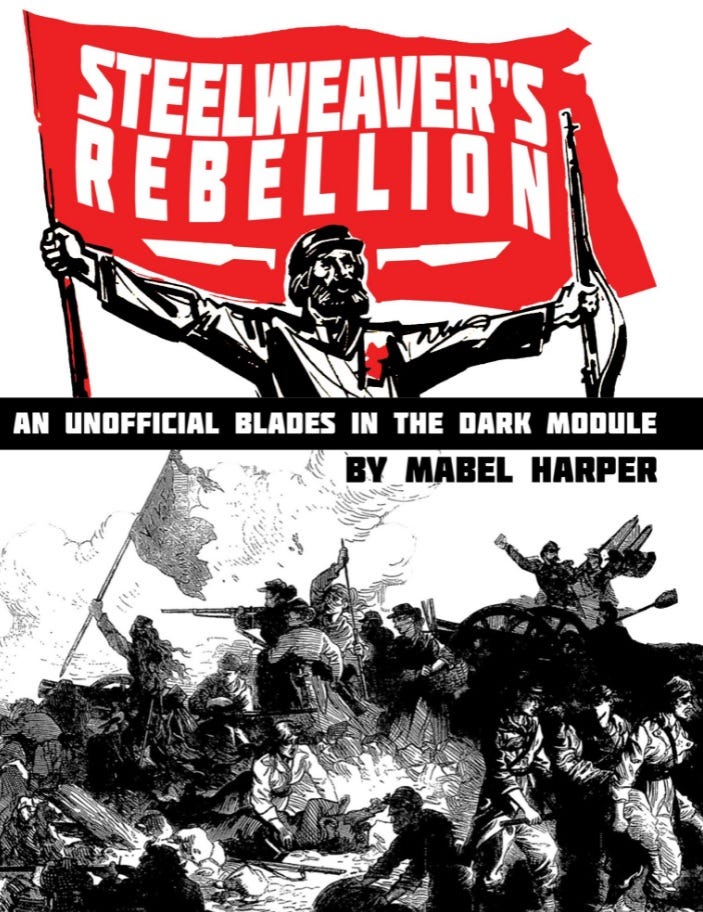
Steelweaver’s Rebellion, a module for Blades in the Dark
“The color has been stripped from the miner’s skin. His cough is getting much worse, and his blood is starting to run black. He is tired all the time, and, in the little naps he steals away among dark galleries of coal, he dreams a pastoral dream. He wants to see fields of flowers. He wants a horse. He wants his family to be fed always. A future he knows he cannot have. He is ten years old.”
— from Steelweaver’s Rebellion, page 1.
Steelweaver’s Rebellion is the story of a workers’ revolt against a cruel industrialist. An unofficial module for Blades in the Dark, it plays out like a mashup of Reds, Bloodborne, and Taboo. It is exceedingly pro-union, pro-eat-the-rich, and pro-revolution. To call it “subversive” would be an understatement.
If you’re uninitiated, Blades in the Dark is a steampunk-supernatural-crime RPG. D&D re-imagined by Michael Mann and Guy Ritchie. The core gameplay feels like Ocean’s 11, but meaner. Professional scoundrels take down scores, like smuggling occult artifacts or robbing a fancy ball. Blades in the Dark is an absolute hoot, and the latest TTRPG to get noticed by Hollywood.
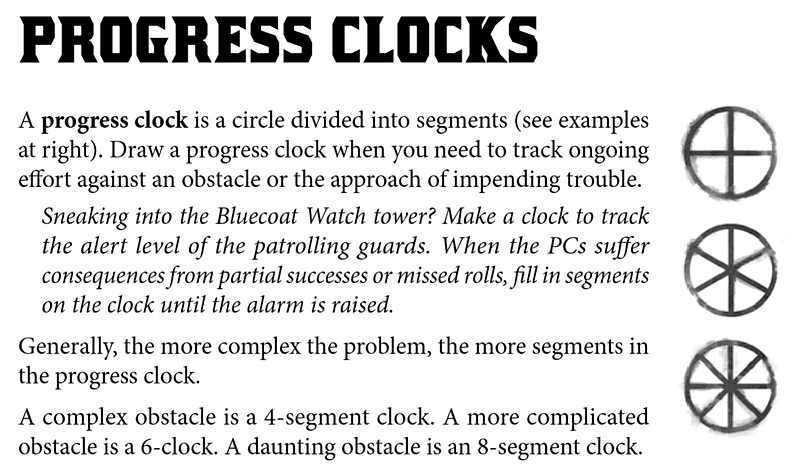
Clock mechanics are a big part of the Blades experience. Clocks track complex problems and situations. A Danger Clock can represent how close the guards are to spotting a break-in. A Faction Clock can track a merchant guild’s progress in controlling the contraband market. Blades in the Dark has about half a dozen uses for Clocks.
Steelweaver’s Rebellion shifts the focus of Blades from crime to revolt. The player-characters are Revolutionaries sowing discontent in Coalridge, Doskvol’s industrial district. They agitate, liberate, sabotage, and terrorize their way to an uprising before a local coal baron can bring the hammer down.
Said coal baron is Lucretius Dream, the campaign’s obvious Big Bad. He is rich. He is cruel. He is greedy. He doesn’t give a shit when children die in his factory. In my head he looks like Jeff Bezos crossed with Ebenezer Scrooge.
Dream and the Revolutionaries aren’t the campaign’s only interested Factions. The Pink Roses are sex workers that protect and manage themselves. They want to control the brothels. The Coalridge Laborers’ Union is a still-underground workers’ collective. They want to strike. The Bluecoats are the local cops. They want bigger guns. These and every other Faction are tagged as philosophically Advanced, Intermediate, or Backward. Wooing Advanced and Intermediate Factions into joining the cause is a big part of the game. So is undermining the Backward Factions.
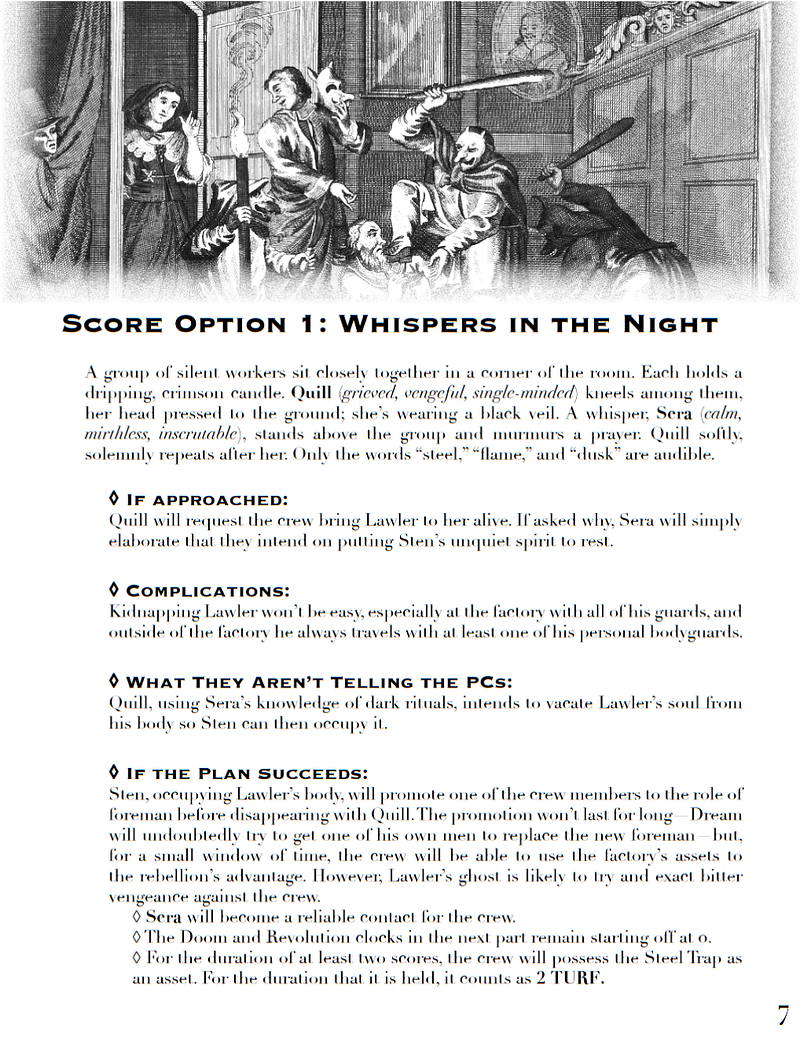
Blades is normally player-driven and improvisational. There’s rarely a planned story. Steelweaver’s Rebellion breaks this tradition with five introductory scores to choose from to get the ball rolling.
After the first score, two Clocks are introduced that shape the rest of the campaign. The Revolution Clock advances when the Crew does something to help the cause along. The Doom Clock advances whenever Dream tightens his grip on Coalridge. If the Revolution Clock strikes midnight first, workers strike en masse and the people take to the streets to do revolution. If the Doom Clock strikes midnight first, the rebellion is crushed before it even gets started.
Revolution is the sole win condition in Steelweaver’s Rebellion. This leads to Coalridge being cut off from the rest of Doskvol. The means of production are seized. Militias are formed. Counter-revolutionary factions are kicked out, or worse. All that fun stuff.
Revolutions are terrifying, mainly because they rely on people to hold them together. And people can’t be trusted. Institutions may be cruel, but at least they’re consistent. Revolutions need time to build new institutions. Meanwhile, everyday people are forced to make it up as they go along just to survive. Mutual aid works great within a functioning civilization. After a revolution, without institutions, everyday people find themselves in a feral city.
So when people call for revolution, they must be so tremendously desperate they’d rather take their chances without those institutions. Anger isn’t enough. Rebellions happen when people have nothing left to lose, even if those rebellions might lead to another kind of oppression. When your dreams are ruthlessly crushed, revolt is the only sane option.
The module also addresses, and prosecutes, reform. Third Way politics is introduced soon after the first session, and lingers throughout the campaign. Revolution is a sexy idea for some, but a lot of folks would rather try to fix what’s already there. Revolutions are unpredictable and most people would miss the institutions once they’re gone. Even when revolutions succeed, rebuilding is a long and painful process. Reformers believe it’s best to play it safe and avoid starting from scratch
Is moving the needle from ‘bad’ to ‘tolerable’ a good thing in the long run? Do reformers prop up deeply flawed systems when the right thing to do is tear them down and start all over? The module’s author thinks so.
Steelweaver’s Rebellion packs a lot of political discourse into 31 pages. Adding very few mechanics reveals whole new dimensions to an already sophisticated game. Reframing a cesspool of crime as a hotbed for revolt adds new flavor to an already delicious setting. The module is godlike. The campaign is fascinating. The message is brutal.