
People Fail Logic, Logic Fails People.
People around the world are slandering logic as we speak. People fail logic, and logic fails people. The problem is in both scenarios, we find ourselves pulling our hair. The problem with speech is that it is a right while it should be a privilege (tongue-in-cheek) Fine… uh…logic should be a duty and not a luxury? I just cannot come up with a polite way to state it.
Our brains and reasoning screw us over more often than we care to admit or plan to rectify but it does (better, now.) The more we dwell in the world around us, the more we realize that rationale does not govern society, country, or for that matter our homes. We see the world is usually governed by narratives. We see that we accept the convenience in favor of the consistent.
Logic is the bedrock of pretty much all human knowledge. Yet, it is not the foundation of public discourse and narrative.
So we agree that logic is important, yet we also agree that our society and politics are not based upon rationale. I will push this notion further and say that our Polity, Media, and Society is waist-deep in logical fallacies. We see these fallacious arguments every day but ignore them because they fit the narrative.
Here are fallacies that Politicians, News Media, and Society (you, me, everyone) commit on daily basis:
Appeal To Bandwagon (Argumentum ad populum)
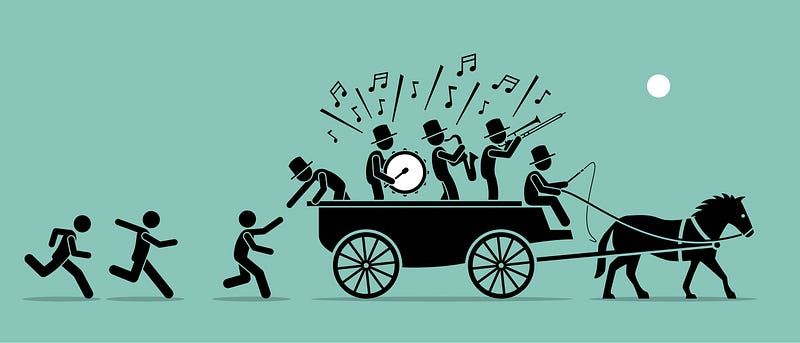
The hyper-social nature of our species causes us to appeal to outside influences. We all want to belong to a community. We all want to associate with high-status people. Thus we are ready to join the bandwagon. Just because a particular side has more people, it does not mean those people are right. In the past, a vast mass of people in the US was in favor of slavery (doesn’t make slavery right, does it?) However, this very argument is employed all around us.
A political incumbent makes a decision, the decision fails miserably but the news reports his ratings are rocketing — people automatically reason the decision is great. “12 crore citizens have shown trust in our candidate, he is the best choice” or “Every 3rd Mexican reads our newspaper” These statements lack any merit on their own except the fact that a large mass of people has trust in a candidate or like a newspaper. They are simple appeals to fall in line with the majority (sometimes, only a large group) because who requires rationale?
Ad Hominem
Ad Hominem arguments are considered to be fallacious as irrelevant for discussions based on attacking an arguer’s character rather than the claim his making. Translated as “toward the man” in Latin, the point is directed towards a man rather than his words. We see in the political and media discourse that people are attacked over who they are more often than over what they said.
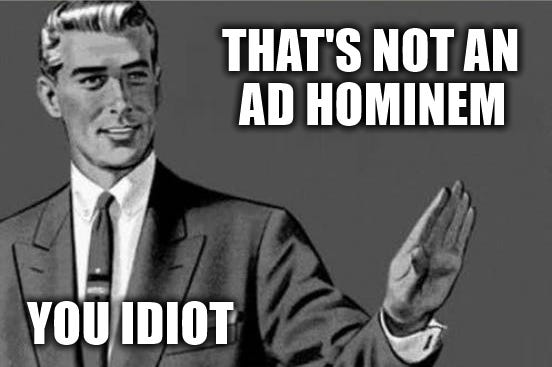
Personal jibes, name-calling, or remarks like: “Look at that face. Would anyone vote for that?” or “You didn’t even finish high school. How could you possibly know about this?” constitute Ad hominem.
This is usually employed to intimidate and insult. It is very commonplace in political debates, news panel debates, and can-I-do-something-new arguments with your parents. I refrain from posting many examples of this fallacy because it is very impolite and derogatory in nature. I hope you have understood the fall of reason here, you dimwit.
Straw-Man Argument

A strawman is a fallacious argument that distorts an opposing stance to make it easier to attack. A straw man is a form of the argumental fallacy of having the impression of refuting an argument. Meanwhile, the proper idea of the argument under discussion was not addressed or properly refuted. One who engages in this fallacy is said to be “attacking a straw man”.
The use of a strawman comprises the following three stages:
First, person A states their position.
Then, person B presents a distorted version of person A’s original position, while pretending that there’s no difference between the two versions.
Finally, person B attacks the distorted version of person A’s position, and acts as if this invalidates person A’s original argument.
See this example, Teaching assistant: the homework assignment was much harder than we thought, so I think we should give a few extra points to students who completed it.
Professor: that’s a terrible idea. If we give everyone a perfect score, students won’t bother working hard.
Politicians do this all time, they oversimplify the criticism at hand and make the solution look simple. Take, for instance, the need for stricter legislation against sexual assault against women is regularly met with some outrageous remarks like “Women should dress appropriately” (be more vigilant, you will see this in news)
Slippery Slope Fallacy
A slippery slope argument, in logic, critical thinking, political rhetoric, and case-law, is often viewed as a logical fallacy in which a party asserts that a relatively small first step leads to a chain of related events culminating in some significant effect. You have probably faced this fallacy firsthand:
“If you don’t do your homework, you’ll fail the class. If you fail this class, you won’t graduate from school. If you don’t graduate, you won’t get into college. If you don’t attend a good college, you won’t get a good job. If you don’t get a good job, you’ll be poor and homeless. You don’t want to be poor and homeless, do you?”
Donald Trump famously predicted this during the campaign. Ford is going “to build a plant, and illegals are going to drive those cars right over the border. Then they’ll probably end up stealing the cars.” A slippery slope is a chain of interlinked assumptions that are both farfetched and illogical. Political campaigns employ this fallacy with beauty and conviction, sample this (actual billboards in the USA) — “Atheism is Anti-American, Anti-American is treason, Traitors lead to civil war.”
Like the article? Here is another one on the topic
The Importance Of Sound Reasoning
If you haven’t noticed, we are all poor at this logic and reason thing. This list is just a tiny slice of the logical fallacies pie, but probably accounts for a significant portion of what we think and are exposed to each day. Society at large faces severe challenges because of these shortcomings — from misinformation and propaganda to war and anarchy.
But that doesn’t mean we shouldn’t try to be better. Logic and reason are our life preservers in a vast sea of uncertainty. To let go of the life preserver, to cling onto the latest, greatest fad or the imposter who’s currently on your television screen… well, that’s intellectual suicide.
Not to mention that a lot of these logical fallacies can turn you into an insufferable and insociable pretty quickly. Debating with someone over the merits of an idea or argument is already contentious enough. But falling into the trap of these logical fallacies, many of which hinge on making a mockery of the other person’s ideas (or the person themselves), will not make you the biggest hit at children’s parties. Not to mention people won’t be thrilled to talk to you about anything meaningful.
Fallacious reasoning keeps bad ideas alive. At its worst, it pits us against each other in a hopeless downward spiral of tit-for-tat where nobody really wins and everyone definitely loses.
Logical reasoning isn’t about “winning” an argument. It’s about finding the truth. And inevitably, getting closer to truth requires one to recognize and admit when they’re wrong. An untested belief might be convenient but it is stale. We do not however argue to be part of the “widely accepted” or “generally agreed” but understand our locus on the spectrum of belief. To gain a better understanding — we must indulge in merit.


