
🙅♂️5 Steps To Say No Gracefully To Product Ideas
The hardest part of being a product manager is probably managing other people’s ideas.
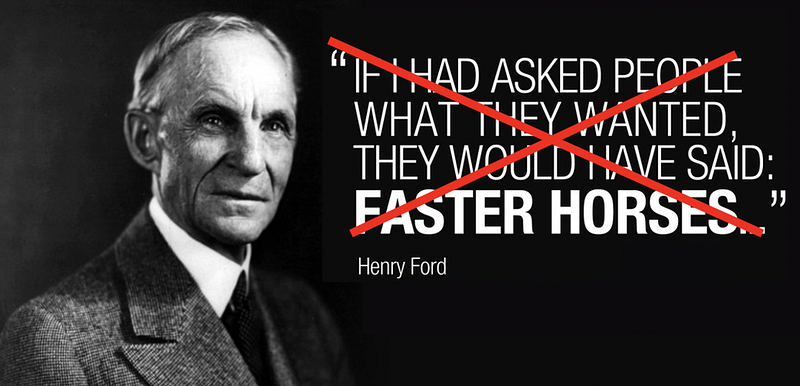
We’ve all been there — that meeting when your CEO / GM is pitching an idea and drops the Ford-Bomb: “If I had asked people what they wanted, they would have said faster horses.” Then the discussion is over, and two weeks later you come out of the build with a product no one asked for.
Adding even more insults to injury is that according to the Harvard Business Review, there was no evidence that Henry Ford ever declared the quote.
Ignoring Customers Didn’t Work for Ford Either
It’s not common knowledge, but Henry Ford had a failed company before he started The Ford Motoring Company in 1903.
His first company was in 1896. Henry Ford raised $86,000 (the equivalent of $2.61 Million in 2019) from investors and started the Detroit Automobile Company.
The first product of this new company was a delivery truck. Ford refused to put the car into production until he had perfected it to his satisfaction. The final product was a slow, unreliable, complicated to manufacture and no one wanted it. The company failed two years after. Henry Ford’s reputation went down the drain.
(Ironic as this invalidates a quote that he never uttered!)
“People Didn’t Ask for Faster Cars. They Asked For Cheaper Horses.”
Horses, however, were costly to maintain back in the 1900s, and the average cost was around $2,180 per year.
Ford knew they were competing with Horses.
But Not faster horses, not harder working horses, but “cheaper and more reliable horses”.
When the Ford Motor Company started in 1903, he learnt from his failures and focused the company on innovating within the assembly line. The innovation was on speed and reliability. Groups of two or three men will work on each car and only had one product: the Model T. This reduced the time to assemble a car from 12 hours to 1.5 hours.
The cost of the Ford Model T dropped from $850 in 1908 to $360 in 1927. Significantly cheaper than a horse at $2,180 per year.
To date, the Model T is the 8th most sold car of all time at 15 million cars.
Nailing the Customer Problem is the Biggest Reason Product Managers are hired for
Your job is to prioritise the companies resource to solve a valuable problem effectively. Most of us are not Henry Fords, and if we ignore the customer, we won’t have a second chance to redeem ourselves.
So the next time this happens to you…
Here Are 5 Steps to say No to Your CEO Gracefully:
Step 1: Clarify If the Idea Is a Problem or a Solution
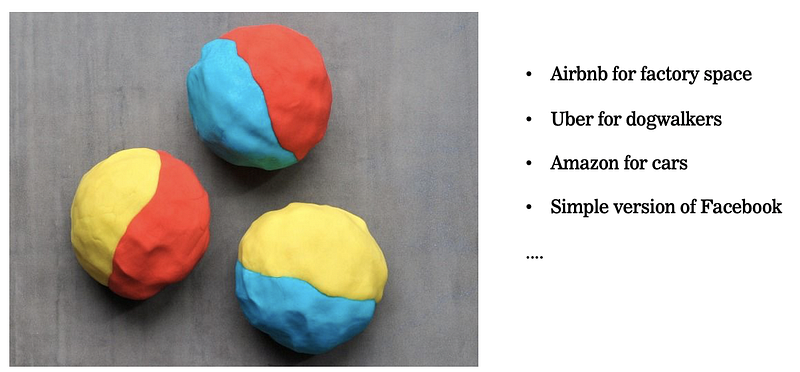
When we have new ideas, it’s often that the problem and solutions are jumbled together like a piece of Playdoh. Our brain is wired to think visually, not conceptually. It’s easier to visualise a solution (a faster car) than to visualise a problem (affordable personal transport).
Step 2: Tell them to Focus on the Customer Problem & Write It Down
You’ll need to take the hard road and untangle the Playdoh into two separate areas the problem and the solution.
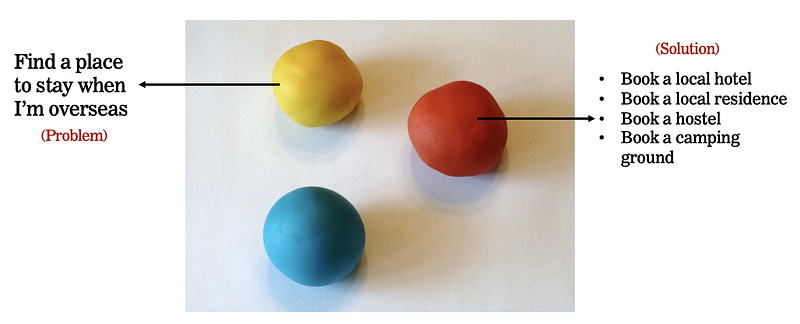
An easy way to do this is to ask your stakeholders to write down the idea. Ask your stakeholders to approach this with an open mind; They’ll need to remove their positive bias as they are writing down the problem.
Here is a handy template I use to help me frame customer problem with the emotions attached to it.
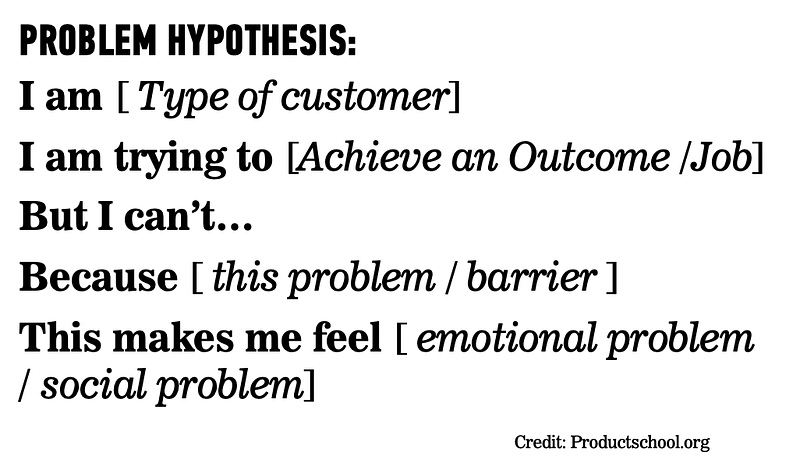
Here is a link to a PDF or PowerPoint version of the template if want to use it
For example, if you want to reframe the Uber App idea, here is how it looks like:
I am [ an urban dweller ], I am trying to [ find a taxi that will take me to the airport ], But I can’t Because [ Hailing a taxi on the street is unpredictable], This makes me feel [ nervous because I might miss my flight ]
The reason why I like this template is it captures two types of Problems most people face:
The functional problem — the actual outcome. Usually, this is pretty mundane. That’s normal because our problems don’t change often. E.g. Getting from Point A to Point B.
The emotional problem — How I feel when I have this problem. E.g. Anxiety, Frustrated, Sad, Insecurity, etc.
(Sometimes there is a social problem too but not always. E.g. How others see me when I have this problem.)
Step 3: Highlight Unknown Areas in The Problem Statement
Once your customer problem has been framed, sit down with your stakeholder and highlight the riskiest and most unknown areas of your hypothesis — these are now your assumptions.
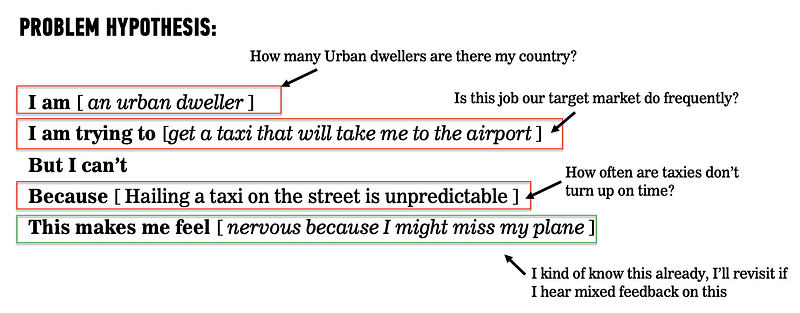
These red areas are the areas you need to do research validate the assumptions. Start doing your research to understand the following:
1, Talk to your customers to understand the collective attitude towards this problem (e.g. People don’t like booking Taxis because it’s unreliable)
2, Use internal and external data to measure the total number of customers (e.g. The number of Urban dwellers in your city, or the number of customers who have this collective problem)
This process can take minutes from the back of a napkin to a few weeks of research. Read more about how to use data to make right decisions here.
Step 4: Come up with at least 3–4 Solutions To Solve The Problem
Once you have nailed the problem, brainstorm a few ways to solve the problem.
Problems are always the same. It’s the technology and the customer behaviour that changes.
Using the example problem statement above:
I am [ an urban dweller ], I am trying to [ find a taxi that will take me to the airport ], But I can’t Because [ Hailing a taxi on the street is unpredictable], This makes me feel [ nervous because I might miss my flight ]
- The most obvious solution is using a mobile app that allows you to book taxis for a set time or an add-on package that guarantees a time.
- You can also create a WhatsApp Bot that you can get someone to arrange a booking for you.
- You can also build a B2B solution with an Airline that sends buses out every 30 min.
- You can also build a meta-search site that checks all ride-sharing apps for the most reliable transport to the airport. The solutions are endless…
Step 5: Offer to Test Out the Solutions with an MVP
You can use various types of MVP techniques to help you figure out your solution. (read here for more info)
Again highlight the risky areas, then test them out. But this time you want to use an interactive prototype. Here the four common types:
- The Concierge MVP (used by Food on the Table)
- The Wizard of Oz MVP (used by Aardvark)
- The Landing Page MVP (used by Buffer)
- The Email MVP (used by Product Hunt)
And That’s It — You’ve Just Saved Weeks of Building The Wrong Thing
So the next time you have a brilliant idea from a senior stakeholder do this:
1, Show them the Playdoh — Be Clear If this is a Problem or a Solution
2, Nail Your Customer Problem first. Write it down by framing the customer problem using a Problem Hypothesis Template.
3. Test the riskiest assumptions from your customer problem using Quantitative & Qualitative data.
4, Come up with at least 3–4 Solutions
5, Offer to test the solutions with using MVP’s
Quick update Nov 2020: I’ve just launched an online course that covers this topic, and every other topic in Product Management. The course is designed for busy Product Managers who don’t have time for class.
Don’t pay thousands learning PM, check my course at: https://www.productschool.org/