
People Are So Starved For Star Wars They’ll Forgive The Mandalorian’s Poor Storytelling: Part 2
I wish it was good, but The Mandalorian suffers from a lack of anything but nostalgia beneath its cuddly surface
Continuing along my exploration of how The Mandalorian sacrifices good storytelling and meaningful characters for references, cliches and the ever-present cute factor.
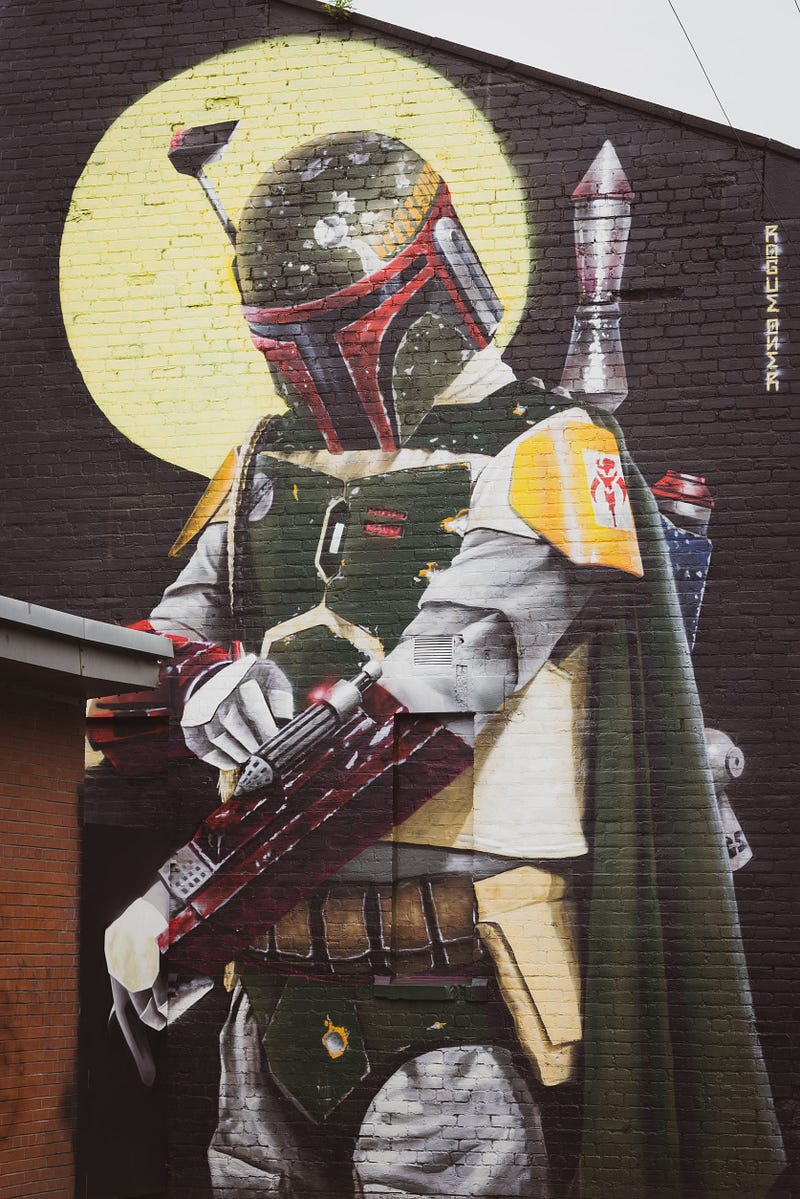
Chapter 4: Side Characters
I cannot impress enough upon the lack of distinctive side characters in The Mandalorian. The show literally treats every episode’s new characters as throw-away entries who are more appealing for their visual makeup than what’s underneath. And of the few returning characters in the show, we know very little. In fact, I can’t name any of them by heart.
Carl Weather’s Greef Karga (apparently) plays a sort of loveable one-dimensional antagonist in the first season, only to have a life-altering and deeply contrived change of heart by its end. Unfortunately, I can name none of his characteristics other than he likes money and power. We’re not given any insight into what motivates him or what he fears; which is probably a good thing, because his evolution into a good guy is so instantaneous and disingenuine that it would only be exposed as utterly fraudulent had we known his story.
Gina Carano’s character is likewise one-dimensional and nameless. She’s simply a bad-ass whose there when Mando needs her to be and pursues an end because it’s plot convenient and makes for a very cool action scene rather than a character who comes alive through the exploration of their goals, needs or fears.
Then we come to our big bad, Mof Giddian. For him, they brought the talented but typecast Giancarlo Esposito in to do his usual wicked snarl and inhabit an evil menace to the group. Unfortunately, the show fails to cloak him in fear-inducing mystery and instead casts him as a paint by numbers baddie. Literally, we never actually see him do anything evil. I mean, he does try to kill our team and capture Baby Yoda on convenient seasonal bookending occasions, but we never see how evil he is or what other things he’s willing to do in order to get to them. He even makes the moronic bad guy mistake of giving our heroes heaps of time to escape through the back door at the end of season 1.
What inures and endears us to characters, good or bad, is not always what they do but how and why they do it. Here, the Mandalorian trips and falls into a hole of its own making. For never does the bad guy outsmart our heroes. Never do our heroes want anything other than their immediate goal. Never are they forced into a position where they must choose between two desperately bad options or put under sufficient pressure to reveal who they are when it matters. Most episodes are simply this, The Mando is shot at, he does a good deed, then leaves…the end. In this way, The Mandalorian makes for a western where the heroes are bulletproof and as bland as the armour which makes them so. The accumulative effect of this takes almost all of the tension, intrigue and nuance out of a genre where it should suffuse every scene, like a standoff in the old west that inspired it. Without these, all the show has to prop it up are a cute magicians assistant in Baby Yoda, nostalgia and the cool factor, all of which can’t hold forever.
Chapter 5: Dialogue
The Dialogue is definitely the worst aspect of the show and is a symptom of a much larger problem with the characters and story. Basically, the issue is this: because the characters always act predictably, their interactions never have a charged undercurrent of subtext or subtle emotions to them, thus everything they’re saying is exactly how it is. Does a character have a feeling? Is a character conflicted about something internal? Nope. Not even remotely. Characters act and especially talk with obvious exactness, saying what they mean all the time.
Dial-up the painful one-liners and inject some cliched, cringe-inducing and exposition filled conversations and you’ll get gems such as these, ‘I gotta get me one of those,’ — has he seen Batman Begins?-, ‘Come to mama!’, ‘Did you catch them all,’ — what is this, pokemon?, ‘They all hate you because you’re a legend,’ -he’s talking to the audience, not the Mando-,‘There he is,’- when a giant sandworm has just popped out and half the people have started running already, no duh! And, of course, how could I forget the ultimate eye-rolling catchphrase, ‘this is the way…’ Every time they say this, it’s used not as a cool line, but as a way to have the characters avoid explaining why exactly this is the way and why the hell he’s following it. I have a feeling Han Solo would have just shot the Mando for standing in his way and trying to use such a fluffy catchphrase: the original Han that shot first, not Disney’s version.
Do side characters begin as scum bags? Yes. Do they change by the end? Nope. Usually, just double down on what they already are. The Mando may have an impact and leave an impression where he goes, but it’s mostly by virtue of his helmet and his adorable side-kick rather than the emotional impact he’s made on a particular mission or people it effects. For instance, we meet little to none of the villagers the giant sandworm supposedly torments in Season 2 and we barely get to know the jungle village in Season 1 before we have to leave. None of these characters leaves a lasting impression as to deserve remembering or revisiting, but we likely will anyway because the show likes to treat them as if they’re beloved.
The dialogue, no matter how witty, quippy or Disney-fied it gets, can only do so much. It can’t bolster characters that aren’t there in the first place. Carl Weather’s bosses people around, so that’s what his character talks of. Moff Gideon and Werner Herzog are evil, so they speak as though they’re straight out of a spoofed 60’s bond film. But worse than this, almost all dialogue out of a side character’s mouth’s is expositional. Meaning they talk about little else other than what’s relevant to the immediate mission. They aren’t conflicted, expressing their doubts, uncertain of their own motives or seeking their own duplicitous ends (which in a western should pop up all the time). Characters simply show up, act as thin as the paper their ‘traits’ are written on, then leave or are unceremoniously killed off. Even for a western, that’s cold.
Chapter 6: The Weight of Nostalgia & Expectation
It’s not an oversimplification to say that The Mandalorian is crammed full of references and easter eggs. In this way, it makes for many fans wet dreams, as they get to discover Star Wars lore in a more organic way, expanding the layered universe bit by bit like an onion. And while I credit the show for this, the amount of care and attention towards these should really have been put first and foremost into the characters.
Instead, they’re left playing not second or third but fourth fiddle to fanservice and cliched storytelling. I mean when the fantastic artwork we see in the credits does more storytelling than the episode did, you know you’re in trouble: each episode should be an expansion of these, not the other way around.
But from what I can understand, fans are simply relieved that at least The Mandalorian isn’t terrible. Which happily it’s definitely not. It looks amazing, executes fanservice well enough to keep every comment section happy and just so happens to have perhaps the most engaging musical score of the decade. The trouble is, if we’re drawn in at all its not by the depth of storytelling, the challenging message or the intricate portrayal of characters, but by its shiny surface and the relief fans have that it’s not another sequel/prequel series.
The Mandalorian is a show that doesn’t have the same kind of pressure to perform as unknown shows that must build an audience through the strength of their stories. It can literally coast on simply being not terrible — as other recent Star Wars entries have been. In this way it doesn’t have to do anything dynamic, doesn’t have to try or add anything to the genre but the visual styles which its extreme budget permits.
I wonder how long it will take people to realise it’s actually a very paint by the numbers show masquerading — behind references galore and love of Baby Yoda — as a Star Wars epic. Will it be the third season, where its throwaway episodes and directionless storytelling amount to nothing; where hallway shootouts become tedious — no one gets hurt and each can simply dive behind their conveniently designed wall cover; that the audience finally says, oh, this is actually kind of shit. Or will it be later down the line when fans are forced to concede that the show was mostly fanservice that didn’t deliver on its brilliant premise in the beginning and now in its fourth season has delved little deeper into its hollow characters and vanilla interactions? Which is strange considering the genre offers so much potential!
Chapter 7: A Real Space Western
Over the next two nights, I binged watched all 14 episodes of Firefly, Joss Whedon’s Space-Western that’s a sort of galaxy not so far away cousin to The Mandalorian. After watching, I was struck by how amazing it is on its own and even more so when compared to The Mandalorian. Firefly is a deeply engaging show that only improves upon repeat watchings: its cult status hasn’t come from nothing, after all. It’s rich and layered characters with intricate and entertaining interactions make up the heart of this adventure show and cement themselves on top of the space smugglers pyramid of excellent storytelling.
By inevitable comparison, The Mando evolves into something worse when you realise just how good a Space-Western can be and especially when you consider how little budget they had to do it. In fact, I thought the Mando would make for a companionable returning character in Firefly because his stoic and cold personality is conducive for a good bounty hunter (Boba Fett style) or an emotionless warrior for Captain Mal’s much more layered heart of gold to bounce off.
If anything, Firefly proves space westerns can work exceedingly well. They don’t have to be a cliche-driven experience full of tired story beats, rehashed stereotypes and trite characters. I suppose if you find the idea of a Space- Western interesting, simply watch Firefly: it’s infinitely better in all the ways that matter.
In the end, the Mandalorian makes for very simple storytelling and an altogether passable show which doesn’t really have much to say except take a look at how we’re connecting these Star Wars references and how cute is Baby Yoda. It leads me to question if the most recent Star Wars films had been any good, whether people would be clinging to The Mandalorian so desperately. And I get it, I’m truly craving for Star Wars to be good again, but the Mando just isn’t the one to take us there. It’s a lifeline, I’ll give you that, but it’s nowhere near as uplifting as his famous jetpack wishes it was.
Chapter 8: Legacy
What’s most annoying of all is that Star Wars fans are so relived the Mando offers hope that they’re willing to completely overlook, or perhaps, blissfully ignore its deep misgivings and disregard any criticisms; or at least as far as the very vocal online community’s goes. And such unbridled praise is worrying because it means we’re not only forgiving of Disney/Star Wars’s bland idea of storytelling but actively going a step worse and endorsing it. By making The Mandalorian an unflappable hit, we’re telling the makers: it's okay if we don’t get well-crafted character stories, just keep giving us shiny shallow adventures in the Star Wars universe with cool weapons and passable missions and we’ll keep on forking out for it.
This paints a gloomy shadow for the future of the Star Wars universe as a whole, because if that’s what sells, then that’s what they’ll keep on making. Some might say more like the Mando isn’t a bad thing, that Star Wars has never been about great standards or truly deep storytelling and that it's only about reappropriating cool western tropes in space. To those, I would say, if that were in any way true Star Wars would not have become the most culturally epic franchise in history. It couldn’t, because in order for it to have gained such status its base must be made up of solid foundations rooted in richly constructed storytelling. This is exactly why the original trilogy is so beloved nearly half a century after its creation. And it’s what it will take for the Mandalorian to become just as beloved: a realisation that it needs more than just nostalgia to prop it up, it needs artful storytelling.
Given all of the above, I will endeavour — somewhat stupidly — to delve into the plot of The Mandalorian in my next few articles and try to rewrite the first season so its that little bit more intriguing. In the meantime, thanks for reading!