
People Are Lazy. I Have the Stats to Prove It.
Readers and views alike have short attention spans.
Much has been said about social media’s deleterious effects on people. It is said that social media sites and apps encourage people to speed up their consumption of content, to quickly move on to the next item on the list. I am inclined to agree with such criticisms, having watched people mindlessly swiping through social media sites, seldom lingering on any one post or video for longer than a few seconds.
However, it would be a mistake to entirely blame social media. Many people had short attention spans long before social media came about. Those Web sites and apps exploit the old human tendency to be too lazy to engage with anything for extended periods of time.
Obviously, not everyone is lazy, and not everyone is always lazy. One of the challenges of content producers is to create content that holds people’s attention spans longer than average. Longer than average is the key concept because the average is shockingly low.
What YouTube Taught Me
I’ve had a YouTube channel for several years. At some point I became disturbed by YouTube’s reports about the average percentage viewed of my videos. The reports indicated that people were only watching my videos between 25% and 40% of their length. For example, a 10-minute video would have an average viewing length of 3 minutes. Very few viewers watched more than half of any video, much less the whole video.
My first question, naturally, was what was I doing wrong. What wasn’t holding viewers’ interest for the whole video? What did other video makers know that didn’t know? I assumed people normally watched most if not all of videos like I tended to do.
Then I discovered an interesting report offered by YouTube — audience retention compared to other videos. The report shows what percentage of viewers are still watching at any given time in the video compared to videos of the same length created by all YouTube channels. Here is a typical example for one of my videos:
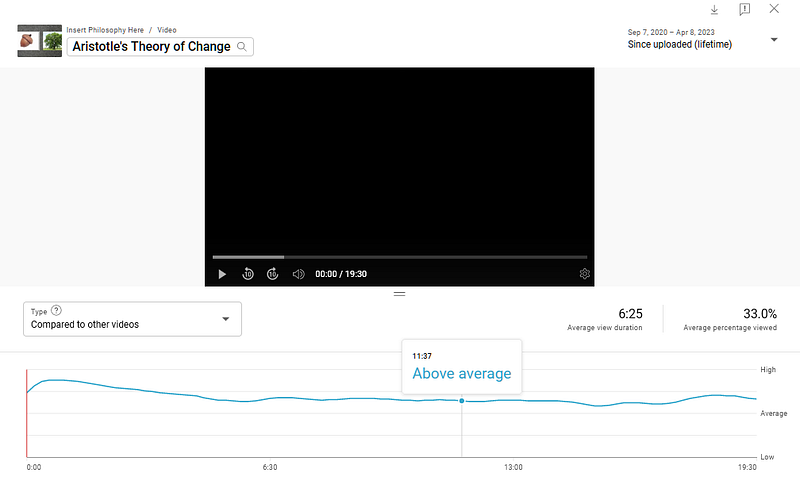
So, yes, even though my average percentage viewed seemed low, it was still higher than a typical YouTube video. I felt a little better.
The question remained about the low average percentage viewed. Another YouTube report shows viewer retention for each time segment and reveals that about one-third of all viewers have stopped viewing within 30 seconds and that that is typical for all videos across YouTube. I’ve communicated with other YouTube creators and they tell me their videos have the same statistics.
Yes, a third of all people who click on a YouTube video never watch past 30 seconds. That partially explains why the average percentage viewed is low. Even videos in which the average percentage viewed is over half of the video length, lost one third of viewers within 30 seconds. Some of that one-third stat must be from accidental clicks, after which people quickly leave, but that still leaves a significant portion of people being too lazy to watch enough of a video to get much out of it. After 30 seconds, engagement gradually declines until on average across all of YouTube, around 15% of people watch the entire video. This is the case regardless of the length of the video.
The Law of One-Third?
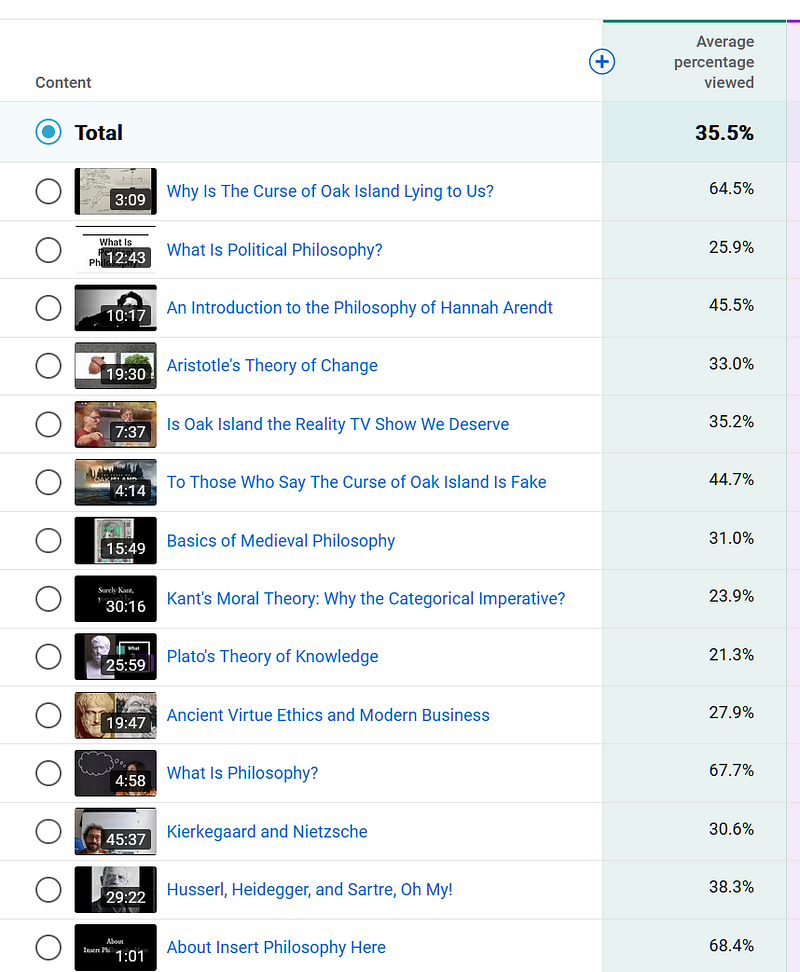
One third of all video starts end before 30 seconds watched. The average percentage viewed clusters around one third of the length. What I find remarkable is that these statistics hold regardless of the length of the video. Here is a report of my most viewed videos, and with only a few exceptions, regardless of the video length, the average percentage viewed is around one-third.
This same law of one-third also appears on Medium. Here is a report from my recent Medium articles. The “Read ratio” measures the percentage of readers who read over half of a story. Since half is more than a third, the Read ratio is a little lower than one-third, but like YouTube videos, the length of engagement with a Medium story is reasonably consistent regardless of the length of the story.
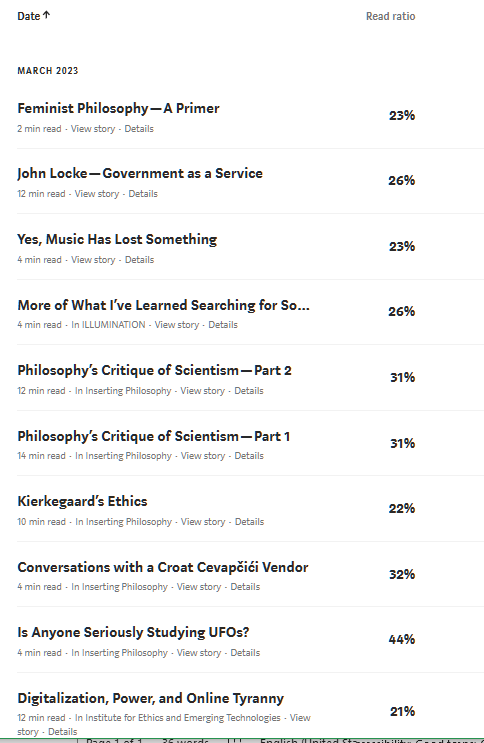
Whether a Medium story is a 2, 6, or 12 minutes read, about the same percentage of people people will read about the same percentage length of the article. It is as if there is a subconscious block that most people can’t get past that prevents them from engaging with more than a third of the content of what they have clicked on. Similar stats exist for podcasts. This isn’t about the content delivery, it is about human nature.
I’ve even noticed something similar on my Twitter account. When I or someone else Tweets a link to one of my articles, videos, or podcast episodes, only about one-third of those who Like the Tweet actually click on the link to the article, video, or podcast episode.
Yes, people are lazy. I have no explanation for it, but I have the stats to prove it. So bizarre. So unfortunate. No wonder ignorance is rampant.


