People Analytics for Better Corporate Results
The New Tool for the HR Business Partner

People Management or Human Resource Management (HRM) has usually immersed itself with issues like people, culture, talent management, training, learning, employee engagement, total rewards, and salary benchmarking, among other HR stuff. HRM is not usually associated with hard numbers and data, and HR practitioners are regarded more as people-centric than data-centric. Often when not armed with objective “scientific” analytics, HR professionals risked being tolerated as just people with opinions based on feely-willy gut-feel and subjective experience.
The need for information is integral to effective management decision-making. Data refers to the raw observed elements before their organization into understandable categories to become information. In People Management or HRM, managing data and information is not new. The People function in an organization is abundantly rich in data — recruitment data, workforce data, performance data, training data, competencies data, employee engagement data, salary data, salary equity metrics, performance-pay profiles, staff turnover or attrition data … and then some. This is long before “data science” was created and promoted as a “science”.
“Data science” refers broadly to encompass quantitative research, advanced analytics, predictive modeling, machine learning … etc. Data science is a new “science” and has yet to establish itself as a distinct discipline. To many, data science are nothing more than the modern application of legacy, well-grounded mathematical and statistical theories, models, and paradigms.
Why the reluctance to embrace data science methods in a more strategic People Analytics framework for a more effective HRM?
Information technology combined with the Internet of Things (IoT) has resulted in a data-driven economy and an information-driven society. Too many HR Professionals are languishing in the days of minutia activities like subjective recruitment and selection methods, unreliable employee satisfaction surveys (and other surveys) counting training activities and programs, labour cost savings, overtime control, monitoring tardiness, and other wasteful, time-consuming activities.
HRM activities generate an enormous amount of people data and information. They have often been used for operational purposes eg KPI measures of demographics, rate of absenteeism, amount of overtime … etc, and not by way of people metrics that can provide insights for business-critical considerations to deliver significant impact on the business strategy and goals.
This shortcoming points to the failure of HRM as Business Partners to leverage the emergent data science to create the necessary People Analytics to assure the validity and objectivity of its recommendations for crucial management decisions.
People analytics is the systematic identification and quantification of the people drivers of business outcomes (Heuvel & Bondarouk, 2016). People analytics drives business results only when their measurable metrics unpack business-critical insights to add value to the business issues and solutions. For this to happen, the HR Professional must become an effective Business Partner when equipped with the competencies of data analysis skills.
People analytics include the use of digital tools on data to measure, report, and understand employee performance and other personal and unique characteristics. It is a part of the Enterprise analytics eco-system architecture which empowers management and decision-makers to use data and information to understand every aspect of the business.
It is important to know that data is generic and possesses no value unless placed in a meaningful business context. Metrics, analytics, and decision-making depend on the interaction of people, processes, and technology. When applied to people issues in business, People analytics must take into consideration the organizational vision, mission as well as business context while being sensitive to the dynamic competition in the marketplace. Analytics is not all about technology.
Technology is certainly useful for sophisticated data processing and statistical analysis. Data science attempts at creating predictive models from often inadequate or insufficient data and/or data uncertainty as well as unrelated data beyond the operational levels so as to be relevant at the strategic decision-making level is at best a daunting task. The important key question is whether data science models can provide a sufficient foundation to build important business decisions that empower the company’s human competitive advantage.
The business context is critical for effective data science applications in any kind of Enterprise analytics, including People analytic. Data science models are often typological and very seldom predictive or prescriptive. Their limitations often lie in their underlying static assumptions instead of incorporating the actual unpredictable dynamism of human creative processes.
The preoccupation of data science in promoting machine learning and artificial intelligence (AI) as a substitute for human decision-making could very well be the reason behind the slow buy-in by HRM and HR Business Partners.
Data science devotes much of its efforts to build and continually refine increasingly predictive heuristic models so as to remove human dependency altogether eventually through detailed documented workflows in the organizational infrastructure. It may have inadvertently ignored the active but dominant role of HR Business Partners for human sense-making and instinct to obtain truly effective and well-informed management actions.
Success Lessons from Chevron
Chevron began its journey into using data science-based analytics when it realized that there was little coordination among its various HR functional areas and business units. As a direct result, there was wasteful duplication of data, data collection methods, and metrics as well as analysis reports.
A Team was created based in its Headquarters to standardized people metrics and provide reports. The Team’s Mission was “to support Chevron’s business strategies with better, faster workforce decisions informed by data”. Among its first tasks was a global process to define and prioritise all people analytics projects in the corporate group of companies. The Team developed an in-house workforce analytic curriculum to equip both HR and non-HR stakeholders the critical data analytical competencies, ranging from problem-solving and data analysis to statistics and visualization. A common language to establish corporate-wide understanding and ability was thus embedded.
The Team evolved a practice community of nearly 300 staff across all important divisions of the company, involving HR business partners, specialists, and analysts from around the world. The community of practice provides a forum for interested analytics professionals in the organization to learn gather virtually; share and discuss data models, showcase innovative techniques, design new standardized metrics, and develop relevant analytics programs.
Within 2 years, Chevron’s people analytics practice has significantly and dramatically reduced analytics project cycle-time with enhanced reliability for all people-related decisions. The company now has standard reports across the business for all talent metrics. The HRM Team has become a credible and indispensable Business Partner, being consulted for decisions on everything strategic business issues spanning, but not limited to, growth, expansion, re-organisation, and restructuring.
Conclusion
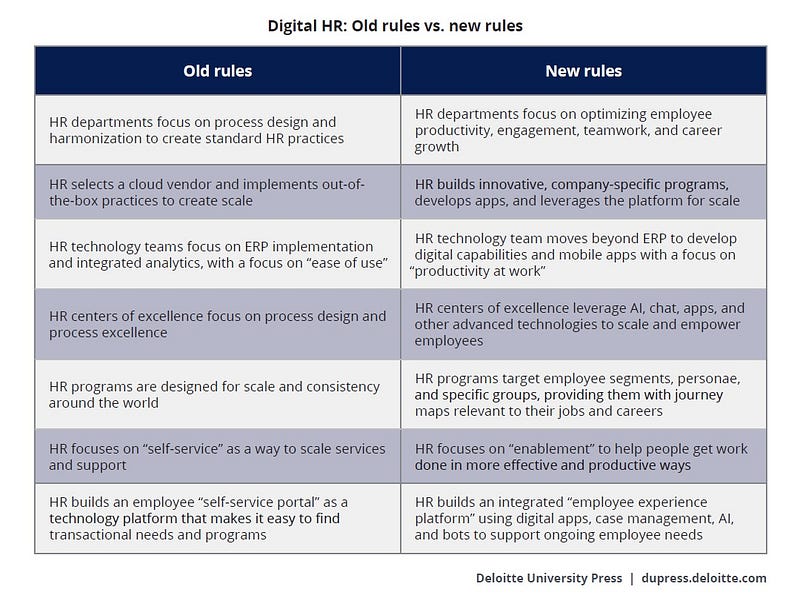
People analytics, using data science, is only as valuable as its impact on the organization as a whole. As seen in the Chevron case, the use of analytics can expand data science impact to various business areas; internal (e.g. HR, employee experience, compliance) and external (customers experience, sales, marketing). HR Business Partners should use data to engage with the rest of the organization in an evolving value-adding way; transactionally at first, then collaboratively, and eventually anticipatively. And as their impact deepens, HRBPs would move from just sending static analysis reports to model building to dashboards to sophisticated data applications for internal end-users and predictive interactive application portals. As the HR Business Team continues to incorporate feedback from the business, it would grow to be accepted and become part of the core capabilities of the organization. Armed with data science, the HRBP can continue to deliver the reliability of impact analysis and results that have a sustainable impact on the organization.
Please enjoy my recent Articles.
You can also subscribe to my stories and social media posts via your email.
Enjoy more interesting Articles by signing up to Medium here: https://thefuturistoracle.medium.com/membership