
PenTestGPT: The Future of Automated Penetration Testing ?
Discover how PenTestGPT revolutionizes cybersecurity through automated penetration testing, leveraging ChatGPT’s power for enhanced security protocols.
In an era where digital threats evolve faster than ever, the cybersecurity landscape demands innovation and agility. PenTestGPT, a novel tool designed by a Ph.D. student at Nanyang Technological University and shared on GitHub, stands at the forefront of this battle.
This ChatGPT-powered tool ushers in a new age of automated penetration testing, blending the latest in AI technology with the critical demands of cybersecurity defense.
Note that all figure from this article are from the paper of PenTestGPT (see references).
What is PenTestGPT?
PenTestGPT is an automated penetration testing tool that harnesses the capabilities of OpenAI’s ChatGPT, specifically the GPT-4 module, to streamline and enhance security testing processes.
It’s designed to automate the various complex procedures involved in penetration testing, providing a high-quality reasoning and test generation that was previously unattainable without extensive human intervention
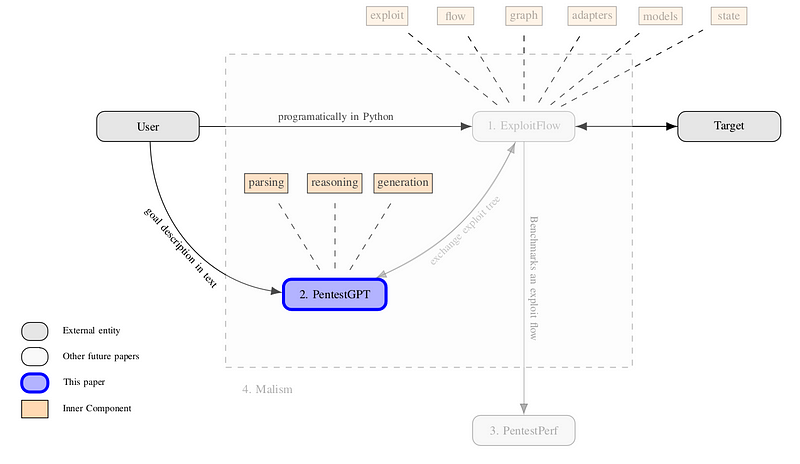
MALISM framework
The MALISM framework is designed for developing fully automated penetration testing tools, termed cybersecurity cognitive engines. It integrates three main components: (1) ExploitFlow for creating cybersecurity exploitation routes, (2) PenTestGPT which leverages LLMs for testing guidance, and (3) PenTestPerf, a comprehensive benchmark for evaluating penetration testing performances.
MALISM enables users to generate cybersecurity cognitive engines for extensive penetration testing across various targets without deep security domain knowledge.
More on this framework will be explain in another article !
Features and Design
At its core, PenTestGPT is built around a sophisticated architecture comprising three self-interacting modules:
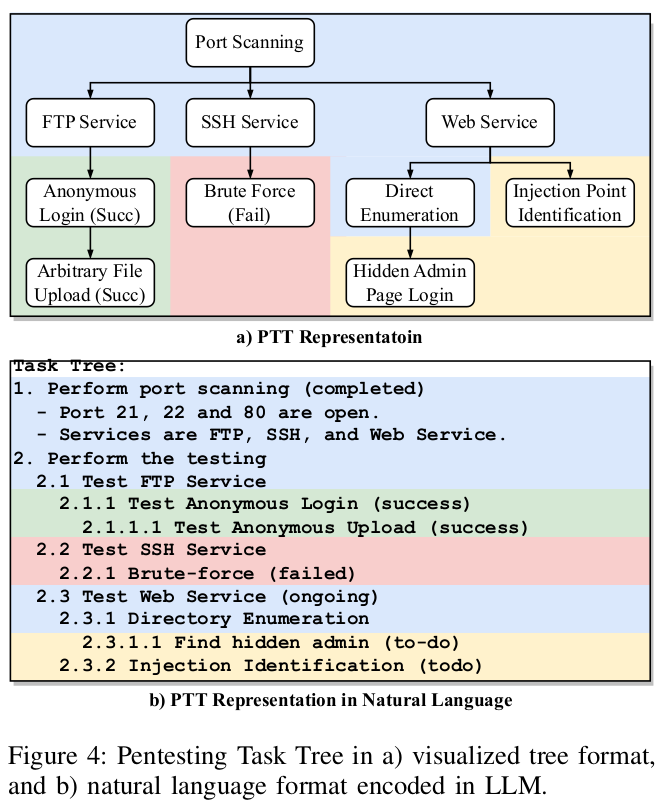
- Reasoning Module: The Reasoning Module functions as the strategic core of PenTestGPT, analogous to a team lead in human penetration testing teams. It assesses the overall testing strategy based on inputs from the user and the results of previous actions, deciding on the next steps. Utilizing a pentesting task tree (PTT), it maintains a comprehensive overview of the testing status, ensuring that long-term memory issues are addressed and that the testing process remains focused and efficient
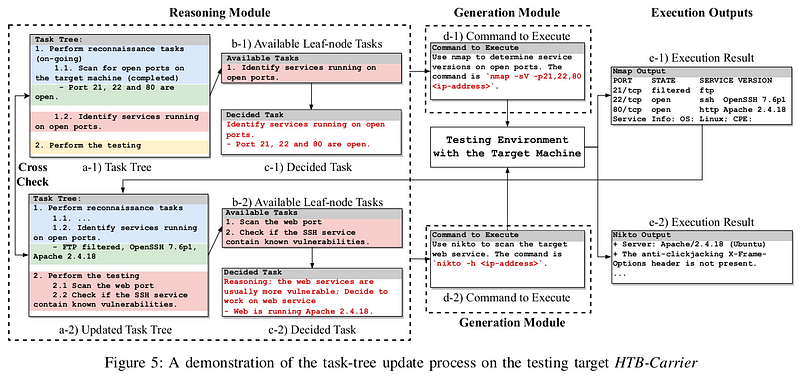
- Generation Module: The Generation Module is responsible for translating the strategic directions from the Reasoning Module into concrete actions and commands. By initiating a new session for each sub-task, it ensures that specific operations are generated with focus and precision, mitigating the challenges associated with LLMs’ inaccuracies. This module enhances the system’s ability to produce specific and actionable steps for penetration testing.
- Parsing Module: The Parsing Module acts as a supportive interface, streamlining the processing of complex outputs and user inputs into a format that can be efficiently managed by the other modules. It addresses the challenges of handling verbose tool outputs and the need for precision in summarizing critical information, ensuring that the system can effectively process and act upon a wide range of data types encountered during penetration testing.
Design Rationale: The design of PenTestGPT is directly informed by the challenges observed during an exploratory study on the capabilities of LLMs in penetration testing. The study highlighted issues such as memory retention, focus on recent tasks, and inaccuracies in generating specific operations.
To overcome these, PenTestGPT adopts a structure that mirrors real-world human testing teams, where strategic oversight is separated from the execution of specific tasks.
This design enables PenTestGPT to maintain the broader context of the testing process while efficiently managing detailed operational tasks.
Active Feedback: PenTestGPT incorporates an active feedback mechanism, allowing users to interact directly with the Reasoning Module to refine or correct its outputs. This feature ensures that the system remains adaptable and can incorporate user expertise and insights into the testing process, further enhancing its effectiveness and accuracy.
Practical Applications and Benefits
PenTestGPT’s real-world applications are vast, ranging from automating routine tests to tackling complex challenges like HackTheBox machines and CTFs.
In the practical evaluation of PENTESTGPT over active HackTheBox challenges, the tool demonstrated notable performance across a series of penetration testing objectives open to global testers. Each challenge consisted of two components: a user flag, retrievable upon initial user access, and a root flag, obtainable after gaining root access. The evaluation covered five targets of easy difficulty and five of medium difficulty, focusing on the capture of the root flag as the definition of success.
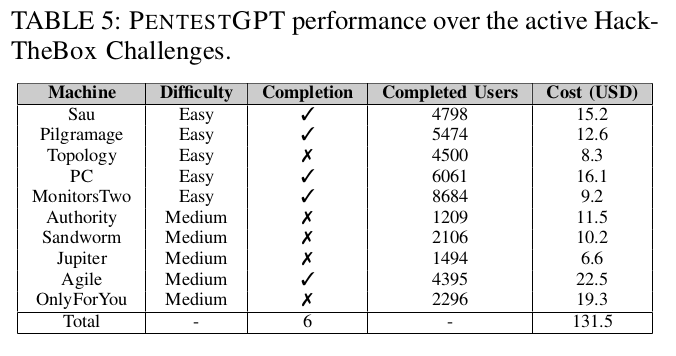
The total cost of these exercises amounted to $131.5 USD, averaging $21.92 USD per target, which is significantly lower than the cost typically associated with employing human penetration testers.
Here is a video demonstrating PenTestGPT:
By automating these processes, PenTestGPT not only saves valuable time but also enhances the thoroughness and effectiveness of penetration testing efforts.
Its AI-driven approach enables a level of reasoning and problem-solving that significantly advances the capabilities of cybersecurity professionals.
Installation and Setup
Getting started with PenTestGPT involves a few key steps, primarily centered around ensuring access to the GPT-4 API through a ChatGPT Plus membership.
Installation requires setting up a Python environment, installing dependencies, and configuring authentication cookies to establish a secure connection with the ChatGPT API. These steps ensure that users can leverage the full capabilities of PenTestGPT for their cybersecurity testing needs.
More at
Challenges and Limitations
Despite its innovative design and capabilities, users of PenTestGPT may face challenges, particularly around the accessibility of the GPT-4 API and the need for continuous updates to keep pace with evolving cybersecurity threats.
However, the active community and open-source nature of PenTestGPT provide a solid foundation for overcoming these obstacles, ensuring that the tool remains at the cutting edge of cybersecurity testing.
Conclusion
PenTestGPT represents a significant leap forward in the field of cybersecurity, offering an automated, AI-powered tool that simplifies and enhances penetration testing. As digital threats continue to evolve, tools like PenTestGPT will be invaluable in the arsenal of cybersecurity professionals, providing them with the advanced capabilities needed to defend against the ever-changing landscape of cyber threats.
We invite you to explore PenTestGPT further on GitHub and join the community of users contributing to its development. Your engagement and feedback are crucial for continuous improvement and innovation in the field of cybersecurity.
👏 Please clap if you found this article useful and follow for more insights into cybersecurity innovations.!
Follow my Twitter and LinkedIn for more updates.
References
- GitHub — GreyDGL/PentestGPT: A GPT-empowered penetration testing tool. Available at: https://github.com/GreyDGL/PentestGPT
- Cyber Security News — PentestGPT: A ChatGPT Empowered Automated Penetration Testing Tool.
- (Paper) PentestGPT: An LLM-empowered Automatic Penetration Testing Tool.


