Penny Ponders On The Reality Exchange
A different Starling from Hannibal Lector’s nemesis, but equally resourceful
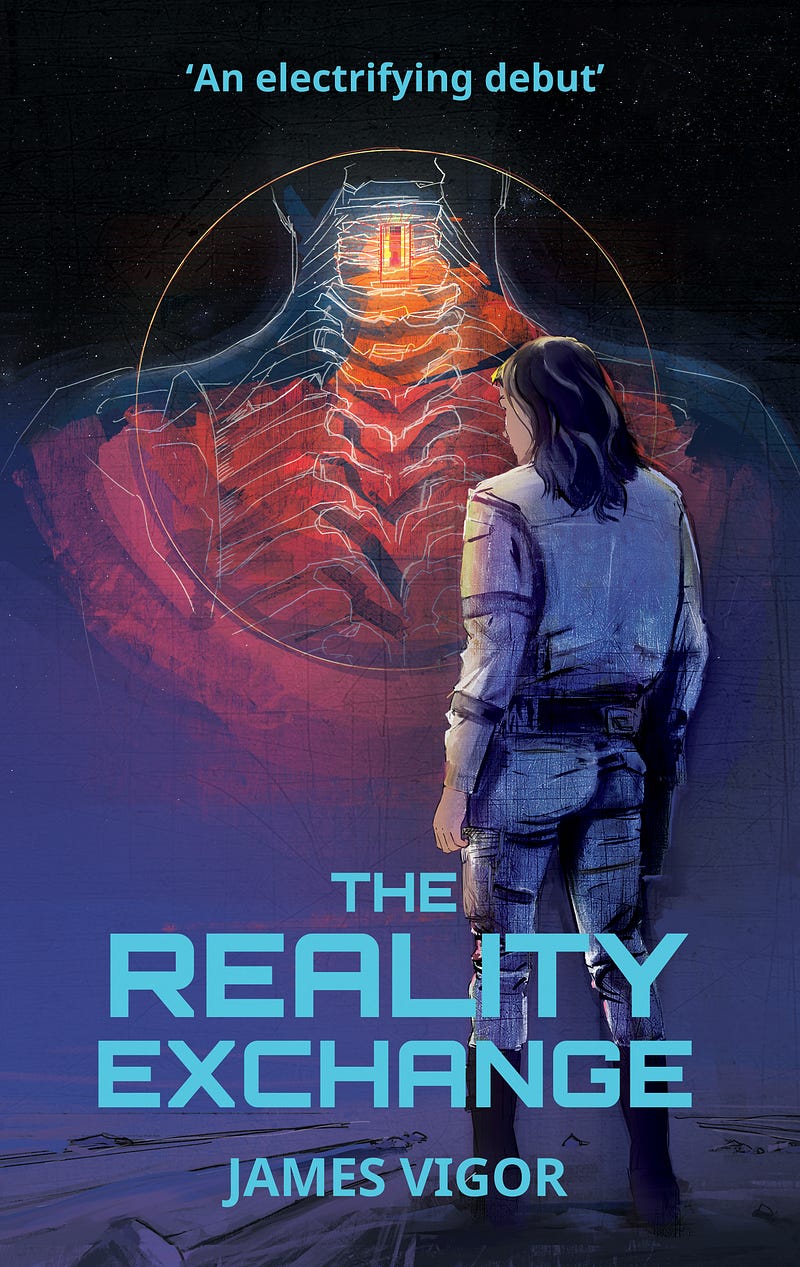
This being James Vigor’s first book, I had no idea what to expect when I picked up The Reality Exchange. I found it written with a light touch that made it an easy read.
The main character, Winter Starling, is nowhere to be seen as the book opens. We see a group of border security guards at a spaceport heading towards the end of their shift. It’s not the routine day’s end they’re hoping for, but Winter Starling has no part in the ensuing chaos, indeed no interest in it, except in as far as it inconveniences her own plans.
The way Starling is introduced gives the perfect picture of a young woman wrapped up in the minutiae of her own life, uninterested in politics or the wider world. She lives at home with her parents but is carving her own niche, well aware that it’s not something her family would approve of.
I liked that Starling bucked the trend for young people at the centre of space adventures — space travel is not on her bucket list, she’s happy on her own planet, her ambitions go little further than the next deal, she lives for the day — and as it turns out, she has good reason to live her life this way.
But I’m not reviewing this book — not as such — which is good for me because I don’t feel constrained by the usual boundaries of a book review. And anyway, I can’t better the reviews linked below.
I’m diving into specific aspects of the spotlight books for Fantastic Books Publishing’s
For in-depth reviews of The Reality Exchange, I recommend you read fellow authors Stuart Aken here:
And Mark P Henderson here:
This is the way I want to travel through space
Humankind has been creeping closer to large-scale space exploration for decades. The idea of traveling to a distant star system has always appealed to me but as I’ve pretty much hung up my travel boots when it comes to long-haul terrestrial flights, I don’t think I could cope with the physical rigours of space travel.
That is… until I read the way that James Vigor envisaged it in The Reality Exchange.
It was the way that this aspect particularly intrigued me that prompted me to ask James Vigor this rather convoluted question:
Winter Starling’s views on immersive virtual reality will chime with a lot of people. She’s tried it, but doesn’t care for it, though of course there comes a point where it’s a level of escapism she realises she needs — not to mention she gets no choice.
I found that the way you used immersive virtual reality in long-distance space travel was one of those ideas that feel obvious once explained, but not something I’d have thought up for myself.
The way you presented it, it felt like something credible even if we’re a way off being able to do it. Do you think it could become a reality?
I was pleased to get a comprehensive reply confirming my belief that this was an area he had really thought through:
There was a time not too long ago that I might have been sceptical about the future of VR. Shortly after the release of the first mainline commercial VR headsets — the Oculus Rift and the HTC Vive — it began to feel like the price of entry was too high and that the industry wasn’t taking it as seriously as it should. I was worried for a while that it would all just fade into obscurity, and we would look back on it as just another fad.
While those issues haven’t truly gone away, I think VR is over the hurdle now. Standalone VR headsets are cheaper than current generation games consoles. There are plenty of things that can only be experienced in VR that I would heartily recommend everyone to try. It really does feel like something special.
In The Reality Exchange, the technology is incredibly advanced. It provides sensory input directly to the user’s brain and gives them full, natural motor control over a virtual version of their own body, all while leaving their real body motionless and unconscious, paired with a form of suspended animation that keeps them healthy and protected over several weeks of space travel. I certainly couldn’t speculate on whether we will ever see virtual reality reach such incredible levels of immersion, nor do I have the kind of education to speak about the future of suspended animation, but my short answer to the question is absolutely yes!
Given the state of technology today, I believe that this kind of usage of VR is not only plausible, but inevitable. In The Reality Exchange, it’s essentially a form of travel entertainment. We already have cars with screens built into the seats so people can watch films or play games while they’re on the road. It doesn’t feel like a stretch to think that VR headsets could be included in a particularly luxurious package. Perhaps this would be something seen more on planes, where journey times are longer and motion sickness is less of a concern.
VR is being used all over the place already. There are all sorts of things, from exhibitions to theme park rides, that use virtual reality as a way of enhancing the experience by drawing people into immersive new worlds. I don’t see any reason why we couldn’t see VR used as a way to ease the tedium of lengthy travel times today, with a high enough budget.
Virtual reality technology is really still in its infancy. I’d love to think that one day, we’ll be able to dive completely into a whole new world, the way Winter does. She had a pretty rough go of it the first time, but I’m sure even she would agree that there’s something wonderful about it.
Thanks, James, I’m sold! I’ll take the first spaceship with fully immersive VR and a ticket I can afford.
MABLE 2022
Both The Reality Exchange and James Vigor are in the spotlight during this autumn’s online MABLE 2022 event that will run during September and October. Do sign up. It’s free and you’ll have the chance to chat with the authors.


