
Penny for your thoughts: Copper-based electrolytic memristor neural network, Part 4
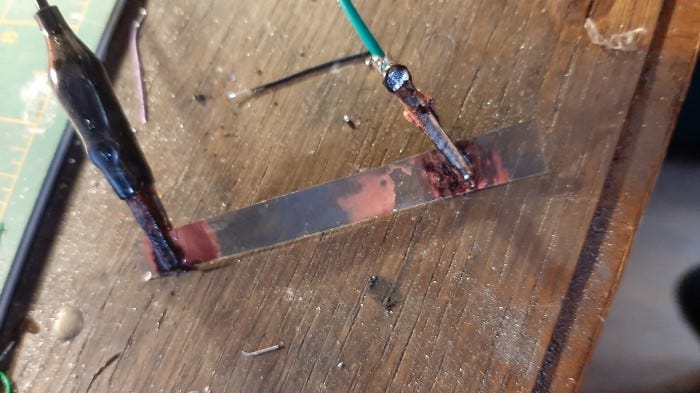
In this update, I layout the design for a SUPER simple memristor based neural/dendrite system based on my electrolytic memristor design.
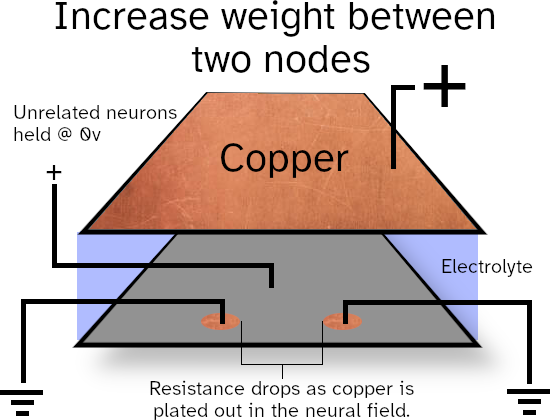
Copper plates out quite nicely in a copper sulfate solution, on a continuous resistive surface, will grow to cover the space between two connections. This creates a VERY simple electrolytic memristor, as you can alter the extent of the copper (effectively 0 Ohms) vs the extent of the resistive surface (mine ~8kOhms/cm). This allows the resistance to change with current flow until the copper is in equilibrium as the copper will plate on copper much easier than extending the edge. With a third electrode, the amount of copper in the system can be modified… meaning, for our neural network, that we can tune the resistance between two nodes externally, or via memristor activity. My experiments have shown some promise, and I now believe I can scale up my neural network design to a 2d grid, which does leave open the possibility of a 3d network at some point.
You can read about the basic theory in my first article: An Experimental Open-Source Memristor/Programmable “Diode” I created some neural networking application ideas and further in experiments in my second article The Crafted Mind: Building an electrolytic memristor neural network, Part 2 Then I created a version of the cell using copper on graphite coated PETE plastic in Penny for your thoughts: Building a copper-based electrolytic memristor neural network, Part 3
Step 1: Establishing a Neural Grid
This update is to highlight some of the techniques I plan to attempt in the next few months. The first is to create a grid of neurons on a sheet of PETE plastic. Each connection point will represent a dendrite connecting to a neuron.
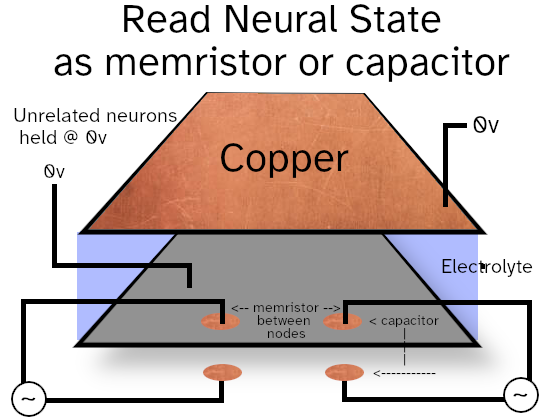
Reading values
I have two strategies here, and I’m not sure which I prefer:
- Use the connection between the two endpoint neurons as a memristor — so current flowing from the left side will force ions to migrate the right side. This is the original purpose of my memristor. “Far away” neurons are effectively too high of resistance to matter when current is flowing. granted ions will go where they go, but that gets into my last section “myelin”/insulation
- Or, use an additional metal disc on the opposite side of the PETE to create a capacitor, and use that to modulate a sine wave like an LC circuit. I’m not sure that’s useful, but it seems like it might have some interesting side effects. Mainly, that if I combine multiple such frequencies together, I might use the output peaks as my trigger for my activation function using a band-pass filter.. sorta. Just kind of an idea of other ways to use this.
Myelin/Insulation
An important property of neurons is that the signals are insulated from randomly passing through the intracellular medium (“electrolyte”) of the brain. In your body this is done with myelin. In our cell, I’m thinking we only have a single output from a neuron acting as the input to our grid, and then multiple outputs. This way, the relationships between this neuron and other sibling neurons in the same layer are isolated. With some caps and resistors, we can electrically isolate them as well.
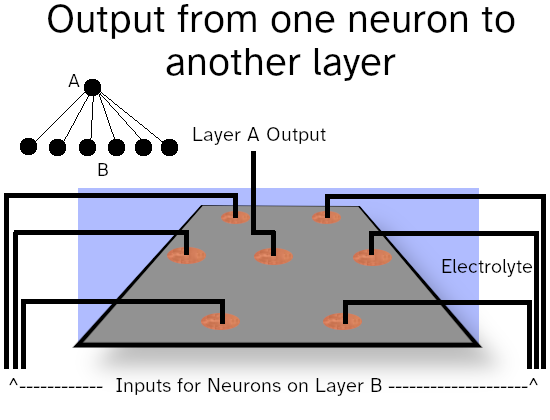
So, this is a SUPER simple way to create tunable connections from a single neuron in layer A with a number of neurons in layer B.
Back-propagation
I think, because of the way I designed the bulk plate/strip feature of the overhanging copper plate, I can accomplish back-propagation very easily — reverse the polarity on all the dendritic cells for a brief time to unload some of the copper and increase resistance. Retrain/reload as needed.
Integrated chips
I believe with this method of plate/electrolyte/resistive panel and carbon electrodes, it might be practical to create a “neural chip” with these features. if part of the chip integrates the activation function capability (opamp?) then creating a neural network quickly and cheaply is definitely possible. With some FLASH ram/rom, you could even “save” the values in the network, unload/reload or mass produce them.
Next Step: Activation Function
I’m going to brainstorm some activation functions, from a simple opamp adder to my frequency idea. I suppose a prototype is needed.
Another Idea: Computer Memory
Just sort of realized that the plated copper between two leads could be used as computer memory. Each cell could be one byte of data. This might be a fun experiment for prototyping the plating process… or build that copper tube with two leads and resistor and just make a one-bit component. a “Binary” memristor.
Side Effects: Electrolytic Variable Capacitor
Reading some other articles about AM radios — I realize I might be able to use this technique (the pads below the memristors) as a tunable variable capacitor. You could even roll the whole mess up like an electrolytic, with an extra lead to “add” or “remove” capacitance. I suppose you could do this on both sides, instead of having just one side plating out.