
Penny Candy, Portraits, and Swastikas
David and the Lion’s Den , chapter 14
Kevin reached out a hand and laid it on my shoulder. “Excellent,” he murmured.“I haven’t defended an innocent client in a very long time. What a refreshing change of pace.”
We trooped down to SoHo en masse to see my paintings hanging in Renaud’s show.
I absolutely didn’t plan to.
Last thing on my mind. After Kevin finished talking to me, he got with Hilda, Richard, and Jill to record all their memories and impressions on that yellow pad of his. Then the subject of my paintings came up.
Kevin was adamant. “I’m going to need to see them as soon as possible.” He started counting on his fingers. “If I’m understanding right, you’ve got 6 or 7 back at the apartment?”
“Not anymore,” Jill growled. “They tore the place apart the night they arrested him. Took all his canvases and supplies. Mine too!”
I felt like she’d punched me in the stomach. They took my paintings? I was furious!
“Richard looked me in the eye and put a hand on my shoulder. “Why don’t we go down the gallery?” he suggested.
I convinced Mom and Dad to leave the rental in the garage with Kevin’s sedan. Parking isn’t even theoretically possible in SoHo. Richard offered to take Hilda home, but she insisted that she wasn’t too tired to come along. If only she’d been more reasonable.
I was beyond tired, floating in a sleepless dream state, vibrating with caffeine, out-of-body numb.
Renaud bustled over to the door when we walked in. He looked ridiculous in a black turtleneck and beret — shocked, yet deliriously pleased to see me, a little black bowling ball of oh-so-concerned enthusiasm.
“David, mon pote,” he gushed, air kissing both my cheeks, looking me up and down as if inspecting a prized possession for damage. “Such news we have of you! So tragic.
“And look at you,” he murmured, shaking his head. “You’ve dressed up for the show. How very… quaint.”
Mom had run down to the boutiques in the lobby while I showered. So, I was wearing chinos and a button-down oxford. I was strongly considering incinerating my boat-party outfit.
I was out of place in the packed gallery. As we worked our way in, introductions in full swing, I eyed the crowd nervously. Your normal mix of working artists in paint-splattered jeans rubbed shoulders with edgy, vintage-clad hipsters, power-suited patrons, and eccentric party-circuit types who you have no idea why they’re there, but you see them at every opening. They probably come for the free cheese and Prosecco.
I must have looked like a student touring the City with Mommy and Daddy. At least that’s what I worried about.
I shouldn’t have.
All the local TV stations had been blaring my story for two days. I made the front page of the Post. I was the baby-faced monster painter who killed for his art, who sidled up to the weakest and neediest with promises of succor and support, then poisoned them just to watch them die.
This explains Renaud’s delight at my arrival.
You see, openings are never about the art. Most of the time it hangs on the walls or sits on plinths looking lonely and abandoned, a date cast aside for a newer, more fascinating companion. Openings are about seeing and being seen, about being in the scene. They’re about what current gossip can be verified or shattered, about whose career is about to be made or destroyed, about anything, really, except honestly, deeply, and critically thinking about what’s supposed to be the evening’s showcase.
I keep sounding bitter about the art world, I realize, but I’m honestly not. I dislike certain parts of it, is all, and the seeds of my distaste were planted that night.
Let me explain.
Renaud had brought together an eclectic mishmash — examples of art from across a broad spectrum of disciplines. His only common theme was HIV/AIDS, although as I remember, the connection was tenuous with some of the pieces.
Keith Haring’s graffiti line-figures shared wall space with surreal, hazy photography, high-concept textual art, cartoon sketches, and with traditionalist painting — not only my own. Sculpture broke up the open floor, some of it less than obvious about what it had to say.
I had to pull Mom back before she tossed her Benson and Hedges into an urn. “Mom, um … that’s not an ashtray.” I was pointing out the white card on the pedestal that identified the artist when Renaud cruised by and tossed in one of his stinking Galois.
“I think you’re supposed to,” Jill groaned, rolling her eyes. “Look.” She pointed out a scattering of butts at the bottom of the common-looking vase, some of them still smoking.
Mom laughed and added her slim filter tip to the mix. “Dave, honey, you know what this is, right?”
I shrugged.
“Remember poor Uncle Harry? This is the same cremation urn we put him in.”
Conceptual art.
It’s not actually the work itself that’s the art so much as the concept behind it. It’s mostly not about beauty. It’s the communication that counts. The aesthetic lives, if anywhere, in the thoughts and emotions the piece evokes in the consumer. So goes the theory, anyway.
I’m a painter and a sculptor. What would I know?
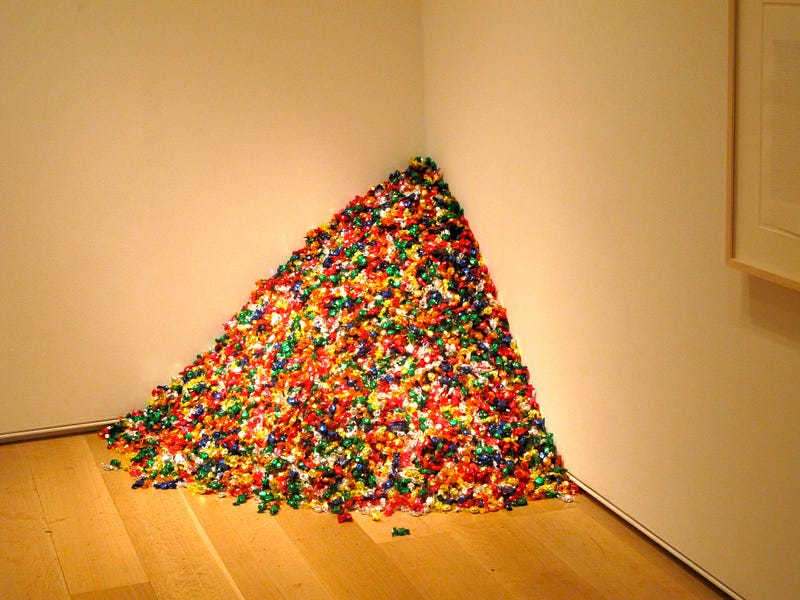
“David, Liebchen,” Hilda interrupted. She’d been hanging onto my elbow, swaying a little. “What is this pile of candies and bonbons in the corner?”
We were working our way through the crowd. I could barely make out what she meant. Then, right before Keith Haring shook my hand, the sea parted briefly, and I spotted a mound of penny candy heaped chest high against the back wall.
“David, there you are!” Renaud’s voice broke in as I watched a woman in a bizarre straw hat pick up a sourball and unwrap it. “David, s’il vous plaît. Je vous présente M. Keith Haring. Mr. Haring, please. David Martin.”
Hilda let go as I reached out to grasp the hand of a tall man, reedy and angular with messy dark hair and a warm smile. Some force deep inside my fatigue buzzed in silent stress. If I hadn’t been so dead, I’d have been terrified. “Pleased to meet you,” I said, numb. “Please call me David.”
“I’m Keith,” he rumbled in an unexpected bass. “Listen, I’m glad you could make it. I saw your paintings last night and I’ve been wanting to talk to you. They, uh … They’re …”
Renaud broke in. “Not just en ce moment, boys.” He grabbed Haring’s elbow and shouted across the room. “Felix! Over here!” Then he pulled us toward the candy mountain. “Come, Felix! I have them now together.”
He wanted photos.
He posed the three of us — me, Haring and Felix Gonzalez-Rodriguez — against the pile of candy that was Rodriguez’s concept piece. We smiled for the birdy underneath some of Haring’s stick-figure works, then finally up against a wall where I spotted my own canvases hanging.
Each time we stopped and posed, Renaud’s photog waved a light meter around and assaulted us with blue flashes. It didn’t take long for more cameras to join the pack, so by the time we were through, I was pretty well blinded.
I heard my lawyer sounding loud and firm on the subject of “no interviews,” as I blinked, trying to focus on my paintings. This was my first real show. I wanted a moment to feel proud of myself, to take in my work hanging in an authentic SoHo gallery.
I heard Keith’s voice in my ear as the dazzle faded and my vision cleared. “I like the idea of the salon hang. It forces your attention to the central portrait and highlights the textual element.”
Textual element? I had no idea what he meant.
“But what I don’t understand,” he went on, “is why you decided to conceptualize at all. Your painting is haunting. I cried when Renaud showed me. Don’t you think it stands on its own?”
Kevin distracted me for a minute, pushing himself between me and a woman with a notepad. “I said no interviews. I’m afraid I really must insist.” With my lawyer shielding me bodily from the crowd, I finally got a good look at the wall.
I sucked in my breath and glanced beside me to confirm that Hilda was still there. Her portrait glowed in the center of random cluster, warm under carefully placed lights. My other pieces surrounded it at staggered heights and distances — a salon hang.
But what was that odd poster board? I squinted as Hilda grabbed my arm and hissed, “Mein Gott!”
They outnumbered my paintings — cream-colored posters the size of my canvases, covered in bloody Gothic print. As I watched Hilda reading the text on one of them, I stepped back and craned my neck to take it all in.
I gasped when it snapped into place for me.
A swastika.
Hilda’s portrait anchored the center. The posters made up the arms, and four of my paintings served as the termination point of each crooked branch.
And to think I’d taken it for a casual salon hang!
Hilda went bone white. She shook like a bird in my arms.
Keith’s voice sounded in my ear. “Oh, my God. You didn’t know. You must be furious.”
I rapidly scanned the ornate, majuscule script.
… Born in Vienna to a wealthy …
… raised in the elegant privilege afforded to …
With the Anschluss…
… selling herself to the Harbormaster mere days after the miscarriage …
I turned to her. “Hilda! No! I swear I had no idea. I promise you that Renaud didn’t get this stuff from me.”
She made an incoherent noise as Richard appeared to grab her other arm and steady her. He went pale faster than she did.
Keith kept talking in my ear. “David, your portraits are very moving. Beautiful and painful. I’m so sorry Renaud did this. He’s always been a bastard.
“But, look,” he went on, pointing three times at three different canvases. Beside each one was a little red circle, a peel-off label like you find at office-supply stores.
Keith chuckled darkly. “He may be a total whore, but he sure knows how to sell art. You just have to love to hate him.”
Each red dot represented a sold piece. Somebody, or maybe more than one somebody, had bought my paintings! I enjoyed a guilt-laden glow until Kevin grabbed me. “All right, enough. The art press is bad enough, but the crime beat is figuring out you’re here. Let’s get out before it gets too insane.”
As if it wasn’t already too late for that.
You just read chapter 14 of a character-driven mystery set in Greenwich Village during the worst of the HIV Plague Years. David, Jill, Hilda, Richard, and Howie — and Raphael — are walking a path that leads to intense friendship and love, to the creation of gorgeous but wrenching art, and to the unraveling of a series of horrific events that nobody sees, not even as they happen.Because sometimes what you’re looking at isn’t what you see.