avatarDr John Frederick Rose

Summary

The Pennsylvania Railroad's K5 4–6–2's were experimental steam locomotives designed to improve upon the K4s, with two prototypes built in 1929, ultimately leading to only moderate success and no further orders due to the Great Depression and the railroad's electrification efforts.

Abstract

The Pennsylvania Railroad (PRR) developed the K5 class of 4–6–2 "Pacific" type steam locomotives in 1929 as an experimental successor to the K4s, which were struggling to handle the increasing weight of passenger trains. Despite being more powerful, the K5's lower factor of adhesion hindered its effectiveness, as it was prone to wheel slip. Although the two K5 prototypes remained in service, the PRR did not proceed with additional units, largely due to the economic impact of the Great Depression and the shift towards electrification. The K5's were among the last steam locomotives developed by the PRR, with subsequent projects focusing on duplex and steam turbine designs before the transition to diesel.

Opinions

  • The K4s were deemed insufficient for the heavier trains of the mid-1930s, often necessitating costly double or triple heading.
  • The K5 was an attempt to increase efficiency by eliminating the need for multiple locomotives, but it was constrained by strict budgetary objectives.
  • The factor of adhesion was a critical metric in evaluating the K5's performance, with a value below 4 indicating potential wheel slip and inefficient power utilization.
  • Despite the K5's moderate success, the PRR's steam locomotive development was effectively halted by the Great Depression and the significant investment in railway electrification.
  • The K5's were considered a qualified success, performing well enough to remain in service but not sufficiently to justify further production.
  • The article suggests that alternative designs, such as the 4–8–2 "Mountain" or 4–8–4 "Northern," might have been more effective than the K5.
  • The PRR's subsequent development of the duplex 6–4–4–6 and the 6–8–6 Steam Turbine Locomotive were seen as magnificent last efforts in steam locomotive technology before the eventual switch to diesel engines.

Pennsylvania Railroad’s K5 4–6–2's.

K5 experimental 4–6–2 “Pacific” type, built in 1929 to replace K4s.
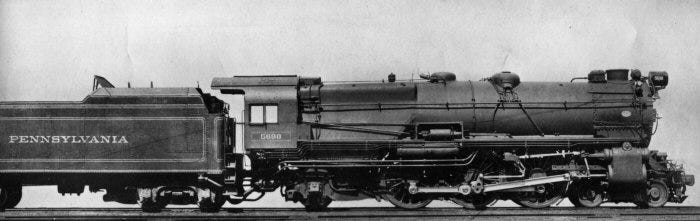
Pennsylvania Railroad class K5 w:steam locomotive #5698. Source: This image has been scanned from a publication entitled Trains Album of Photographs Number 17: Locomotives of the Pennsylvania Railroad, published by Kalmbach Publishing Inc, w:Milwaukee, Wisconsin (the publishers of Trains magazine)., Public Domain, https://commons.wikimedia.org/w/index.php?curid=106932369. This work is in the public domain in the United States because it was published in the United States between 1928 and 1977, inclusive, without a copyright notice.
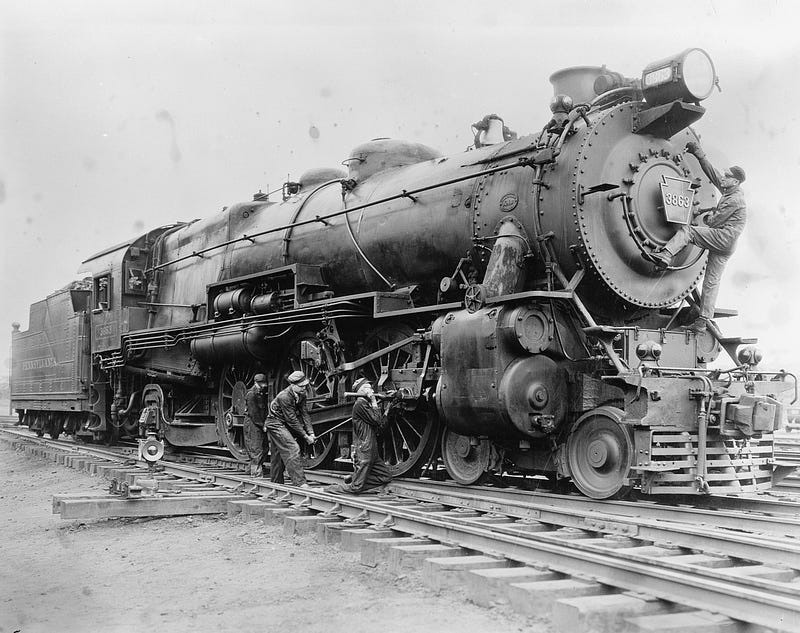
PRR №3863 at Washington D.C. National Photo Company Collection — Library of CongressCatalog: http://lccn.loc.gov/2016823173Image download: http://cdn.loc.gov/service/pnp/npcc/28200/28270v.jpgOriginal url: https://www.loc.gov/pictures/item/2016823173/, Public Domain, https://commons.wikimedia.org/w/index.php?curid=66621909. No known restrictions on publication. This work is in the public domain in the United States because it was published in the United States between 1928 and 1977, inclusive, without a copyright notice.

Pennsylvania Railroad (PRR) K4 Pacific 4–6–2 class, 425 built between 1914 and ‘28, Premier passenger-hauling loco from 1914 to 1957, K5 represents attempt to improve on K4’s.

Motivation to Replace K4.

K4's not powerful enough for heavier trains of mid-1930s, Often required double or triple heading that was effective but expensive, Although PRR had extra locos displaced by electrification desire for cost efficiency resulted in idea of K5 to eliminate running costs of double and triple heading, Meant K5 development subject to strict budgetary objectives.

Factor of adhesion was key in deciding outcome between K5 and K4 classes, Factor of adhesion is weight on driving wheels divided by starting tractive effort, Rule of thumb for factor is slightly greater than 4 is good, Below 4 loco may wheel slip on starting and requires skilled driving, Greater than 4 meant excess weight or insufficient power.

K5 experimental 4–6–2 built 1929.

PRR’s class K5 was experimental 4–6–2 “Pacific”, 2 prototypes built in 1929, No.5698 at PRR’s Altoona works and No.5699 by Baldwins.

Both K5’s fitted with larger boiler than K4's, Same grate area and 80 inch drivers, Here’s comparison table.
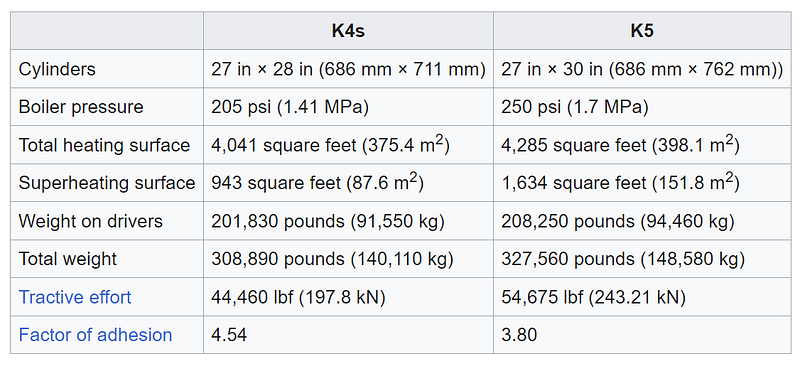
Comparison between K4 and K5 classes Courtesy of Wikipedia.

K5’s factor of adhesion decided class’ fate, K5 more powerful than K4's but needed more weight on drivers, Factor of adhesion below 4, K5 unable to make effective use of additional power.

Either 4–8–2 “Mountain” or 4–8–4 “Northern” designs with more drivers considered preferable alternatives to proposed K5 class.

Two Prototype K5’s in service

K5's were only qualified success, performed well enough to be kept in service but did not persuade PRR to order more.

Great Depression and electrification's huge cost meant PRR steam locomotive development effectively ceased after K5 prototypes, Not quite true as there was duplex 6–4–4–6 and 6–8–6 Steam Turbine Locomotives, Magnificent last gasps of steam in PRR.

Blessed be.

Join Medium with my referral link — Dr John Frederick Rose. Read every one of my stories and thousands of other writers on Medium. Medium uses membership fees to support writers. You’ll also get full access to every story on Medium.

Poetry
Steam Locomotive
Railfan
Pennsylvania Railroad
History Of Technology
Recommended from ReadMedium