
Pay Up or Pave Around: a Garden-Owner’s Guide to the Takings Clause
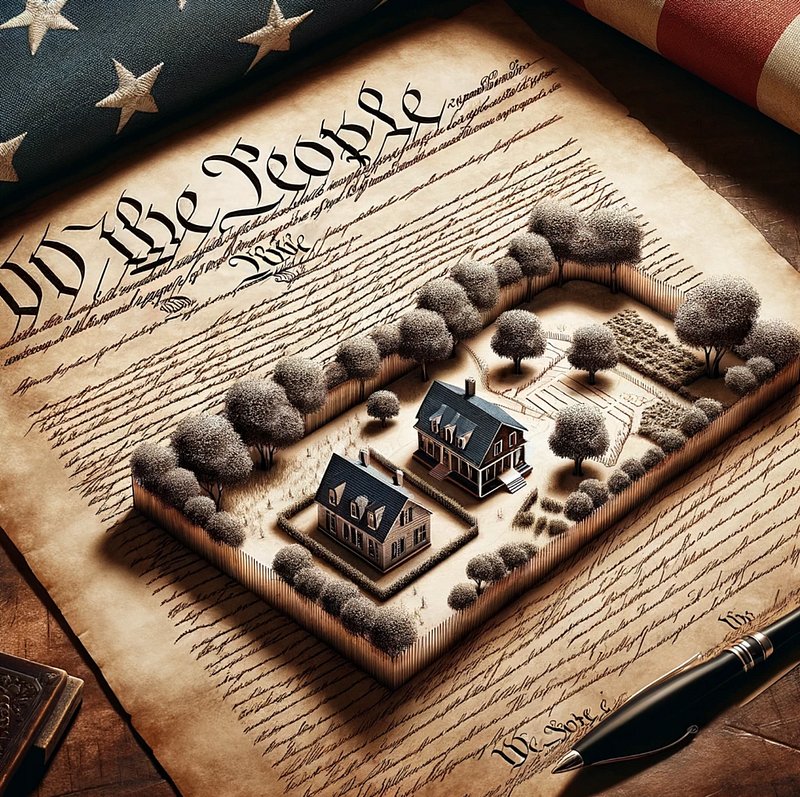
This story is about the Takings Clause of the Fifth Amendment to the U.S. Constitution, how the government can turn your cherished garden into a highway, as long as it compensates you fairly, if you are lucky.
The Takings Clause of the Fifth Amendment simply means that the government can take private property if it needs to use it for something that benefits the public, but it must pay the property owner a fair amount of money for it.
Takings Clause. Amendment V
“…nor shall private property be taken for public use, without just compensation.”
Let’s say you have a small piece of land where you’ve planted a nice little garden. You spend your weekends tending to the flowers and vegetables, and it’s your favorite place to relax. One day, the government decides it needs to build a new road to make it easier for everyone in town to get around, and that road goes right through your garden.
Under the Takings Clause, the government can do this because building the road is considered a public use, meaning it benefits the community as a whole. But the government can’t just take your garden without giving you something in return. They have to pay you “just compensation,” which means they have to give you a fair amount of money for the land they’re taking. This amount should reflect the value of the property as if you were selling it on the open market.
So, while you may be sad to lose your garden, the Takings Clause ensures that you will be fairly compensated and that the government can use the land for a project that benefits of other people.

What Actually Constitutes Property?
Imagine that the government wants to build a new public park, and it has its eye on a piece of land that is currently used as a parking lot and is owned by a company, let’s call it “General Motors.” Under the Takings Clause, the government can take that land for public use (eminent domain), but it must pay just compensation.
First, the Court would determine whether General Motors’ parking lot qualifies as “property” under the law. The Court looks to prior cases regarding property rights under the Due Process Clauses of the Fifth and Fourteenth Amendments to make this determination. Essentially, if the law has traditionally recognized such an item or interest as property, then it is considered property for purposes of the Takings Clause.
So, in United States v. General Motors Corp. (1945) the Supreme Court ruled that when the government had to take a warehouse from General Motors for military use during World War II, that warehouse was property for which the government had to compensate.
Types of Taking
Imagine you have a toy box, and in that box you’ve got all your favorite toys. Now, let’s say the government is like a big sibling with special rules about how you can play with or even keep your toys.
- Possessory Taking. This is like when a big sibling just takes a toy out of your box and claims it as their own (confiscates or occupies), leaving you without that toy. It’s pretty simple — they took it and now it’s theirs. This is similar to what happened in Loretto v. Teleprompter Manhattan CATV Corp. (1982) where the government was said to be taking property in a way that’s easy to see because they physically took or occupied someone’s property.
- Regulatory Taking. Now imagine another where your big brother and sister don’t take any toys out of the box, but they make rules that are so strict about how you can play with your toys that it’s almost like you don’t have them at all. For example, they might say that you can only play with your toy car if it doesn’t move. This rule takes the fun out of playing with the toy car and makes it almost useless to you. This situation is similar to what happened in Pennsylvania Coal Company v. Mahon (1922), where the government didn’t physically take the property, but made it so difficult to use that it might as well have.
When the government does something that impacts your property or the way you can use it, the Supreme Court looks at three main things to decide if it’s a regulatory taking:
- Economic Impact. How much does the rule affect the value or use of your property?
- Investment-Backed Expectations. Did you buy your toy expecting to play with it a certain way, and now you can’t because of the new rules?
- Character of the Governmental Action. What’s the reason behind the government’s rule? Is it something reasonable, like making sure no one gets hurt, or does it feel more like they’re just making rules to control how you use your toys without a good reason?
This way of looking at things was laid out in a case called Penn Central Transp. Co. v. New York City (1978), where the court tried to balance these factors to decide if the government went too far in controlling what could be done with a property, turning rules and regulations into something that felt more like taking away the property without physically taking it.
Private Use in Takings
Let’s continue with our toy box analogy. Now imagine that the government decides that it needs some of your toys, not to keep for itself, but to give to another child in your neighborhood. The idea is that by giving your toys to this other kid, it will somehow make the whole neighborhood a better place to live. Sounds a little weird, right? Well, that’s what happened in Kelo vs. City of New London (2005).
People were divided over whether the government could take your toys (in this case, someone’s property) and give them to another kid (or a private developer), even if it was supposed to benefit everyone in the neighborhood.
The Supreme Court has ruled it’s okay for the government to do this as long as there’s a good reason, like making the neighborhood more fun or improving the area’s economy. The Court decided that improving the neighborhood through economic redevelopment was a good enough reason. They believed that this type of plan could benefit everyone, making it a “public use” of the property.
After Kelo, the rule of thumb became that if the government’s plan to take and repurpose your toys could potentially make the neighborhood a better place, then it’s considered a public use. Courts usually don’t question the government’s reasoning too much, as long as there’s a credible explanation that the plan could help the public.
Just Compensation?
Imagine that your big sibling takes a toy from your box to use in a neighborhood project. It’s only fair that they give you something in return to make up for the loss of your toy. This is similar to what the law requires when the government takes private property for public use. The Supreme Court says that the fairness of what you get in return (compensation) should reflect what you lost, not how much the new kid (or the government) benefits from having your toy (Phillips v. Washington Legal Foundation (1998)).
- Fair market value. Let’s say your toy could sell for $10 in a toy store today. If your sibling takes it for a neighborhood project, he should give you $10 to compensate. That’s because $10 is what someone else would pay for the toy now, so it’s a fair way to measure what you’ve lost.
- Economic Injury. If taking the toy doesn’t really hurt you financially — for example, if it was a toy you never played with and had no real value to you-then the situation might be different. But usually, if there’s a loss on your part, you should be compensated.
- Exceptional circumstances. There have been some special cases, such as during wars, when the government has taken or destroyed property but hasn’t compensated the owners at all. The Supreme Court’s decisions in these situations have been a bit murky. It’s like if, in an emergency, your sibling used your toy to stop a neighborhood flood. It’s not clear whether you don’t get compensated because the action doesn’t count as a “taking,” or because just compensation under those emergency conditions would be considered $0 (United States v. Caltex (1952)).
Disclaimer
The information provided in this article is for informational and educational purposes only and is not intended to serve as legal advice or as a substitute for legal counsel. While efforts have been made to ensure the accuracy and completeness of the content herein, it is important to note that legal principles and regulations can vary significantly based on jurisdiction and specific circumstances. Therefore, this article should not be used as a definitive legal resource or as a basis for making legal decisions. Readers are strongly advised to consult with a qualified attorney for advice on legal issues or matters, as each individual case may require detailed and personalized legal analysis.
Reliance solely on the information provided in this article without seeking professional advice from an attorney may lead to unintended legal consequences or misinterpretation. The author or publisher of this article do not accept responsibility for any potential errors or omissions, nor will they be responsible for any losses, injuries, or damages arising from its display or use. The information provided here does not create an attorney-client relationship between the reader and the author or publisher.