
Pause After “How Are You?” Act Like You Wanna Know!
In Peru, greetings taught me how to put my agenda aside and care about who is talking
We sat down to an overpriced “authentic” Peruvian meal that cost 5 times what you might buy in a restaurant casero, or homemade mom and pop’s type of place. My friend looked especially stunning with her purple coat and silvery hair. I’m not joking, an “order” of corn and cheese, a Peruvian specialty, cost $12 at that place. I thought I should “run to the bathroom” and find a street vendor selling the same thing for the customary $.25. I just gaped discreetly towards my boyfriend who was shaking his head in a way only I could notice, wondering how we’d survive paying the bill since that was only the appetizer! Luckily, my friend ended up paying. She also dished out some of her own thoughts about language, as she was a writer and poet.
“I dislike the polite forms in Spanish. It’s too much about kissing ass,” she remarked. I, on the other hand, like the formality of the language. After getting more acquainted with other types of Spanish, I realized that Peruvian Spanish comes with a large helping of Peruvian culture, calm, unassuming, polite, respectful, and person-centered tones and outlook. If I had grown up in Peru, I might have been a calmer person.
Nevertheless, there are some things about Spanish that allow for a harmonious blending with Peruvian gentility, which are the usted form and greetings. The usted form is the polite and respectful form of “you” in Spanish. Now, let’s get into the greetings.
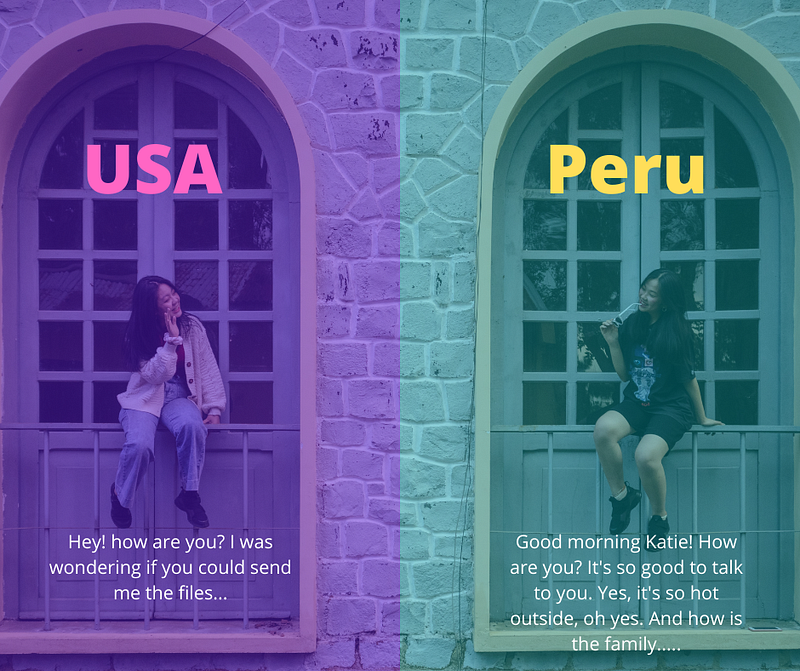
I’ve noticed that in English people are abrupt. Some might call this efficient, others might call it plain rude. For example, a nurse called me this morning to confirm a doctor’s appointment. She said, “How are you?” I replied, “I’m fine, thank you.” But funnily enough, she had already embarked on her barrage of questions. In effect, my answer to her question interrupted her interrupting me.
Her voice faltered like she hadn’t expected me to answer anything after her “How are you?” Then she laughed, “No, not really. Otherwise, I wouldn’t be calling.” First of all, that makes no sense. She was simply calling to update whether I had allergies or was taking medications. Second of all, why ask how someone is if you are certain the person is doing terribly (even without evidence)? Thirdly, if I say I’m fine, why would you argue against it? It’s like saying to someone, “Do you like peaches?” and they reply that they don’t. Then you say, “Of course you like peaches, otherwise, why would you be at the grocery store?” Impolite and also incoherent. I have little patience with that.
I wouldn’t say everyone in Peru is great at customer service. There have been a few times I have walked out of a restaurant because no one came to take my order. However, people tend to be more polite and there is a golden rule in Peru. You greet someone and you wait for the person to give their response. You also say goodbye to someone. In a snapshot, you’d say, “Good morning,” “Good afternoon,” or “Goodnight,” and not “Hello.”
Further, you need to stretch out your goodbyes. If you say, “Ok, great, have a nice day!” that would be rude. You have to say, “It was great talking to you, I hope everything goes well with X, and I hope to talk to you soon. Say hello to your parents for me! Take good care. Bye. Bye. Bye. Bye.” Yes. You do need about 3–4 “byes” at the end.
It seems basic, but in the US, greetings are a matter of habit and usually not a probe into someone’s state of being
For example, if I were in Peru and the nurse had called, the conversation would have gone something like this:
Nurse: “Good morning Miss MJ, how are you?” (Then you pause, make sure the person answers, because, I suppose you asked because you want to know, right?) Me: I’m fine thank you, how are you? Nurse: I am fine, thank you. May I ask you some questions? (Uses a question so as not to be assuming). …..
(towards the end) Thank you for your time, I hope you have a wonderful day. Take good care. (You must wish that their day goes well.) Goodbye. (Don’t hang up until the other person says ‘Goodbye.’
That’s how it might sound in Peru. In fact, it would be better for both of us to have a more reciprocal phone call, and it would be more fun. The times I’ve been laid back talking to a telemarketer or someone in customer support, we may end up having a friendly chuckle.
For example, when I called Microsoft about a product update, between the tap-tap of the attendant clicking around and typing, I heard a few piercing screeches of a rooster. “Time to wake up!” I joked, and we both started laughing. I could immediately picture this person in their house, maybe a small house in a rural area (I guessed by her accent that she could be from the Philippines), with her headset and laptop, helping me solve my computer issues.
Of course, we all are busy. Our lives are stressful and hectic. If we can find one way to connect in a genuinely human way, through laughter, through pausing in our conversation, through a greeting, we will be a little happier. These little things might make things a little bit better, and will help us feel connected.
Thanks for reading!
~MJ


