avatarJeremy Roberts

Summary

The website content details the story of Paul and Linda McCartney's personal connection with guitar legend Chet Atkins, as recounted by Wings' lead guitarist Laurence Juber.

Abstract

The article recounts the musical and personal interactions between Paul and Linda McCartney and the influential guitarist Chet Atkins. It highlights the admiration the McCartneys had for Atkins, evidenced by a handwritten note delivered by Juber during Atkins' concert in London. The narrative weaves through the summer of 1974 when Wings rehearsed and recorded in Nashville, Atkins' influence on the music industry, and the impact he had on other musicians, including the McCartneys and George Harrison. The story is enriched with anecdotes from Juber, who reflects on his experiences with Atkins and the significance of the note, which was later framed by Steve Wariner, a Beatles fan and bassist for Atkins at the time.

Opinions

  • Laurence Juber expresses respect and admiration for Chet Atkins, referring to him as "Mister Guitar" and acknowledging his influence on many guitar players.
  • The author emphasizes the importance of Atkins' role in shaping the Nashville Sound and his successful career as a Grammy-winning artist and a member of both the Country and Rock and Roll Halls of Fame.
  • Juber's recollection of the note delivery indicates a deep level of camaraderie and mutual respect among musicians of that era, particularly between the McCartneys and Atkins.
  • The article suggests that Atkins' mentorship and production work, especially with Jerry Reed and Elvis Presley, were pivotal in their careers.
  • The author seems to appreciate the historical significance of Wings' time in Nashville, noting the recording of "Junior's Farm" and "Sally G." as outcomes of the McCartneys' stay.
  • The mention of Steve Wariner treasuring the note from the McCartneys suggests a reverence for the legacy of the Beatles and the personal connections between music icons of different generations.

Paul and Linda McCartney’s note to Nashville guitar picker Chet Atkins
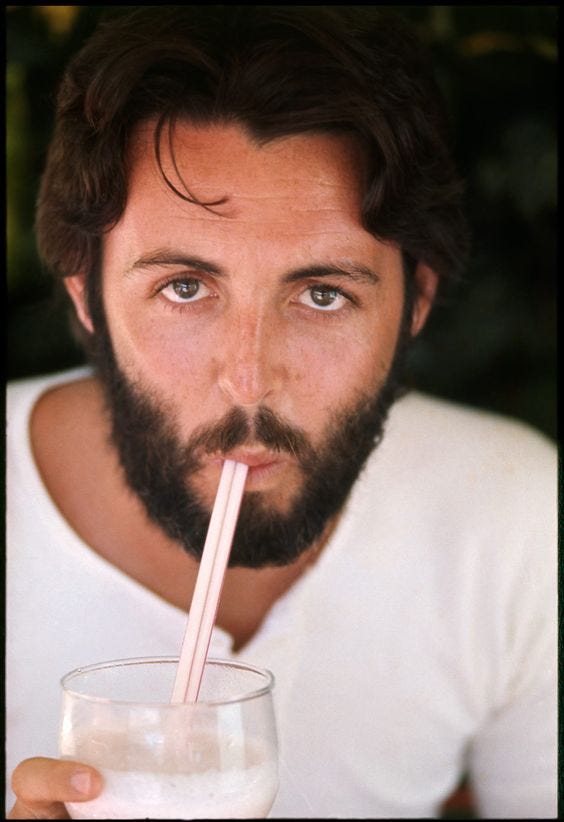
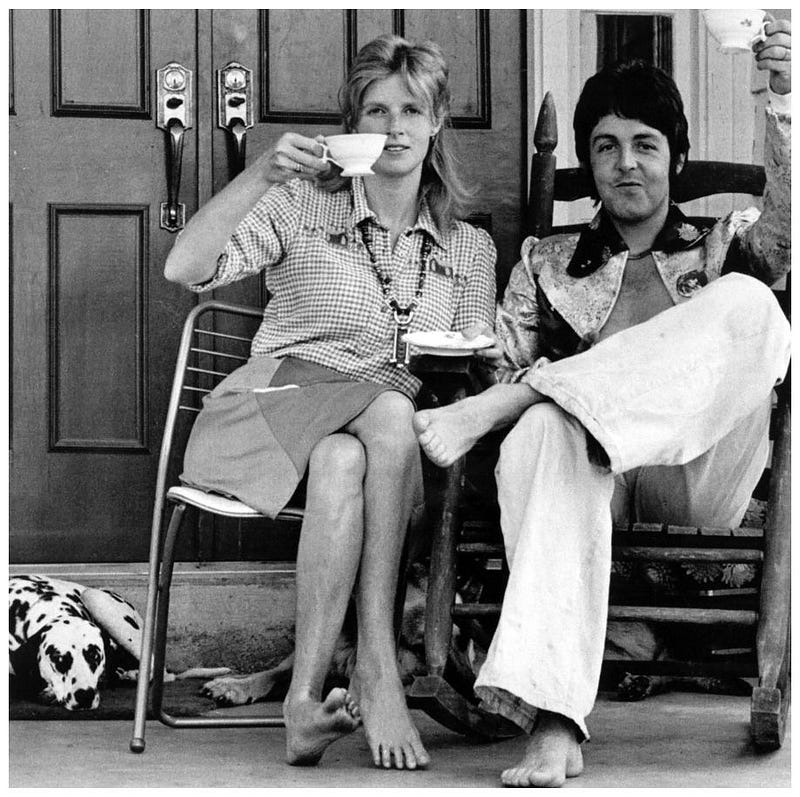
Wings’ final lead guitarist Laurence Juber clarifies whether he really delivered a handwritten note from Paul and Linda McCartney to “Mister Guitar” himself, Chet Atkins. In the world of revolving Beatlemania, George Harrison repeatedly brandished a 1962 Chet Atkins “Country Gentleman” Gretsch hollow body electric guitar onstage. Meanwhile, anyone for a champagne glass filled with milkshake? In the aftermath of the Beatles’ acrimonious split in April 1970, a bearded, albeit very striking McCartney is seen sipping from two straws during a vacation with late wife Linda Eastman and kids Heather and Mary in the South of France. Photography by Linda McCartney / MPL Communications

“Country Gentleman” Chet Atkins influenced countless guitar players over a 60-year career. A multiple Grammy winner and a member of both the Country and Rock and Roll Halls of Fame, he invented the Atkins Style where he used the thumb and the first two fingers — sometimes three — of the right hand to pick a tune on his Gretsch Country Gentleman electric guitar, a customized model adopted onstage by George Harrison, Elvis Presley, and other rock luminaries.

Besides accumulating hit singles “Mr. Sandman” and “Yakety Axe,” Atkins’ forays into jazz and classical brought sophistication to audiences exemplified by Chet Atkins’ Workshop [1960]. “Mister Guitar” pioneered the Nashville Sound which controversially sanded away rough honky tonk elements — fiddles and steel guitar — for pop listeners. He guided Presley’s early RCA Victor trajectory and played rhythm guitar on “Heartbreak Hotel” and “A Big Hunk O’ Love.” As Vice President of RCA Victor’s country division, he mentored Jerry Reed, producing most of the “Guitar Man’s” career-making singles.

With so many accomplishments to Atkins’ credit, it is no wonder that other musicians idolized him. Take Paul McCartney and Wings, the third most successful rock act of the 1970s. When Wings planted roots on “He Stopped Loving Her Today” songwriter Curly Putman’s 133-acre farm in Lebanon, Tennessee — 40 minutes east of Nashville — for a six-week long combination rehearsal-recording session in the summer of 1974, meeting Atkins was at the top of their agenda. An intimate conversation with McCartney about their fathers prompted the duo to tackle “Walking in the Park with Eloise”, a toe-tapping jazz instrumental distributed as a rare A-side.

Five years later Wings was recording inside London’s famed EMI Studios. Fingerstyle guitar expert Laurence Juber had plans to catch a concert by Atkins that evening. Although Paul and devoted wife-keyboardist-backing vocalist-photographer Linda Eastman couldn’t attend, they devised an ingenious method of contacting the legendary picker.

A prolific studio cat — Soul of Light is ideal for a late at night romantic rendezvous— who also routinely wows North American crowds, Juber exemplifies a committed musician who doesn’t bide time by reclining on his laurels. In an extensive four-part conversation featured in this column — check out “Have Guitar, Will Travel: Maverick Wings Axeman Laurence Juber Steps Out” to catch up — Juber sheds light on his long career. The story reaches it finale as the musician humorously recalls his delivery of the McCartneys’ note to the Country Gentleman.
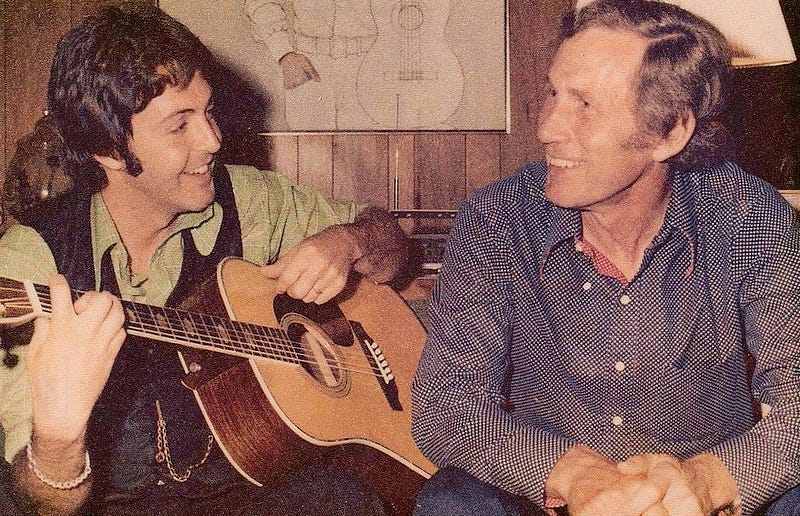
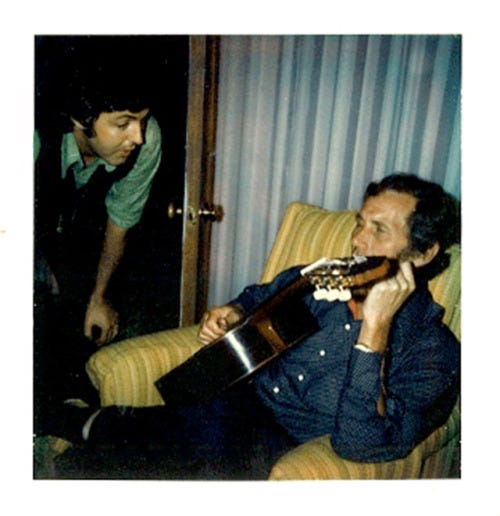
Jamming on an acoustic guitar, Paul McCartney meets “Boo Boo Stick Beat” guitar idol and record impresario Chet Atkins. The demanding bassist was in Nashville, Tennessee, for six weeks [June 6 — July 18, 1974] to rehearse and record with Wings. Shockingly, the former Beatle did not play a show in Nashville until 2010 at the Bridgestone Arena. Photography by Linda McCartney / MPL Communications

The Laurence Juber Interview, Part Four

Did you really deliver a handwritten note from Paul and Linda McCartney to “Mister Guitar” himself, Chet Atkins, in 1979?

Yes [laughs]. I was recording in the studio with Paul and Linda one day. I told them I was going to see Chet later that night, since he was doing a concert in London. As I got ready to leave, Linda exclaimed, “Oh, let me give you a note for him!” So she grabbed the nearest thing, which was a Cornflakes box, and a black Sharpie and scribbled a note on this cardboard box. Then she and Paul signed it.

I then dutifully took it with me to his show. I was very respectful, so I didn’t actually read what was on the note. Now I couldn’t tuck it in my pocket. I mean, I held it for the whole concert. Afterwards, I went backstage and was introduced to Chet. I said, “Chet, I have a note for you from Paul and Linda McCartney” [laughs]. I handed it to him, and he chuckled.

At the time, Steve Wariner was playing bass for Chet. Steve was a huge Beatles fan. Many years later, I ran into Steve, and he said, “Do you remember that note you gave Chet?” I had forgotten all about it, and I went, “Oh my goodness.” He admitted, “I still have the note. I framed it” [laughs].

Chet, knowing that Steve was such a big Beatles fan, gave it to Steve [Terry Wariner, a longtime rhythm guitarist in his elder brother’s band, now possesses the paper]. I thought that was very sweet. I’ll never forget having to clutch that note through the whole concert, then actually handing it to Chet.

Around 1996, I did an all-star guitar night in Nashville where I shared the stage with a number of guitar players. If I remember correctly, I performed “Pass the Buck” and Jimi Hendrix’s “Little Wing.” Chet went onstage right before I played. That was my second Chet experience [Author’s Note: Spotlighting a rare lead vocal, Atkins notched a Top 40 country hit with the comical, Buddy Kalb-penned “Frog Kissin’” in August 1976].
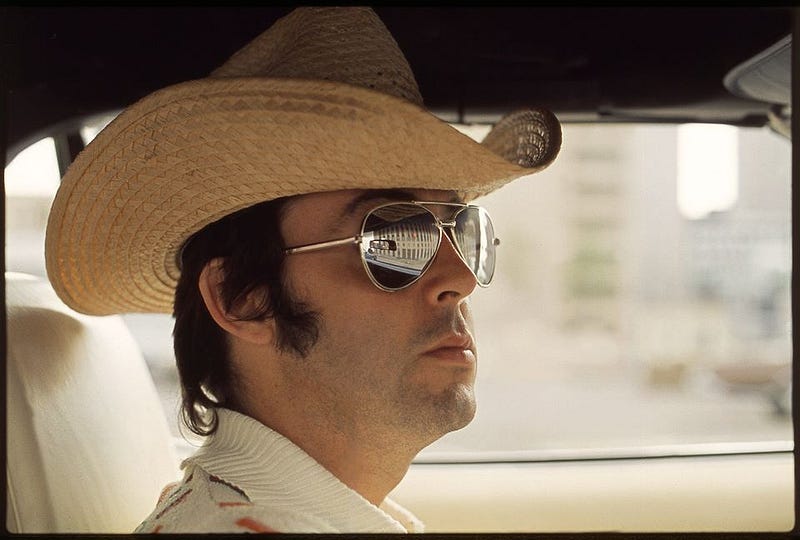
Six weeks in Nashville [June 6 — July 18, 1974] reveal Paul McCartney’s inner cowboy as he sports a curled straw hat and sunglasses during an afternoon drive around Music City USA. Wings, then consisting of rhythm guitarist Denny Laine, keyboardist Linda McCartney, lead guitarist Jimmy McCulloch, and drummer Geoff Britton, were in Nashville to rehearse and record at Sound Shop Studios. McCartney first met Chet Atkins that same summer. Photography by Linda McCartney / MPL Communications
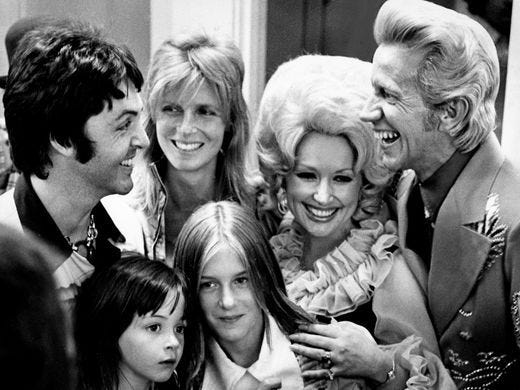
Former Beatle Paul McCartney, daughter Stella, late wife Linda, daughter Heather, singer-songwriter Dolly Parton, and pompadour-sporting balladeer Porter Wagoner chat backstage during the third annual Grand Masters Fiddling contest at Opryland on June 16, 1974. Wagoner and Parton ended their seven year professional partnership that same summer, documented in the “backwoods barbie’s” career-making record, “I Will Always Love You.” Photography by Jack Corn / The Tennessean
Paul McCartney and devoted wife-keyboardist-backing vocalist-photographer Linda Eastman hold court on the front porch of country songwriter Curly Putman’s 133-acre farm in Lebanon, Tennessee, on July 17, 1974, during a highly informal press conference the day before Wings’ six week rehearsal sojourn in Nashville ended. Putman wrote Tom Jones’ tear-jerker ballad, “Green, Green Grass of Home,” Roger Miller’s “Dad Blame Anything a Man Can’t Quit,” Dolly Parton’s “Dumb Blonde,” Tammy Wynette’s “D-I-V-O-R-C-E,” and George Jones’s iconic CMA Song of the Year “He Stopped Loving Her Today.” McCartney penned Wings’ No. 3 POP single “Junior’s Farm” during the summer of 1974 in tribute to Putman’s hospitality and recorded it at Sound Shop Studios. Photography by Robert Johnson / The Tennessean
Paul McCartney leans down to chat with reclining acoustic guitarist Chet Atkins during the Wings leader’s June 6 — July 18, 1974, recording summit in Nashville, Tennessee, that yielded “Junior’s Farm” and “Sally G.” Photography by Linda McCartney / MPL Communications / Beatle Photo Blog
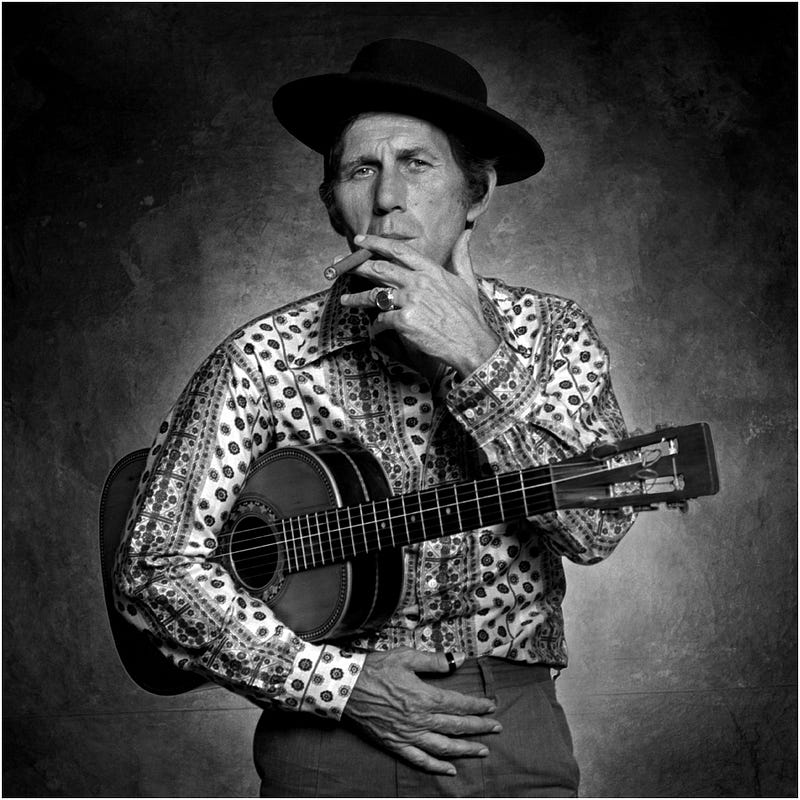
Captured in a Nashville studio in 1976, guitar maestro-record impresario Chet Atkins coolly puffs on a cigar while brandishing an ornate, one-off custom built Martin acoustic guitar. Atkins’ biggest instrumental hits were “Mister Sandman” [No. 13 C&W], “Yakety Axe” [No. 4 C&W], and “Prissy” [No. 30 C&W]. Photography by Jim McGuire / NashvillePortraits.com
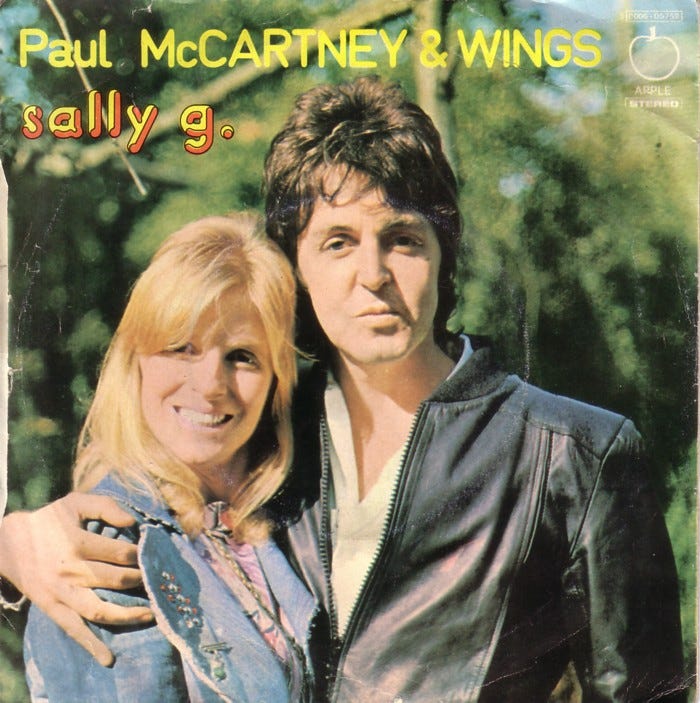
Clad in a black leather motorcycle jacket, Paul McCartney and wife-photographer-keyboardist-harmony vocalist Linda Eastman happily lock arms for the Italian single 45 cover of Wings’ “Sally G.,” the No. 17 POP B-side of the even bigger-charting No. 3 “Junior’s Farm,” dropped on November 4, 1974. Image Credit: 45Cat user Claudio1952 / Apple Corps
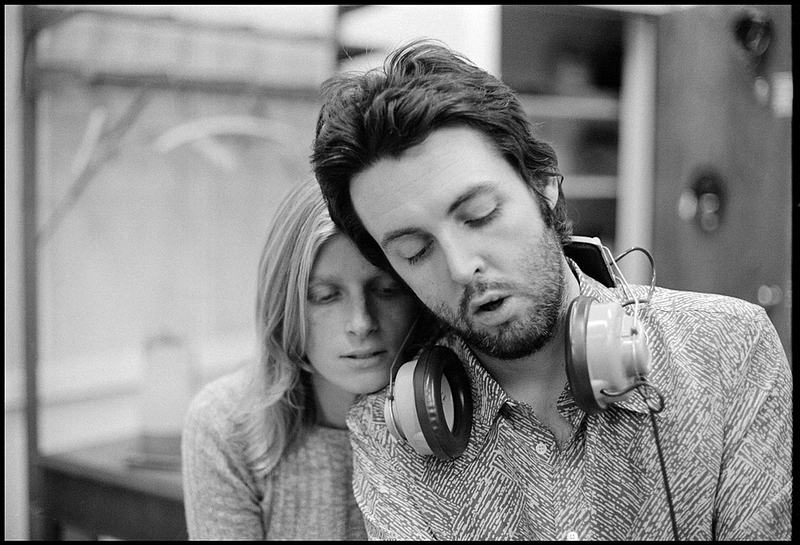
Circa November 1970, a stubble-growing Paul McCartney overdubs keyboards while fetching wife Linda pays close attention during the New York City recording sessions at CBS Studios for “Ram,” the second solo album dropped by the “Eat at Home” songwriter. Image Credit: MPL Communications

© Jeremy Roberts, 2012, 2018. All rights reserved. To touch base, email [email protected] and mention which story led you my way. I appreciate it sincerely.

Music
Paul Mccartney
Nashville
Guitar
Beatles
Recommended from ReadMedium