Patterns of Self
Elin Hughes
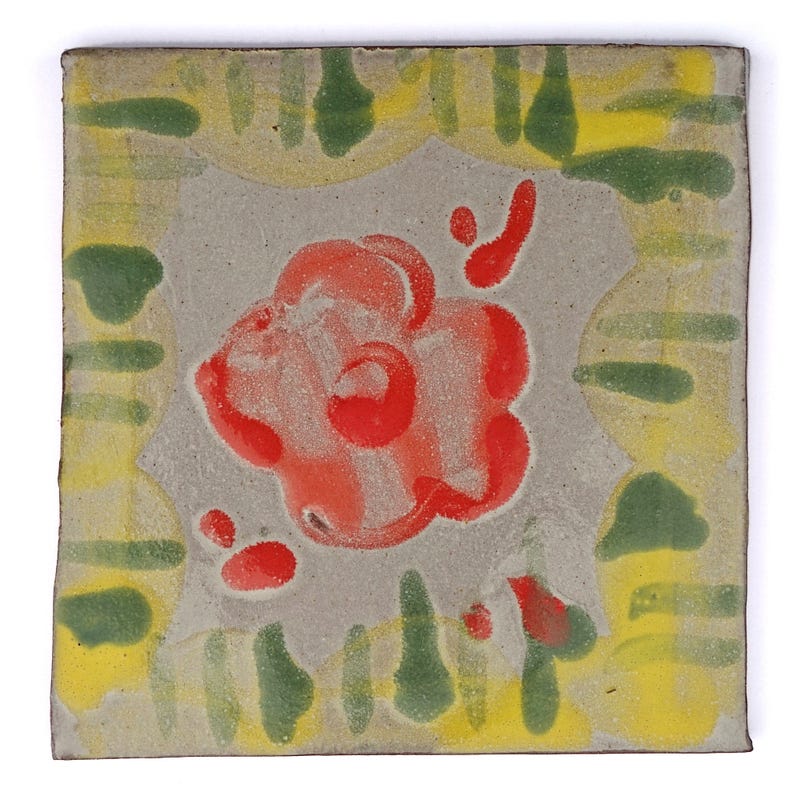
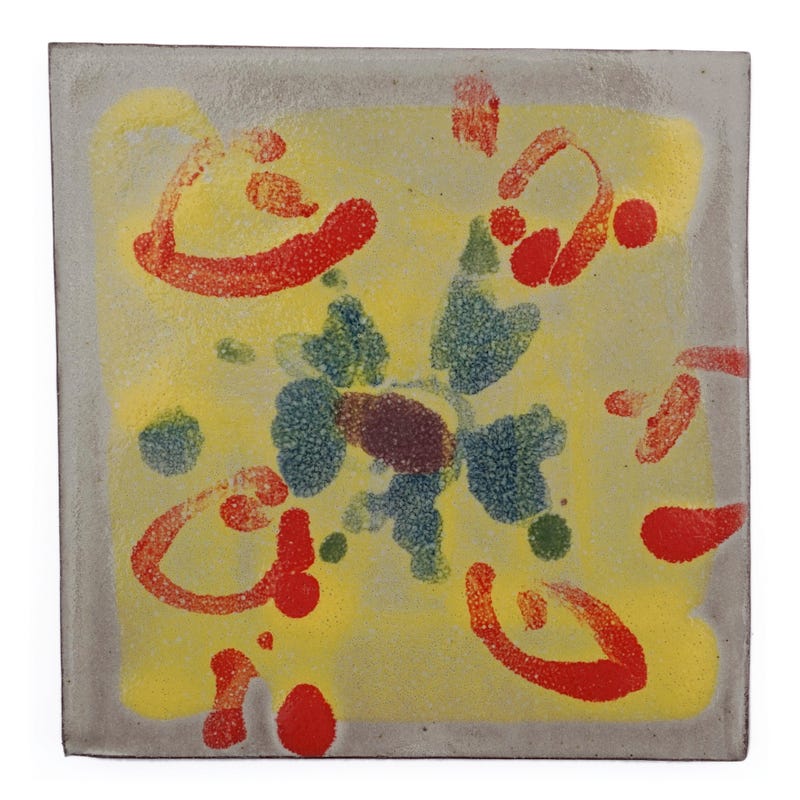
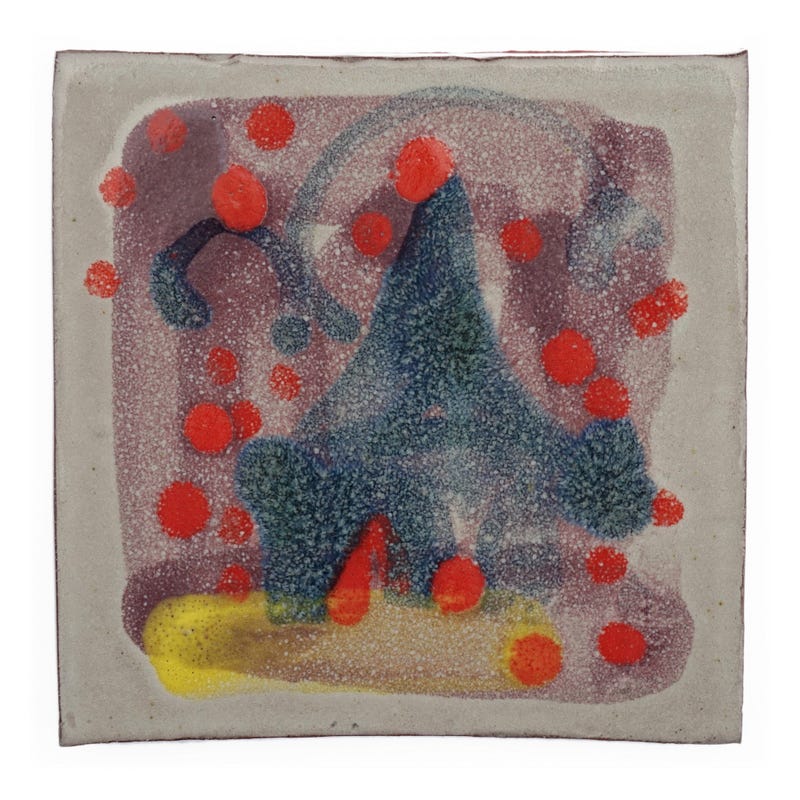
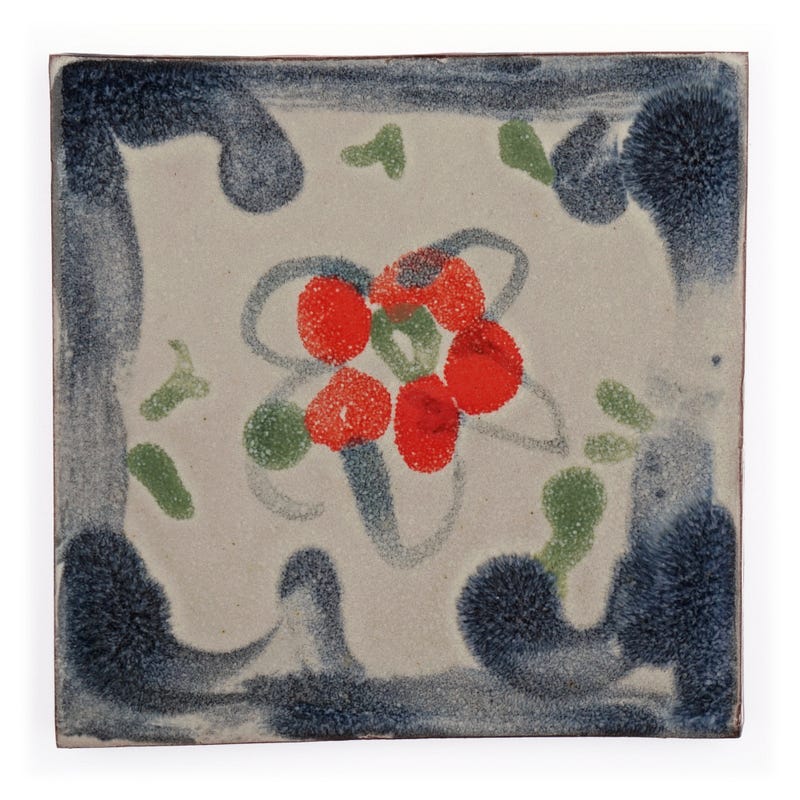
Elin Hughes on ‘Patterns of Self’
Many of us have emotional connections to ceramic objects in our homes. Perhaps a particular souvenir reminds us of a holiday abroad, an inherited set of china may evoke the memory of loved ones or it may simply be a favourite mug that holds just the right amount of tea.
I am a sucker for collecting handmade pottery but my most treasured pot was likely made in a factory in China and is of completely sentimental value. It is a ceramic cup I painted at Narberth Creative Café when I was four or five, a tiny cylindrical toddler’s cup only six centimetres high but to me the purest expression of joy, lack of inhibition and freedom, absolutely unfettered by notions around sophistication, taste or refinement. Bright yellow and purple on the inside, and on the outside green with a blue ear lobe shaped handle and maroon spots and crescents, clustering into constellations of smiley faces. In orange on the base, my name, signed twice. It is the most unadulterated form of abstract expressionism, not made to please anyone but myself, unapologetically garish and vibrantly joyful.
It is this child’s sense of playfulness and spontaneity that I try to celebrate in my making process as a creator of three dimensional objects, manipulating clay to create humorous vessels that celebrate the material’s potential for expression. While working on a project in response to the Aberystwyth Ceramics Archives in 2020, my interest in mark-making with clay developed into an interest in mark-making on clay. It has grown over the past year as lockdown has led to an opportunity for introspection, an attempt to reconnect with my own childhood as I find myself back in my hometown of Dolgellau, North Wales. I realised recently that after studying ceramics for three years, I had more knowledge of Japanese tea bowls and American sculptors than I did of the ceramics traditions from my home country, so it has also been a process of investigating my own cultural inheritance.
I was thrilled, therefore, when a friend introduced me to ‘Gaudy Welsh’ pottery, a Victorian era style made mainly in Stoke and the North-East but widely distributed throughout the Welsh valleys and sometimes, as a consequence, called ‘Swansea Cottage’. There is something endearing about this style of work. Many of the pieces, including a set of sunflower pattern teacups I bought from Ebay, have imperfections, often in the form of running glazes. Their kitsch, tawdry patterns are often pretty chaotic but mimic the cheerful haphazardness of my childhood cup.
The designs are often named after plants or places in Wales and even Dolgellau has its own motif, although why it features festoons of berries is anybody’s guess. I grew up with examples of Portmeirion pottery around the house and those botanical designs on a white background may well have been inspired by Gaudy Welsh, particularly the ‘Welsh dresser pattern’ of our living room fruit bowl.
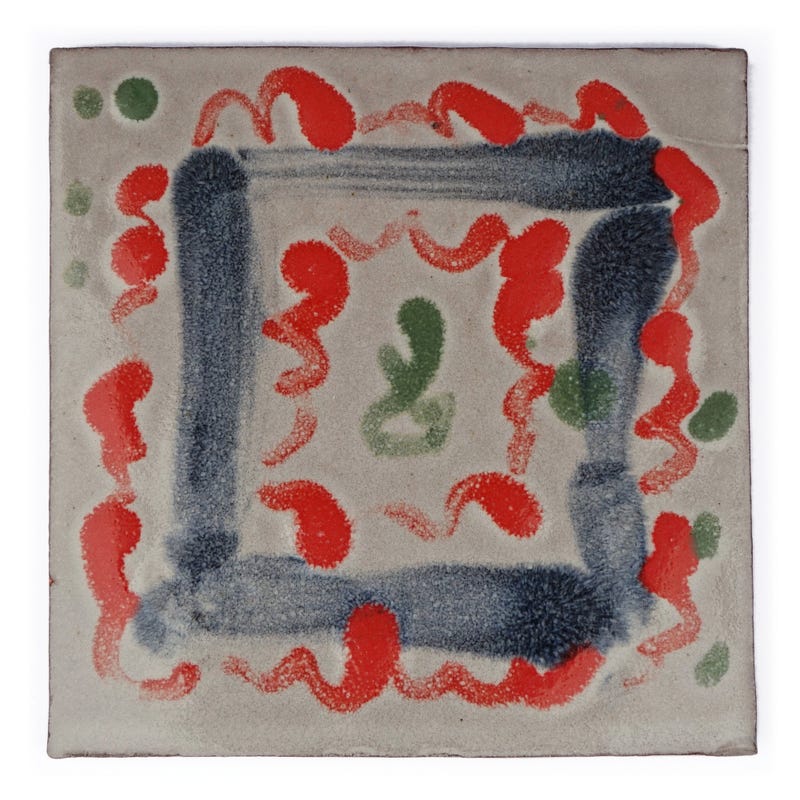
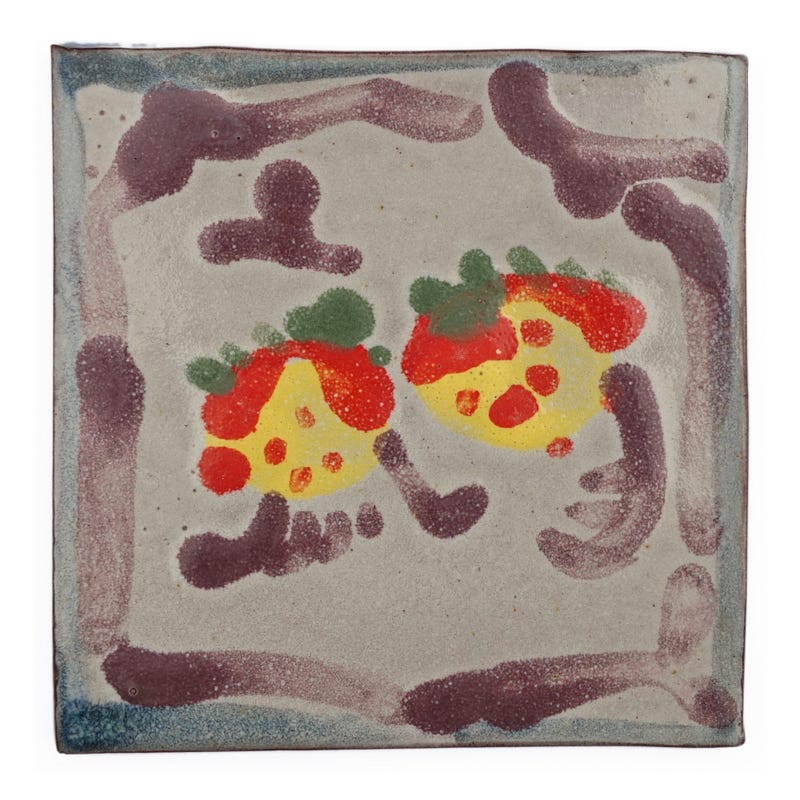
Test tiles to the potter are what sketchbook pages are to the painter. We use them to discover how a particular combination of materials will behave when layered together and to experiment with thickness of application and opacity.
In the case of the test tiles presented here, I wanted to get a feel for how my colour combinations would behave at 1137 °C, and how I could recreate these ‘Gaudy Welsh’ patterns with a fluidity of brushstrokes in preparation for painting onto my fractured vessels.
Gaudy Welsh pots feature vibrant overglazes on a white body, either bone china, or lower down the price scale, cheap earthenware. Visually, it has many characteristics in common with the traditional ‘Majolica’ glazes I have been using — white tin glazes with colourful overglaze that flourished in the Mediterranean around the time of the Renaissance. The name may be derived from ‘Majorca’. It is likely that Majolica glazes were a means of imitating Chinese porcelain, the whiteness disguising the muddy red pauper’s clay of terracotta underneath.
This idea of illusion fascinates me in relation to exploring these ideas around cultural and individual identity. The ceramic vessel has for so long been thought of as symbol for the body and as a result I considered my fractured vessels with their collaged, scarred surfaces as metaphors for how our identities are in a state of transformation throughout our lives, a liberating thought for someone in their early twenties coming to terms with the somewhat oppressively laden memory lane of their hometown. But equally liberating perhaps is the concept that individual identity is an illusion and one which begins to take shape in childhood. The signing of my name on the base of my Narbeth cup was an early recognition of this separateness of self. I make in order to understand who I am but equally I become who I am through the objects I make.
Elin Hughes