
Political Science
Partisanship Drives the American Economic Perspective
Your political affiliation influences how you view the state of the economy. Yes, even you.
W e like to think of ourselves as neutral and impartial decision-makers when it comes to most things: our friendships, religion and political affiliation just to name a few. Of course, most of us also know that while we do get some choice in these matters, other external forces acting upon us can influence what we believe to be true.
This is also the case when it comes to individual perceptions of the U.S. economy.
First, if you’ve decided to dive into any contemporary political science literature in the past 10 years, then you already know that political scientists are obsessed with partisanship and polarization. We hear it all the time. The U.S. is more polarized than ever, both in the electorate and in government.
“Party votes in the House have reached levels not seen since the New Deal.”
Generally, rampant polarization is thought to have started in the 1990’s and has been on an upward trajectory ever since. The two major parties have become increasingly opposite on virtually every issue. Moreover, the number of roll call votes in Congress continue to grow increasingly partisan where there has been more consistent agreement among members of the same party and less agreement with the opposition.
This notion of increasing partisanship seems simple to us. Of course members of the same party agree and fight with the opposition. Sure, but the rate at which this occurs is unprecedented. Academics like Marjorie Hershey, PhD state that “Party votes in the House have reached levels not seen since the New Deal.”
Additionally, the American public shows signs of the same increased polarization and personal attachment to their Party ID. So, I wanted to figure out whether or not the quantified levels of political polarization in the American public translated into perceptions of the U.S. economy.
Hint: It does.
When I say perceptions of the economy, I merely mean whether or not you view the economy to be working well or poorly for the average citizen. In order to find out if someone’s perception of the economy fluctuated in relation to their self-proclaimed Party ID, I focused on what people thought during presidential administrations.
I focused on data from University of Michigan economist Richard Curtin which compared responses from partisan identifiers during both the Obama and Trump Administrations.
The first graph measures the change in economic expectations from June to December of 2008. When Obama was elected president, Democrats scored a 14.20 on the Consumer Index, while Republicans shifted slightly down to -3. This represents a heightened level of economic confidence in the economy by co-partisan Democrats right before Obama took office.
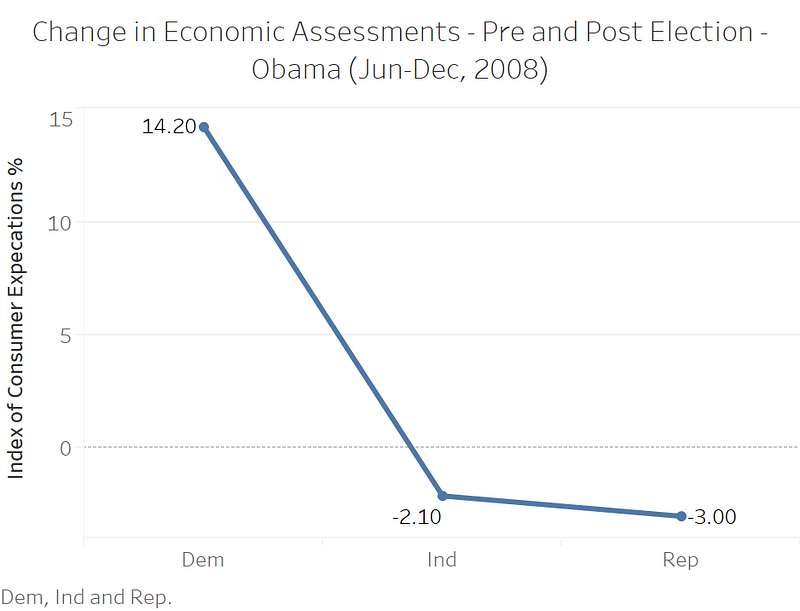
What is striking is how quickly these economic assessments changed even though Obama had not yet become president. These respondents were assessing the same economy, but their opinions changed based on Obama’s election win.
The results of Trump’s election are even more baffling. The graph below measures the change in economic expectations from June to December of 2016 (again, before Trump had assumed the office).
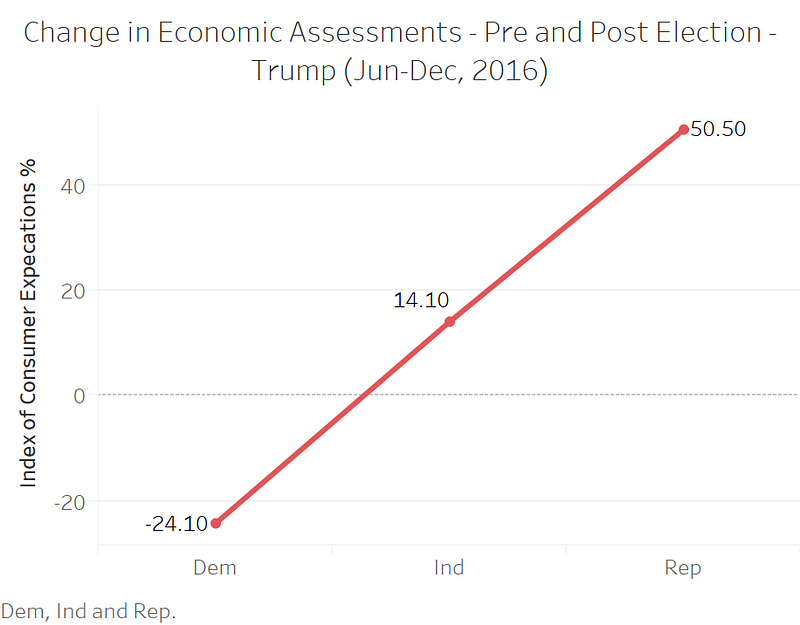
Here, Democrats drop to a -24.10 score, which is a 38.3 point drop from eight years previous. At the same time, Republicans rose to an outstanding 50.50 Consumer Index Score, a massive 53.50 point jump.
The power of party identification is far more telling of the public’s economic evaluations than the actual state of the economy.
The two graphs are virtually the antithesis of one another. How could it be possible that the American public changed their economic assessments so dramatically in such a short time?
Given that both President-elects had yet to assume office during the time of these studies, it isn’t coherent to suggest that these economic attitudes were based in an objective assessment of the economy.
A more reasonable conclusion is that partisans had already changed their economic assessments of the U.S. before any policy was enacted to affect them. Party ID weighs heavier on our minds than many of us would like to admit, and partisanship seems to seep into our own attitudes toward the economy.
So, the power of party identification is far more telling of the public’s economic evaluations than the actual state of the economy. Partisans are getting more and more caught up in whether or not their team wins and it is affecting the ways each of us view a growing number of topics.
It’s more important than ever to keep a close eye on these biases. Our beliefs should inform our partisanship, but it seems that our partisanship is informing our beliefs.
[1] “Chapter 13.” Party Politics in America, by Marjorie Randon Hershey, Taylor and Francis, 2017.
[2] Curtin, Richard. “Consumer Expectations: Politics Trumps Economics.” University of Michigan, 1 June 2017, data.sca.isr.umich.edu/fetchdoc.php?docid=58191.