
Partial Repetitions are Equal to Full Repetitions for Building Muscle
Yes, partial reps count
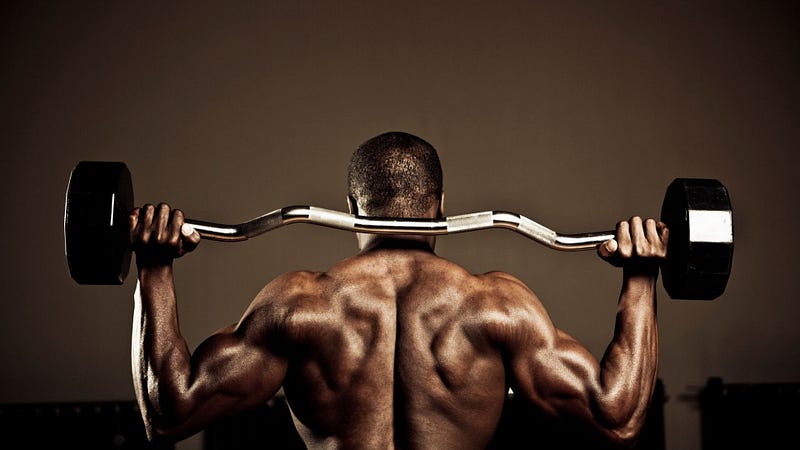
What is the optimal range of motion to enhance muscle growth? There are several considerations and beliefs surrounding this topic.
First, if you are competing in a sport that demands full reps (e.g., powerlifting or CrossFit) then you need to train full repetitions. Strength is developed in the range you train it. Will you develop leg strength with half or parallel squats? Yes. Will you develop strength at the bottom of a full-depth squat? Not so much.
The story changes a little if you are talking about muscle growth. Over the past several years, research has started to accumulate that suggests training at a longer muscle length is needed to maximize muscle growth.
Why?
One potential reason is a muscle produces more force at the end range of motion due to the length-tension relationship of the muscle (getting into the physics of the musculoskeletal system). Another potential reason is time under tension. More time spent doing a full range of motion exercise leads to more muscle development than a partial range of motion exercise.
If you are thinking you can cheat the system by slowing down your movement, research shows conflicting data. You may benefit from slowing down the eccentric phase (e.g., lowering the bar during a biceps curl) but the effects are small. The concentric phase should likely be done as quickly as possible to maximize strength gains.
There is one more consideration, which I will address with a recent study. Could partial range of motion in the lengthened position (e.g., the bottom of a squat or beginning of a biceps curl) lead to equal muscle growth as full range of motion training?
A recent systematic review explored this question.
The trials included in this review were at least four weeks long and they either compared full range of motion training with partial range of motion or they compared two different partial ranges of motion (e.g., lengthened vs. shortened partials). The review included 11 trials (consisting of 297 participants) ranging from 5 to 15 weeks long. Eight of the studies compared full versus partial range of motion.
Overall, the review found lengthened partials and full range of motion training to be superior for hypertrophy compared to shortened partials. When comparing lengthened partials and full range of motion, the results were inconclusive.
What does this study mean for you?
The optimal range of motion to enhance muscle hypertrophy is dependent on your goals and needs. If you are looking to increase muscle size, full range of motion and lengthened partials can both be effective. However, if strength is the goal, then the range of motion should be specific to the desired outcome.
For those in pain (like my patients), partials can be a great training alternative. The lengthened position is often a pain-free range of motion, allowing you to train at a moderate to high intensity without pain interfering. This is a strategy I often employ in the clinic and with my personal rehab.
A final consideration is recovery and potential harm. We tend to see greater levels of DOMS when training in lengthened positions. It is common for trainers and physios to instruct clients to restrict motion and limit the lengthened position (e.g., shoulder protraction during rows or squatting to full depth). The lengthened position is not inherently dangerous, you just need to gradually build up the load and volume.
There is no one-size-fits-all approach. Some people will respond better than others to partial range of motion training. It’s simply another strategy you can employ in the gym.
If you like podcasts, I cover this topic on The Clinical Gap Podcast.