
Part 1. Mastering Open-Source Recommendation Systems: A Comprehensive Blog Series for Beginners and Experts Alike
Introduction to Recommendation Systems: A Comprehensive Guide

In today’s data-driven world, recommendation systems have become an integral part of our digital lives, influencing our decisions on what to watch, read, buy, or even who to connect with. As we kick off our blog series on recommendation systems, we’ll start by discussing the fundamentals of these systems and their significance in the digital landscape. We’ll also explore the various types of recommendation algorithms, including collaborative filtering, content-based filtering, and hybrid approaches.
The Importance of Recommendation Systems Recommendation systems are powerful tools that help users navigate the vast digital universe by providing personalized suggestions based on their preferences, behaviors, and interactions. These systems have become a vital component of many online platforms, such as e-commerce websites, streaming services, and social media networks. They not only enhance the user experience by simplifying decision-making processes but also drive revenue for businesses by increasing user engagement and boosting conversions.
Types of Recommendation Algorithms
There are three main types of recommendation algorithms: collaborative filtering, content-based filtering, and hybrid methods. Each approach has its strengths and weaknesses, and the choice of algorithm depends on the specific requirements and data available for a given application.
Collaborative Filtering
Collaborative filtering is based on the idea that users who have similar preferences in the past will continue to have similar preferences in the future. There are two main types of collaborative filtering:
- User-based Collaborative Filtering: This approach identifies users who are similar to the target user and recommends items that those similar users have liked or interacted with. The similarity between users is typically calculated using measures such as Pearson correlation or cosine similarity.
- Item-based Collaborative Filtering: Instead of finding similar users, this approach identifies items that are similar to the ones the target user has interacted with or liked. The similarity between items is determined based on user interactions or ratings.
Content-Based Filtering
Content-based filtering focuses on the features of items rather than user-item interactions. In this approach, recommendations are generated based on the similarity between item features and user preferences. For example, a content-based movie recommendation system might recommend movies with similar genres, actors, or directors to the ones the user has previously liked.
Hybrid Methods
Hybrid methods combine the strengths of collaborative filtering and content-based filtering to overcome their individual limitations. These methods can be implemented in various ways, such as:
- Weighted hybrid: Combining the results of collaborative filtering and content-based filtering using a weighted average.
- Feature combination: Incorporating item features into the collaborative filtering algorithm.
- Cascade: Applying one method first (e.g., collaborative filtering) and then refining the results using the other method (e.g., content-based filtering).
The world of open-source recommendation systems and their applications
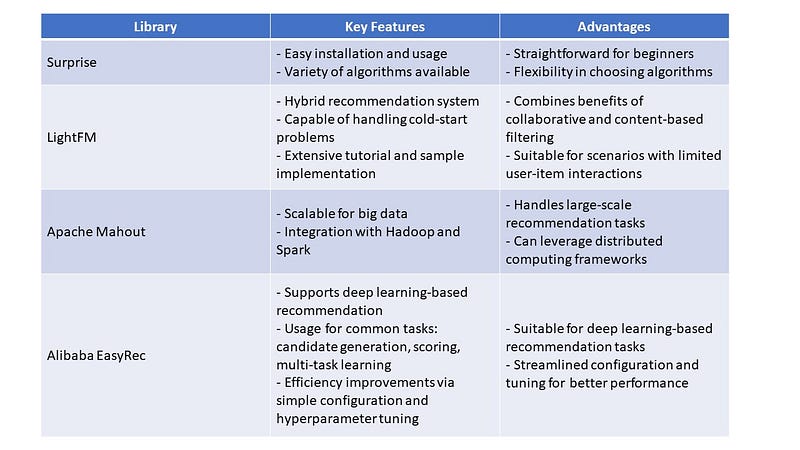
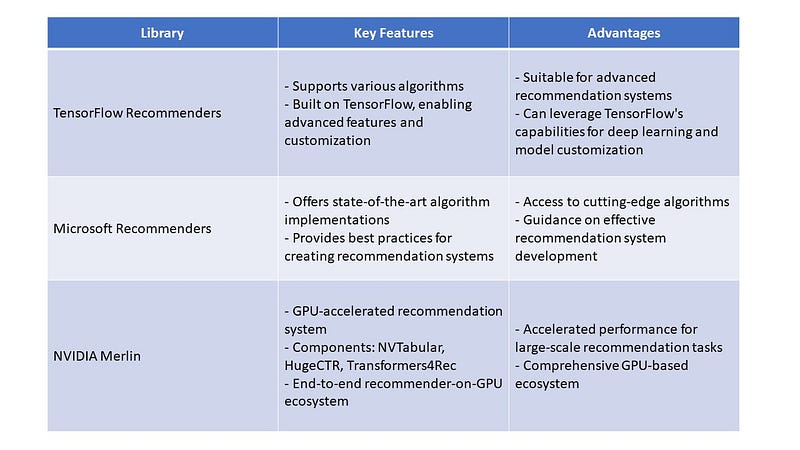
In our upcoming blog series, we will delve into the world of open-source recommendation systems and their applications. This comprehensive series will cover everything from basic concepts to detailed explorations of specific libraries, as well as discussing the future direction of recommendation systems. Here’s a sneak peek at our blog plan:
- Introduction to Recommendation Systems: We’ll kick off the series by explaining the fundamentals of recommendation systems and their significance in today’s data-driven landscape. Additionally, we’ll cover the various types of recommendation algorithms, such as collaborative filtering, content-based filtering, and hybrid approaches.
- Getting Started with Surprise: In this blog, we’ll introduce you to the Surprise library, showcasing its features and guiding you through its installation and usage. We’ll also provide a straightforward example of constructing a recommendation system using one of Surprise’s available algorithms.
- Deep Dive into LightFM: This blog will offer an extensive tutorial on LightFM, its capabilities, and how to create a recommendation system using this library. We’ll discuss the benefits of LightFM compared to other libraries and provide code snippets for a sample implementation.
- Scalable Recommendation Systems with Apache Mahout: Here, we’ll investigate the Apache Mahout library, its features, and its ability to handle big data. We’ll demonstrate how to create a recommendation system using Mahout and explore its integration with Hadoop and Spark.
- TensorFlow Recommenders for Advanced Recommendation Systems: This blog will introduce TensorFlow Recommenders, the algorithms it supports, and how to develop a recommendation system using this library. We’ll also provide a sample implementation using TensorFlow Recommenders and discuss its advantages.
- Exploring Microsoft Recommenders: In this post, we’ll present Microsoft Recommenders, its features, and examples of state-of-the-art algorithm implementations. We’ll also discuss best practices for creating recommendation systems using Microsoft Recommenders.
- NVIDIA Merlin for GPU-Accelerated Recommendation Systems: We’ll provide an overview of NVIDIA Merlin, its components (NVTabular, HugeCTR, Transformers4Rec), and how to develop a recommendation system using this end-to-end recommender-on-GPU ecosystem.
- Alibaba EasyRec for Deep Learning-based Recommendation: This blog will introduce Alibaba EasyRec, its features, and its usage for common recommendation tasks (candidate generation, scoring, and multi-task learning). We’ll discuss efficiency improvements provided by simple configuration and hyperparameter tuning.
- Evaluating Recommendation Systems: In this post, we’ll cover the metrics and methods used to evaluate recommendation system performance, such as precision, recall, and F1 score. We’ll offer examples of how to calculate these metrics using the libraries mentioned in previous blog posts.
- The Future of Recommendation Systems: In our final blog, we’ll discuss emerging trends in recommendation systems, including deep learning-based models, reinforcement learning, and graph-based methods. We’ll also explore the potential impact of these trends on the future development of open-source recommendation system libraries.
Stay tuned for this engaging blog series that will equip you with in-depth knowledge and practical examples of various open-source recommendation systems. Whether you’re a beginner or an experienced developer, this series will offer valuable insights into the realm of recommendation systems and their applications.


