
Parents, You’ve Got It All Wrong
How To Encourage Your Kids to Collaborate (and Step OUT of the Spotlight)
“Any thoughts on sleep-unders?” a reporter asks in an email. “I’m looking for a parenting expert to speak to that…”
I hadn’t realized that sleeping at friends’ houses is now on the ever-growing list of threats to children. But after spending the last many years interviewing parents for my book Family Whispering, I wasn’t surprised.
The boundaries of dangerous have narrowed over the last several decades. The days of allowing children to play in the street, make up games, and fight their own battles are long gone. Worried about gossip and teasing, junk food and allergies, screen time and homework, parents today see peril in everything, even a slumber party.
Those Who Hover vs “Tiger” Parents
Protecting children has been an American preoccupation since the first Europeans “stepped off the boat,” says family historian Stephanie Coontz.
“But what’s new,” Coontz adds, “is the idea that parents simultaneously have to nurture their child’s individuality and orchestrate every step of their mental and physical and emotional development.”
Parents, it’s not your fault.
In fairness, the frenzy to “better” your child is, in part, unconsciously fueled by advertisers who sell products and services by playing on your hopes — and fears. Will my child be safe if I don’t buy this phone? Will he be accepted by his peers if he’s not wearing the right sneakers? Will she succeed in this competitive world if I don’t get him extra help now?
You are also besieged by your peers: fellow parents at pick-up, as well as legions of family bloggers who offer advice and write angry posts for and against various parenting “styles.” If you cut down on the hovering, do you act more like a “tiger mother”? These seem like different choices, but either extreme is all about the children.
You’re exhausted, anxious, and confused; and you’re not having much fun. But there is an alternative: family-focused parenting.
Why Widen the Lens?
Decades of research have revealed that competent, life-affirming adults have certain traits and abilities in common: a sense of responsibility; self-control and empathy; the ability to cooperate and collaborate; and the grit to persevere.
Not so incidentally, those are precisely the qualities a child develops when they see themselves as is a part of the family constellation, not its only star.
We need to give our kids a chance to step out of the spotlight at times. Start by taking in a wider panorama. Observe you family as a whole.
It’s never just between parent and child.
When 10-year-old Morgan refuses to practice guitar, his mother wonders whether he’s lazy or frustrated. However, through the wider lens of family, she would realize that this slice of everyday family life isn’t just about Morgan.
Morgan’s regular teacher is on maternity leave; he misses the familiarity. Mom had a rough day at work and snapped at him earlier. Both of them are victims of the well-documented “spillover” effect that occurs when emotions in one domain affects emotions in another.
Feeling depleted — a byproduct of stress — isn’t the best time for Morgan to learn something new or for Mom to respond.
Instead of trying to control her son at a time when his feelings cloud his ability to listen, a family-focused mother offers Morgan milk and cookies and revisits the conversation when they’ve both had a chance to recover from what the world has thrown at them.
Rooted in systems thinking, this broader perspective reminds us that the One affects the Many, and the Many affects each One.
Morgan’s attitude toward guitar is also affected by his parents’ relationship. When they argue about whether he should be taking lessons in the first place, he listens at his bedroom door and wonders if it is “a waste.”
Meanwhile, his sister Mary has been teasing Morgan about how “awful” he sounds. Recently cut from cheerleader try-outs, Mary unconsciously eases her own disappointment by “comparing down” to her little brother.
Seeing the bigger picture gives us better “intel.” We are more likely to discover new approaches to old problems.
Take chore wars, that annoying and often ongoing battle between partners over who does what. Women nag; men shirk. It rarely occurs to either parent to share the burden with their children.
Doesn’t it make sense to brainstorm together to figure out what “we” need to run our household?
Making the Shift
Granted, it’s not easy to shift from the more narrow perspective of “parent think” to “family think.” The notion of parenting, a verb used to describe something you do to and for a child, has been around for the last fifty years. “Familying” is something you do with.
In the nineties, parenting became increasingly child-centered — which many experts began to criticize, especially hyper parenting, which has gotten consistently bad marks:
Hyper parents try to ensure the academic success of their children and stress over every little thing that could happen to them. So that, far from doing good, they have children who are over stimulated, over protected and insecure.
In many households — even where children aren’t doted on, catered to and constantly amused by their parents — the younger generation tends to get all the benefits of family life and do little of the work.
Parents sometimes feel sorry for their children. They’re under so much stress at school and with all their extracurricular activities.
For example, you make the kids clean their own rooms and put dirty dinner plates into the dishwasher. But that’s not the same as helping them understand how the household runs and giving them real responsibility.
“How can it be otherwise?” you might ask. “Isn’t that too much to ask of children?”
The Family Co-op
Family Whispering urges you to run the family “business” together. Think of managing your household as if you were a vegetable farmer who invites his neighbors to be part of a co-op — everyone pitches in and everyone reaps rewards.
To be clear, parents, you are the farmers in this story and your kids, the neighbors. You still retain a certain level of control.
After all, you have life experience. Your brain is more efficient and mature than your kids’. You are better informed and can step back and see the Big Picture.
Still, all of you are part of the larger entity — the co-op — and all are participants. Each member contributes labor, ideas, time, and attention. And each member enjoys the benefits. All of you are listened to and respected. Each member has the security of knowing they’re part of something bigger.
Raising a competent and caring future adult has means encouraging a child’s independence and, at the same time, continually modeling what it means to be part of a healthy “We.”
A family-focused parent has no need for a “chore list.” It’s not about “helping” Mom or Dad. The message is: This is what belonging to a family entails.
As in any co-op, talking and listening is key. Conversation happens organically and/or it’s scheduled specifically to discuss co-op business. Everyone discusses what’s needed and who’s going to do it.
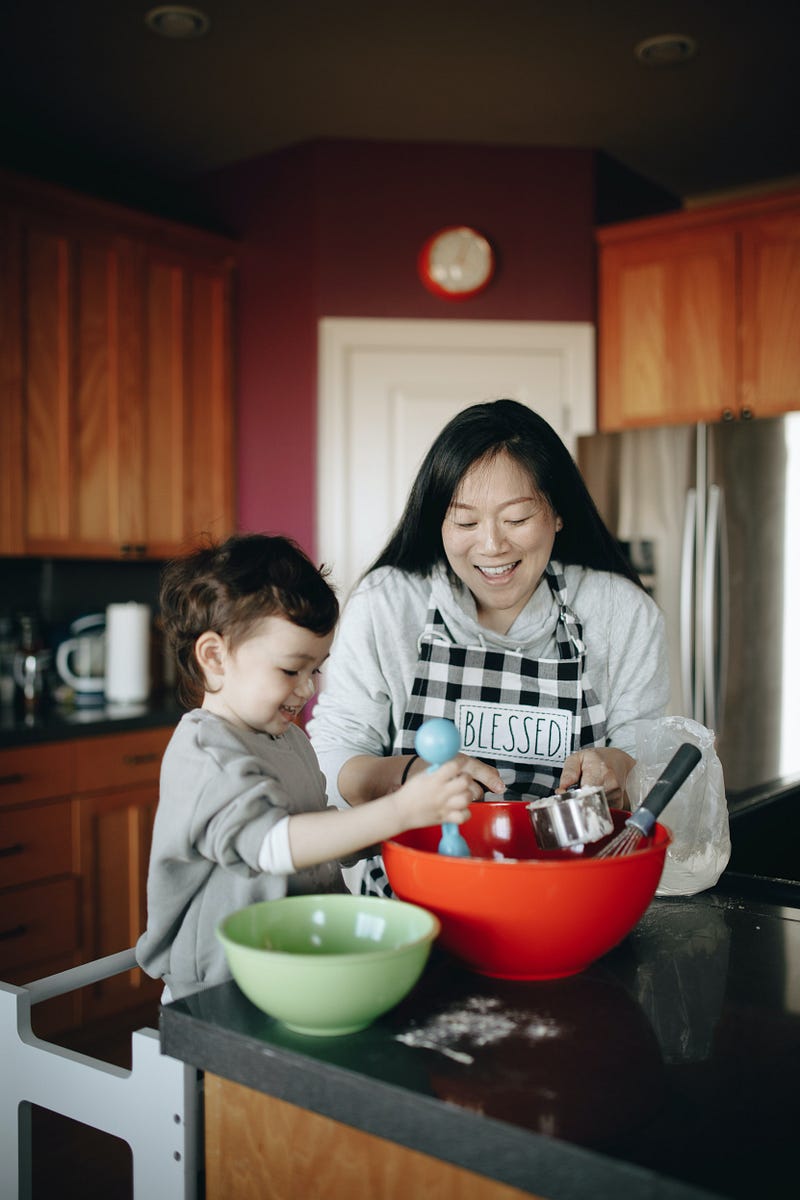
Children and adults volunteer for this week’s “roles” — lunch-maker, pet-feeder, vacuumer, homework helper (a 10-year-old can help a younger sib). Even a three-year-old can be a sock-sorter, a waker-upper, or a bed-maker’s assistant.
You take turns, so no one gets stuck with the hardest or most objectionable jobs. You share chores that are more difficult or time-consuming.
Don’t think it will work? You’ll be surprised. When children are respected and seen as capable, they feel needed and want to contribute.
The Payoff
The adults stop arguing over who does what, and the children develop skills and confidence. According to University of Minnesota emeritus associate professor of family education Marty Rossmann, kids’ participation in household responsibilities from age three or four is the best predictor of success in young adulthood.
Maintaining this idea requires consciousness and, at first, a great deal of patience. We allow time to try, flounder, fail, and try again. We let each person tackle each job in his or her own way. We stretch beyond gender — Sally is this week’s lawn-mower, Bob takes a turn as hair-braider.
Family meetings are also ideal for discussing hard issues and different perspectives — for example, each member’ s ideas about screen time or curfew, about values, dangers, and fairness. Even young children, when they know they’re taken seriously, will be fair and creative.
With family-focus, children are still listened to, but they don’t always have the floor. Adults also discuss their day, too, their feelings. We talk openly about family resources — money, time, energy — and how each is “spent.” Kids become more knowledgeable about life’s realities — and less likely to leave $100 sneakers at the park.
The Even Bigger “System” Outside the Family
Ushering in an new era of family-focused parenting is an important first step toward right-sizing our children and alleviating the guilt and unprecedented stress of modern parenthood. We base decisions on what each person needs and on what the family needs.
But as historian Coontz warns, “Without an additional community focus or a concern for one’s civic involvement, family focus can have the same isolating and ultimately socially irresponsible outcomes.”
Our families are parts of other, bigger wholes: of various communities — neighborhood, school, spiritual — and of a state, a country, the world. We become stronger by sharing strategies, by building family/school coalitions, and by reaching out to families whose circumstances are different from our own.
Granted, this isn’t an easy assignment. Every moment in your family co-op is like drama — a complex mingling of cast members, the lines each of you recites — and all of it influence by whatever else is happening on stage and off.
We must see all that and, at the same time, look beyond our own We.
Rising tides raise all ships. Striving for a society in which all families are honored, strengthened, and supported is a tall order. But too much is at stake not to try.
This story was revised, using portions of an article written for Shareable.net in 2014 when Family Whispering was first published. Given the current state of our world, widening the lens is more important than ever. However, an article can only touch the surface. But if you’re interested in 300+ pages of how-to on “familying,” please read the book!
If you like what you’ve read, by all means:
- Subscribe to my Medium articles — you’ll get an email when I publish.
- Become a member of Medium using this link, and I will earn half of your membership fee: $5/month, or $50/year — a small price to pay to support a favorite writer and for unlimited access to a world of great thinking and writing.
- Follow me on social media via LinkTree