
PARENTING
Parents on a Swing
Imagine if you could look back in time.
“Parenting definitely has some challenging moments.” — Tamera Mowry
Parents can be annoying.
Children are told what to do from birth when all they want to do is play, explore, and have fun. Parents ruin this by making them wear shoes, forcing them to go to bed, and preventing them from watching TV.
As children move into their teens, parents still feel inclined to treat young adults as children. Teens want freedom and choice, and they don’t want to be corrected every time they have a different opinion.
Then parents get older and their habits become more annoying. We tire of the same stories, the shuffling around the room, and the loud chewing. They show us very clearly what we don’t want to become when we age.
Some people can’t be around their parents. They wonder how anyone could have turned out the way they did.
“I never could have been friends with my parents,” they whisper. “They are just so different.”
So different. And, yet, so similar.
We need to look no further than the playground to understand this.
Patterns
We are the product of our parents.
While we try to firmly declare that we will never end up like our parents, they manage to manifest in all of us. We either adopt the same patterns or develop opposing patterns in reaction to our own.
We exist in struggle and conflict as we don’t want to be our parents. We don’t want to adopt the qualities that drove us crazy as children. Sometimes the emotions are so strong that we wonder how anyone could have been friends with them.
We have a very hard time seeing our parents as people. Even if they were successful with careers or projects, we ignore this and focus only on their parental identity.
What if we could reimagine our parents in a different light?
What if we could imagine them as a ten-year-old?
Swings
I attended a personal development program a few years back called the Hoffman Process.
The Process, founded by Bob Hoffman in 1967, is a personal growth retreat that helps participants identify negative behaviors and thoughts that developed unconsciously in childhood and then works to create new approaches to address these shortcomings.
I had a very complicated father who suffered from alcoholism. It was a dark time in my life. I have come to peace with it but the memories and pain still linger.
I was not the only one in the program dealing with parent issues. We all were, even the ones who didn’t think they were products of their parents.
One day the program managers asked us to sit quietly, visualize our parents, and see them in a real-life setting.
Then they told us to imagine our parents at ten years old.
A chuckle runs through half the group, and a groan through the other half. It takes us a moment to move beyond our initial reactions. Then the room settles.
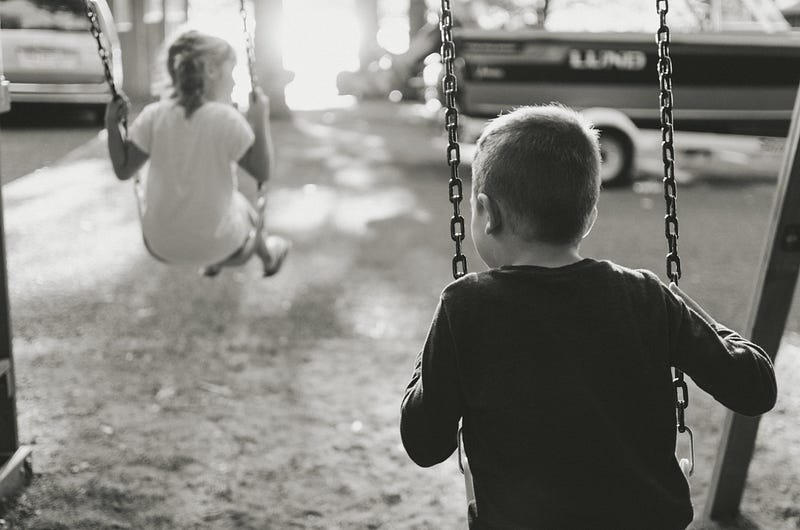
I saw empty swings swaying in the breeze. Then a young boy with dark hair ran up to one and started to kick his legs back and forth. A young girl joined him, her dress flowed behind her as she ran. She hops on the adjacent swing and begins to move back and forth.
They are laughing and chatting together. I, also as a ten-year-old, moved toward the swings and started talking with both of them. We chased each other around the playground, playing tag, and laughing. We talked and shared stories.
I forgot that I was with my mom and dad in their parenting lives. We were simply children playing together, enjoying life.
We became friends.
We often see our parents in a very limited scope, not as their complete selves. We have a hard time understanding that they had a long life before we came to them.
Children will often talk about the age and generation gaps. They declare that parents just don’t understand them because they are too old and things are different. There are different challenges for each generation. But it is uncanny when we peel away some of these layers and see how similar our experiences are.
I play the see-them-at-ten game often with people whom I find I don’t align with. As I look at them, I wonder how they came to be shaped like that. What happened in their lives that made them that way? Imagining them at ten helps me see the child, innocence, and goodness in all of them.
I can simultaneously see my father as an alcoholic and as a ten-year-old boy who did not know what life held for him.
I can only have compassion when I look at life through this lens.
I am now a parent of two. They make fun of my idiosyncrasies and strange habits. There is no getting away from the patterns of the parent-child relationship. Parents will remain an anomaly to their children until the children have children of their own.
I have pushed my children often on the swings through the years. When I close my eyes, I can see us all together on the swings. My wife and I, our parents, and our kids playing together and laughing.
Children on a swing.
If you enjoyed my story you may sign up here to receive an email for new articles. If you want to subscribe to Medium to read all the stories, including my articles, please use my link.


