
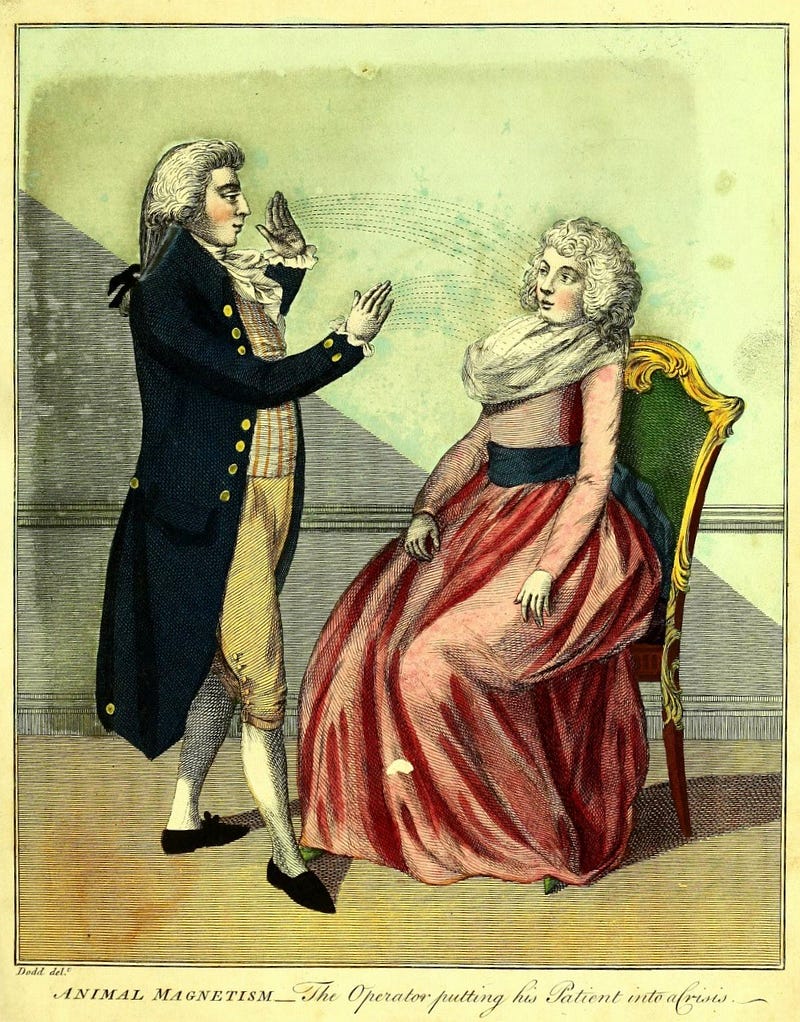
Parapsychology: Evidence & Resources for the ‘Elusive Science’
Is there replicable lab evidence for ESP and related phenomena? The answer may surprise you
Few areas of modern science are as controversial — and misrepresented — as parapsychology.
On Wikipedia and in much of mainstream letters, the rap on parapsychology — scholarly study of extra-physical phenomena such as ESP and precognition — is as recitative as an airline safety video: ESP has never been proven in a lab setting; the data is non-replicable; there’s “not a shred of evidence;” we know you have a choice when you fly…
In his sumptuously illustrated 2019 book The Spectacle of Illusion, stage magician and psychologist Matthew Tompkins offers the typically opaque — and standard — skeptic’s dismissal of pioneering parapsychologist J.B. Rhine (1895–1980), whose card-test experiments at Duke University documented the occurrence of ESP:
Rhine’s research methods and lack of scientific rigour were called into question while attempts by other scientists to replicate his studies failed to produce similar results…the more controls he introduced, the less impressive his results became, and attempts to replicate his results in other laboratories consistently met with failure.
Psi-Busters: 1 Scooby Kids: 0
But look again.
In 2020, parapsychologist Rick Berger, Ph.D., broke down Rhine’s ESP data for the Parapsychological Association, a professional society for parapsychologists, which since 1969 has been affiliated with the American Association for the Advancement of Science (AAAS): “In the five years following Rhine’s first publication of his results, 33 independent replication experiments were conducted at different laboratories. Twenty (20) of these (or 61%) were statistically significant (where 5% would be expected by chance alone).” The Parapsychological Association’s president Charles Honorton noted, “This is 60 times the proportion of significant studies we would expect if the significant results were due to chance or error.”[1]
I intend this piece as both a historical introduction to parapsychology and a clearinghouse for several of my recent articles and talks that summarize and document some of the field’s best evidence extending to the 21st century.
I also contend with meaningful skepticism. No branch of science can thrive without good skeptics — and parapsychology needs better ones; not materialist naysayers who reject psi data on ideological grounds but authentic questioners who pursue evidence wherever it leads, including to agnosticism, the original definition of skepticism.
Before marshaling resources, I offer a historical look at how study of the paranormal burgeoned into a modern science. Doing so requires venturing back to the lace-curtained setting of Victorian séance parlors.
▲ ▲ ▲
German philosopher and psychologist Max Dessoir (1867–1947) coined the term parapsychologie in 1889 to describe empirical scrutiny of the paranormal, including clairvoyance, mediumship, psychokinesis, and after-death survival.[2]
Beginning in 1870, physicist Sir William Crookes, a pioneer in microphysics and cathode ray studies, used the pages of the Quarterly Journal of Science to endeavor a study of psychical phenomena and Spiritualist claims using at least the coordinates and basic methods of scientific study.
“No observations are of much use to the student of science unless they are truthful and made under test conditions,” he wrote, “and here I find the great mass of Spiritualistic evidence to fail.”[3]
In particular, Crookes studied the physical mediumship claims of Daniel Dunglas Home (pronounced “Hume”) and conducted sittings with Kate Fox of the famous Rochester Rappings of 1848. In Crooks’ experiments with Home, the physicist thought he detected some kind of “Psychic Force.” In 1871, the Royal Society, Britain’s premier academy of sciences, rejected two of his reports on Home.
One scientist working alone, and sometimes with ad hoc colleagues, could not get very far. But what if there existed a more concerted and organized effort? These were the lines along which some of Crookes’ contemporaries were thinking.
“Organized psychical research can be dated, symbolically, from a conversation between Henry Sidgwick and his student F.W.H. Myers, one moonlit night in Cambridge about 1870, over the need to validate religious belief through the methods of empirical science,” wrote historians Seymour H. Mauskopf and Michael R. McVaugh in their valuable study of psi research, The Elusive Science (The Johns Hopkins University Press, 1980).
It would not be until 1882, however, that formal scientific scrutiny of anomalous phenomena marked its official starting point with the founding in London of the Society for Psychical Research (SPR) by scientists including Myers (who coined the term telepathy for mind-to-mind communication) and psychologist and philosopher William James — and included a remarkable array of clinical luminaries, such as physicist Oliver Lodge, Sigmund Freud (a member of both the British and American chapters), economist and ethical philosopher Sidgwick, and Arthur Balfour, Britain’s prime minister from 1902 to 1905. Crookes in the late 1890s served as its president.
At its inception, parapsychology sought to test mediumistic phenomena under controlled conditions. The early SPR worked with rigor to hold spirit mediums to proof. Researchers such as the strong-willed Richard Hodgson (1855–1905) and James himself ventured to the séance table intent on safeguarding against fraud and documenting claimed phenomena, including physical mediumship, after-death communication, and clairvoyance or what is today called channeling. (The 20th century medical psychic Edgar Cayce first used the term “channel” in a metaphysical sense in the early 1930s.) They probed unexplained cases, exposed frauds, and created historical controversies that have lingered until today.
In 1886, William James issued a confirmatory initial report on American medium Leonora Piper (1859–1950), followed by continued SPR investigations by Hodgson. In James’s 1896 Presidential Address to the SPR, he famously remarked:
If I may employ the language of the professional logic-shop, a universal proposition can be made untrue by a particular instance. If you wish to upset the law that all crows are black, you must not seek to show that no crows are; it is enough if you prove one single crow to be white. My own white crow is Mrs. Piper. In the trances of this medium, I cannot resist the conviction that knowledge appears which she has never gained by the ordinary waking use of her eyes and ears and wits. What the source of this knowledge may be I know not, and have not the glimmer of an explanatory suggestion to make; but from admitting the fact of such knowledge I can see no escape. So when I turn to the rest of the evidence, ghosts and all, I cannot carry with me the irreversibly negative bias of the ‘rigorously scientific’ mind, with its presumption as to what the true order of nature ought to be.
1886 marked the publication of the two-volume Phantasms of the Living by Edmund Gurney, F.W.H. Myers, and Frank Podmore, which explored 702 cases of spontaneous and crisis apparitions. But SPR researchers were functioning largely on testimony and within Victorian parlor rooms. On the whole, the investigators were not operating in clinical environments, so-called white coat lab settings where an atmosphere of experimenter control abetted seeking evidence for extra-physical phenomena, whether in statistical patterns or documentation of observed events.
The American chapter of the SPR, meanwhile, grew stymied by factional disputes between members primarily interested in the after-death survival thesis versus those committed to the more conservative direction of documenting mental phenomena.[4]
I do not intend to leave the impression that lab-based study of psychical phenomena was absent. In the 1880s, Nobel laureate and SPR president Charles Richet, one of France’s most highly regarded biologists, studied telepathy with subjects under hypnosis. Richet also introduced the use of statistical analysis in ESP card tests, presaging today’s near-universal use of statistics throughout the psychological and social sciences.[5]
In the early 1920s, French engineer René Warcollier conducted a series of experiments on long-distance telepathy. Freud himself, often seen as a materialist counterpart to his more occult-leaning former disciple Carl Jung, publicly and privately pondered the possibilities of telepathy, sometimes delaying publication of key statements posthumously to avoid professional fallout.
This was the case with Freud’s “Psychoanalysis and Telepathy,” his earliest paper on the topic written in 1921 — but withheld from publication until 1941, two years after his death.[6] This was likely at the urging of his English biographer Ernest Jones, who complained to his subject in 1925 that acknowledging telepathy “would mean admitting the essential claim of the occultists that mental processes can be independent of the human body.”[7]
Freud’s first published statement on ESP appeared in the more reserved essay “Dreams and Telepathy” in 1922, where he observed: “Psychoanalysis may do something to advance the study of telepathy, in so far as, by the help of its interpretations, many of the puzzling characteristics of telepathic phenomena may be rendered more intelligible to use; or other, still doubtful phenomena be for the first time definitely ascertained to be of a telepathic nature.”[8]
The paranormal finally burgeoned into an acknowledged, if hotly debated, academic field thanks largely to ESP researcher J.B. Rhine and his wife and intellectual partner Louisa Rhine (1891‒1983). In the late 1920s and early ’30s, the Rhines established the research program that became the Parapsychology Laboratory at Duke University in Durham, North Carolina, which made paradigmatic advances in the scientific study of ESP.
The Rhines trained as statisticians and botanists in the early 1920s at the University of Chicago where both received doctorates, a considerable rarity for a woman then. In the 1920s, botanists were considered at the forefront of statistical theory. While at Chicago in 1922, they were inspired by a talk on Spiritualism by English author Arthur Conan Doyle. Although taken by Doyle’s “utter sincerity,” J.B. later feuded with the writer over the deceptions of one of Doyle’s favored mediums.[9]
With his eyes on greater horizons, J.B. soon grew restless in his chosen career. “It would be unpardonable for the scientific world today to overlook evidences of the supernormal in our world,” he told what must have been a mildly surprised audience of scientific agriculturalists in 1926 at the University of West Virginia, where he held a teaching position.[10]
The Rhines began casting around, venturing to Columbia University and Harvard seeking opportunities to combine their scientific training with their metaphysical interests. Initial progress proved fitful. As often occurs in life, just before they gave up their immense efforts, an extraordinary opportunity appeared. In 1930, the new chairman of Duke’s psychology department, William McDougall, made J.B. Rhine a formal part of the campus.
Although the founding of Duke’s Parapsychology Laboratory is often dated to that year, the program was not christened the Parapsychology Laboratory until 1935 (in 1929 he called his prototype the “Institute for Experimental Religion”), where it remained until 1965. Today the Rhine Research Center continues as an independent lab off campus. It proved a watershed episode in which parapsychology was formally folded into an academic structure. At Duke, J.B. did not quite originate but popularized the term extrasensory perception, or ESP, which soon became a household word. The work begun at Duke’s Parapsychology Lab in the early 1930s has continued among different researchers, labs, and universities to the present day.
The effort is to provide clinically documented evidence that human beings participate in some form of existence that exceeds cognition, motor skill, and commonly observed biological functions — that we participate in trackable, replicable patterns of extra-physicality that permit us, at least sometimes, to communicate and receive information in a manner that surpasses generally acknowledged sensory experience and means of data conveyance. This field of exchange occurs independently of time, space, or mass.
Researchers have also accumulated a body of statistical evidence for psychokinesis (i.e., mind over matter) and precognition or what is sometimes called retrocausality, in which events in the future affect the present. For several years, Dean Radin, chief scientist at the Institute of Noetic Sciences (IONS) in Northern California, has performed and replicated experiments in precognition in which subjects display bodily stressors, such as pupil dilation or increased heart rate, seconds before being shown distressing or emotionally triggering imagery.[11]
These are fleeting references to a handful of recent findings from modern parapsychology. I assembled the list below to provide links to recent resources that I have produced. As I write in one of these pieces, “The Crisis of Professional Skepticism”:
My sympathies for parapsychology are self-evident. I openly describe myself as a critical but “believing historian” of the occult and esoteric, and I spent years as a publisher of New Age literature. I am hardly anyone’s idea of a poster child for disinterest. But if my approach here is reproving, I hope it is attributable to something beyond those factors.
Indeed, no field of inquiry is aided by exaggeration or polemic. I am prepared to stand guilty of the latter but not the former (other than by error). As such, these pieces feature numerous and varied source notes. To both the constructive skeptic and critical affirmant — the only readers I want — I say: probe these references and if anything is out of order, challenge them.
Only through rigor and ethical query can the search advance.
Notes
Within the text, many of my hyperlinks connect to articles at the Psi Encyclopedia, an online resource maintained by The Society for Psychical Research in London. This ongoing effort began in 2014 to provide scholarly reference material on the history and findings of parapsychology. Given the problem of systemic misrepresentation of parapsychology on Wikipedia, which I document in several of the above pieces, the Psi Encyclopedia presents an important counter-source. In my experience, its more than 550 (and growing) entries are both judicious toward skeptics and appropriately critical toward parapsychological claims.
[1] “Has Science Developed the Competence to Confront the Paranormal?” by Charles Honorton, Extrasensory Perception, Vol. 2, edited by Edwin C. May and Sonali Bhatt Marwaha (Praeger, 2015).
[2] Dessoir later became a skeptic, a topic well considered “Max Dessoir” by Andreas Sommer, Psi Encyclopedia, London: The Society for Psychical Research, 2021.
[3] “Spiritualism Viewed in the Light of Modern Science,” Quarterly Journal of Science, July 1870.
[4] Now largely dormant, the American Society for Psychical Research recently made plans to sell its high-end New York City headquarters: “NYC townhouse and occult researchers’ headquarters lists for $15M” by Hannah Frishberg, New York Post, January 17, 2023.
[5] See “Telepathy: Origins of Randomization in Experimental Design” by Ian Hacking, Isis, Sept 1988, Vol. 79, №3; “J. B. Rhine’s Extra-Sensory Perception and Its Background in Psychical Research” by Michael McVaugh and Seymour H. Mauskopf, Isis, June 1976, Vol. 67, №2; and “Charles Richet” by Carlos S. Alvarado, Psi Encyclopedia, London: The Society for Psychical Research, 2015.
[6] The history of the paper appears in a critical postscript to its publication in volume 18 of The Standard Edition of the Complete Psychological Works of Sigmund Freud, published in 1955.
[7] “I am extremely sorry that my utterance about telepathy should have plunged you into fresh difficulties,” Freud replied to Jones in 1925. “But it is really hard not to offend English sensibilities…” For a revealing and sometimes-humorous exchange of their letters on the topic, see The Future of the Body by Michael Murphy (Jeremy P. Tarcher, 1992) and volume 3 of Jones’s The Life and Work of Sigmund Freud (Basic Books, 1957).
[8] Some historians reference Kabbalistic influences on Freud. I question this. Born into a then-secular Jewish family in Austria in 1856, Freud’s milieu was unlikely to include exposure to Kabbalah, which occupied a kind of backburner status among even dedicated Jewish scholars in the modern era until publication of Gershom Scholem’s Major Trends In Jewish Mysticism in 1946. While confluences are always intriguing, and certainly Freud’s Jewish background wielded numerous influences on his work, I find purported Kabbalistic connections indirect, at most. Freud, as I hope these and other brief passages demonstrate, was not averse about publicly naming sources and interests that departed from his proper “Herr Doktor” reputation.
[9] Something Hidden by Louisa E. Rhine (McFarland, 1983).
[10] The Elusive Science: Origins of Experimental Psychical Research by Seymour H. Mauskopf and Michael R. McVaugh with an afterword by J.B. and L.E. Rhine (The Johns Hopkins University Press, 1980). This valuable, and unfortunately out of print, volume is my source for the immediately following details of the Rhines work at Duke.
[11] See: “Time-reversed human experience: Experimental evidence and implications” by Dean Radin, Esalen Draft, 7/31/00, and “Intuition Through Time: What Does the Seer See?” by Dean Radin, Ph.D., and Ana Borges, J.D., Explore, 2009; Vol 5, №4. For a meta-analysis of recent precognition experiments see “Precognition as a form of prospection: A review of the evidence” by Julia A. Mossbridge and Dean Radin, Psychology of Consciousness: Theory, Research, and Practice, March 2018, Vol 5, №1. A comprehensive analysis of psychical research and its replications appeared in the flagship journal of the American Psychological Association: “The Experimental Evidence for Parapsychological Phenomena: A Review” by Etzel Cardeña, American Psychologist, 2018, Vol. 73, №5, 663–677.


