
Papers Explained 08: DeBERTa
DeBERTa (Decoding-enhanced BERT with disentangled attention) improves the BERT and RoBERTa models using two novel techniques.
- The first is the disentangled attention mechanism, where each word is represented using two vectors that encode its content and position, respectively, and the attention weights among words are computed using disentangled matrices on their contents and relative positions, respectively.
- Second, an enhanced mask decoder is used to incorporate absolute positions in the decoding layer to predict the masked tokens in model pre-training.
- In addition, a new virtual adversarial training method is used for fine-tuning to improve models’ generalization.
Disentagled Attention
Unlike BERT where each word in the input layer is represented using a vector which is the sum of its word (content) embedding and position embedding, each word in DeBERTa is represented using two vectors that encode its content and position, respectively, and the attention weights among words are computed using disentangled matrices based on their contents and relative positions, respectively. This is motivated by the observation that the attention weight of a word pair depends on not only their contents but their relative positions.
For a token at position i in a sequence, we represent it using two vectors, {Hi} and {Pi,j}, which represent its content and relative position with the token at position j, respectively. The calculation of the cross attention score between tokens i and j can be decomposed into four components as:

That is, the attention weight of a word pair can be computed as a sum of four attention scores using disentangled matrices on their contents and positions as content-to-content, content-to-position, position-to-content, and position-to-position.
Taking single-head attention as an example, the standard self-attention operation can be formulated as:


Denote k as the maximum relative distance, δ as the relative distance from token i to token j, which is defined as:

The disentangled self-attention with relative position bias as can be represented as




Enhanced Mask Decoder
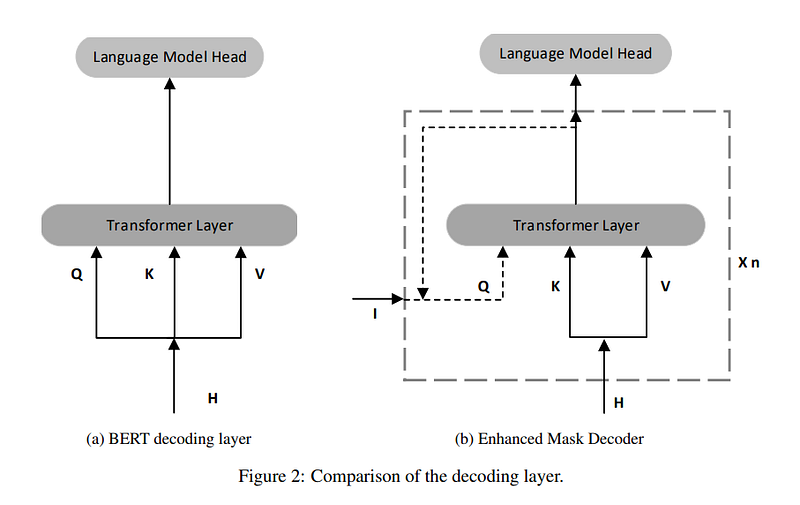
DeBERTa incorporates absolute word position embeddings right before the softmax layer where the model decodes the masked words based on the aggregated contextual embeddings of word contents and positions.
There are two methods of incorporating absolute positions. The BERT model incorporates absolute positions in the input layer. In DeBERTa, these are incorporated right after all the Transformer layers but before the softmax layer for masked token prediction. In this way, DeBERTa captures the relative positions in all the Transformer layers and only uses absolute positions as complementary information when decoding the masked words. Thus, we call DeBERTa’s decoding component an Enhanced Mask Decoder (EMD).
Scale Invariant Fine Tuning
SiFT is a new virtual adversarial training algorithm that improves the training stability by applying the perturbations to the normalized word embeddings.
Specifically, when fine-tuning DeBERTa to a downstream NLP task in the experiments, SiFT first normalizes the word embedding vectors into stochastic vectors, and then applies the perturbation to the normalized embedding vectors. It was found that the normalization substantially improves the performance of the fine-tuned models. The improvement is more prominent for larger DeBERTa models.
DeBERTa v2
Vocabulary In v2 the tokenizer is changed to use a new vocabulary of size 128K built from the training data. Instead of a GPT2-based tokenizer, the tokenizer is now sentencepiece-based tokenizer.
nGiE(nGram Induced Input Encoding) The DeBERTa-v2 model uses an additional convolution layer aside with the first transformer layer to better learn the local dependency of input tokens.
Sharing position projection matrix with content projection matrix in attention layer Based on previous experiments, this can save parameters without affecting the performance.
Apply bucket to encode relative positions The DeBERTa-v2 model uses log bucket to encode relative positions similar to T5.
900M model & 1.5B model Two additional model sizes are available: 900M and 1.5B, which significantly improves the performance of downstream tasks.
Source: https://huggingface.co/docs/transformers/model_doc/deberta-v2
Paper
DeBERTa: Decoding-enhanced BERT with Disentangled Attention 2006.03654
Hungry for more insights?
Don’t miss out on exploring other fascinating threads in this series. Simply click here and uncover the state-of-the-art research!
Do Subscribe for weekly updates!!


