
Paperless: The One Notebook And Pen I’m Never Giving Up
An Apple user bridges the digital–analog divide
Thanks to the paperless workflow I’ve been implementing between my MacBook Pro, iPad Pro and iPhone, nary a scraplet of paper is needed — or wanted — for 95% of the work I do. I’m a small business owner who used to go through forests of paper every year for decades, so that feels like quite an achievement!
As a paperless convert, digital evangelist and an aspiring minimalist, I’m here to tell you about the notebook and pen that stayed when everything else went to the shredder.
It all started with a pen
The BiC 4 colour pen was introduced to the world in 1970 by Marcel Bich. I used it continuously for about 40 years — it truly is a great, iconic product.
Four supremely useful colours in one package — c’est magnifique, n’est-ce que pas! Until the ink goes blotchy and blobby, that is. And then runs out. (Eh bien, Monseiur Bich; vous avez fait de votre mieux.)
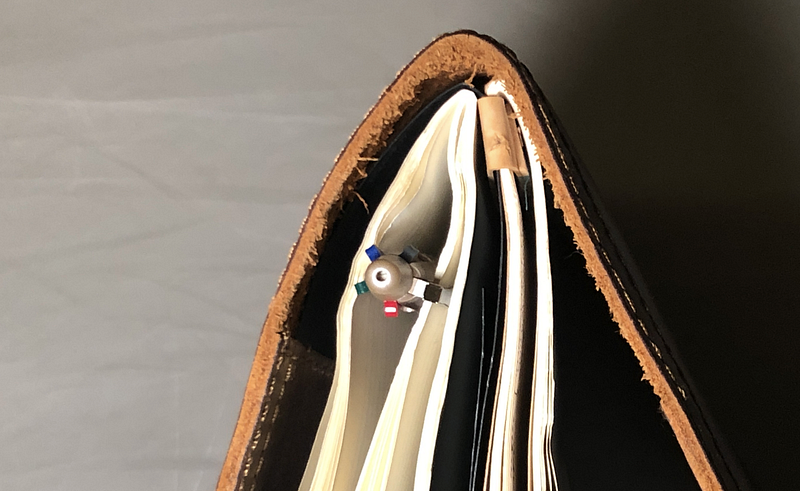
Fortunately, someone has improved upon this paragon of convenience. Allow me to introduce… the Pilot Dr Grip 4+1.
Four familiar colours — black, blue, red, green — plus a 0.5 mm mechanical pencil, in one very comfortable to hold package that’ll see you willingly handing over moolah equivalent to 6 BICs. I usually get mine from eBay for about AU$15.
Refills are readily available in varying colours, thicknesses and ink types. I prefer sticking with the original BVRF–8F refills. The thickness is just right, and I’ve never had issues with them skipping or getting blobby.
One minus: the eraser mostly works as expected, but is a sad disappointment in size and longevity.
I’ve been using the Dr Grip for 4 or 5 years now, ever since discovering that a larger barrelled pen helps my hand to relax while writing. As a recovering RSI sufferer, I can tell you it lives up to the claim that it “reduces gripping power by up to 40% to help reduce muscle strains and fatigue”.
Oddly, I’ve found that the barrel colour of the pen significantly affects my perceived enjoyment of it. Black was and still is my go-to, but for some reason I couldn’t stand using it in blue. Champagne is lovely, and almost (but not quite) makes me want to try a gold toned iPhone or Apple Watch.
The Pilot Dr Grip 4+1 is no Waterman or Lamy and isn’t trying to be, but it does tick all my form, function, comfort and affordability boxes.
I do advise you to keep the old BiC handy, however; you never know when someone you don’t particularly want to offend will ask to borrow your pen.
The everyday notebook I keep coming back to
The notebook I keep coming back to for everyday notes is the Moleskine Cahier, black cover, ruled.
My first Moleskine was the large ruled hardcover version, again in black. In 2012 I finally bought one to try after years of avoiding them, refusing to be drawn into something surrounded by that much hype, trying instead all the similar but less mainstream offerings I could find.
Rhodia, Baron Fig, Leuchtturm1917, Field Notes, home-sewn options. None of them sang in my hands the way the Moleskine did.
Intellectually I can tell you why I like this notebook, that the line spacing, paper size and thickness are just right, but I’ve come to realise there’s more to it than that. Not because of the famous artists associated with the brand, or the back pocket, and certainly not because of the rabidly devoted online Moleskine community.
I don’t have the words to tell you beyond “it just feels right”. The cover of an old hardcover Moleskine looks and feels satisfyingly…I mean, it has a certain… je ne sais quoi.
There are two main reasons I switched from the hardcover to the softcover Cahier:
- The lower cost, less permanent binding reminds me I don’t have to worry about writing incomplete thoughts and scribbles. This is not a book I’ll feel obliged to keep forever. The less precious (literally and figuratively) the medium, the better the work I produce.
- It’s light, thin and easy to carry around. I sometimes pair it with a blank Cahier for sketching, using a broad rubber band to join the back cover of one to the front cover of the other. Both fit nicely in my delightfully scratched and beaten up Saddleback Leather bible cover.
The only other paper notebook I use is Leuchtturm1917’s Some Lines A Day 5 year diary. I’m up to year four in my first book and already have a second waiting on the shelf (found it on Amazon at a good price), ready for January 1st, 2023.
How a notebook and pen fit into my paperless system
My notebook is the inbox, the capture tool I turn to when using a device doesn’t feel quite right.
Like writing down memories or even lines of a future poem while waiting for a funeral to begin, or taking notes in church. Like jotting some quick thoughts in front of my screen-free grandchildren, or in the presence of an elderly relative who thinks anyone using a device when other people are around is rude and thoughtless.
This is the place I can write anything about anything, anywhere. I can even write personal notes in public using the code I learned when I was 15 without worrying about over-shoulder-readers.
Sometimes I use a Bullet-Journal-like key or different pen colours to differentiate between notes, but I never bother with indexes or logs. All of that is taken care of in the digital realm.
Once I’m back at whatever device I pick up next, I transfer information worth keeping into my plain text system via the Drafts app.
Paperless? More like paper, less.
Writing and drawing regularly with the Apple Pencil on an iPad Pro 12.9 inch — arguably the best digital mark-making experience there is — is something I do every day.
I’ve also invested a lot of time and mental energy crafting a way to transfer my previously analog creative and productivity efforts into the digital world in the plain text system mentioned above.
Seriously geeky stuff, right?
Cool as all of that is, my roots remain in the physical world and my notebook and pen remind me of that every time I use them.


