
Paper or Plastic? For Me, the Answer is Neither
Instead of regulations and outright bans, we should give consumers financial incentives to decide.
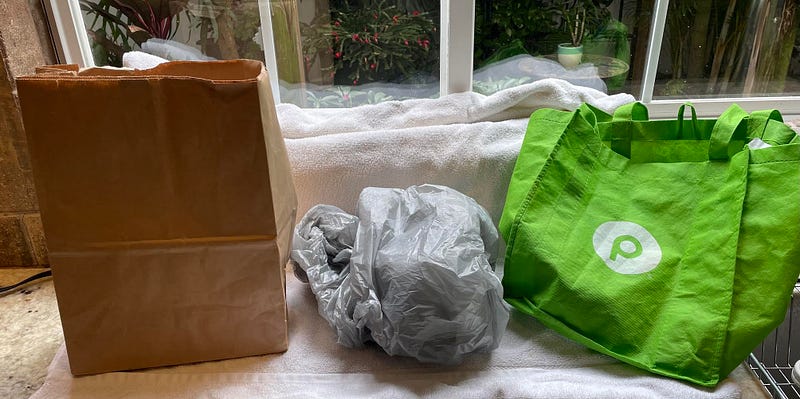
After decades of debate, this modern-day question should have been settled. You place your groceries in the cart and proceed to the checkout counter. Unless you use self-checkout (an annoyance and subject for another day), the cashier asks, “Would you like paper or plastic?” When I was growing up and dating myself as slightly less than ancient, this was not an option. There were no plastic bags.
Now we have paper bags, single-use and multi-use plastic bags, and reusable bags of many types, shapes, sizes, and materials. Good arguments can be made for paper or plastic, but reusable bags offer the best ecological choice.
Single-use plastic bags are the most wasteful as they never degrade and cannot be recycled, leading many cities to ban them altogether. California is the first state to do the same.
Paper bags are recyclable, but conservationists argue they require more fossil fuels to produce. In this same interview, an economist argued that plastic garbage bag purchases increased when single-use bags were banned since many people used them to pick up dog poop, line small waste cans, etc. Thus, a net environmental benefit was never realized.
As an avid fisherman, I regularly see the damage done by single-use plastic bags. I find them floating in the Gulf of Mexico and Tampa Bay. Therefore, I have opted to bring my reusable grocery bags to the store. My non-scientific observations of other shoppers show I am a significant minority.
Environmentalists point out the huge ocean “garbage patches” as reason enough to completely ban plastics. However, most plastics originate from fishing equipment, not single-use plastic bags. And places that have banned plastic, like California and the European Union, produce little of this waste. That inglorious award goes to China, the Philippines, India, Southeast Asia and Brazil.
Anyone who has followed or read many of my stories knows I am a big fan of the free market system. With the proper incentives, the consumer can help solve many problems. Rather than adopting outright bans and laws, I have a practical suggestion.
Plastic bags are not free. They must cost the grocery store something. Ideally, I would like to see shoppers pay $.05 for each plastic bag. However, food prices are high enough; therefore, adding even one penny to the cost of a plastic bag will only anger customers and place stores that institute a surcharge at a competitive disadvantage. But what if the stores incentivized the shopper to bring in their bags? If they gave the shopper $.10 off each reusable, would that significantly affect their profit margins? I don’t think so.
With time, the rebate could increase to the point where it got the shopper’s attention. The stores could even use this as a marketing tool. Perhaps a small charge per plastic bag could be re-visited in the future too.
What is the downside to using reusable bags?
- The customer must remember to bring the bags into the store.
- Checkout store packers tend to place too many items inside one bag, making them heavy and tippy. I supervise them closely and sometimes even pack my bags.
- They can carry harmful bugs like E. Coli and Salmonella if not cleaned or washed regularly.
The last reason is the only time I ask for plastic. I do not want to place raw meats into one of my bags. The same is true of a roasted chicken. Cooked, it won’t transfer harmful bacteria, but the drippings can make a big mess and cause germs to grow inside later.
Microplastics are a huge problem in the environment. However, other options, like turning back the clock and using only cardboard or glass to hold foods and liquids, are not feasible. The consumer can help with positive and negative incentives to use fewer plastics. International cooperation has to do a much better job regulating illegal fishing gear and disposal and fining offending companies and countries.
Radical environmentalists would like to ban all commercial fishing, but this is not a practical solution. The world’s population is too large and still growing and needs more, not fewer, protein and nutritional sources. Not everyone can become a vegan. And veganism can produce its own set of environmental problems.

I close with a caveat of a trip to Switzerland a few years ago. My wife and I took a cogwheel rail car up Mt. Pilatus. As we watched hangliders, we went into a coffee shop for a cappuccino and apple streusel. We were given food and drink in small china cups, plates with real spoons, and a fork. There was no styrofoam, paper, wood or plastic. Yes, someone else had to wash or place them in a dishwasher, which gave another person a job. What a novel idea.
I am a retired MD passionate about writing, reading, culture, health, fishing, politics, and food. Get an email whenever I publish by clicking this link:https://davidmokotoff.medium.com/subscribe
I will never spam you or give out your address.