
Pandemonium: Snake Handling the Pandemic in Alberta
I didn’t intend to go all Jesus in the temple in Olympic Plaza at 4:30 pm on a Friday afternoon. I’d been up since six a.m. and needed a nap. But with no bed in sight and ninety minutes to go before the Red Arrow could rescue me from this shutdown city — Calgary — to carry me back to my own shutdown city — Lethbridge — there was nothing left to do but cover the story in front of me. I jotted copious notes about peaceful Canada Geese and grey squirrels that refused to be alarmed by screaming humans who were about to bloody themselves in a street fight.
With my head down in my notebook, I didn’t see the young man walking up to me until it was too late. By the time I looked up, he was close enough for me to see the religious tract he was carrying.
I was suddenly in the skin of that grade seven girl I usually pretend to never have been. The one who thought she ugly, who couldn’t dance, and didn’t go to movies. The one who only fit in with kids she met at church. If I stood up and high tailed it in the other direction, it would be obvious that I was walking away from him. And that evangelical teen knows how it feels when people leave when you show up.
At least the young street preacher was wearing a mask. So maybe he wasn’t one of the irrational ones. He sits on the bench next to mine. “So where are you from?” he says.
“Lethbridge,” I say.
“What brings you to up here?” he says.
“A doctor’s appointment. I am doing a bit of journalling while I wait for the bus to go home.”
“I am a writer too. I write poetry and songs about Jesus. Can I pray for you?” he says.
“I guess so,” I say. I wish I could be rude.
He takes his hat off.
“Can I touch you?” he says. It’s not really a question because his hands are already reaching for my shoulder.
“I don’t think that’s a good idea,” I say. He doesn’t pull his hand back. He thinks he knows why.
“COVID can’t hurt you. God is more powerful. He can heal anything. He says it in the kindest way someone who thinks they have the only direct line to God can speak.
I jump up. “F off,” I say. (Editing note: We can’t print the real word.)
“You need to know this,” I say. “Last week, a doctor died from Covid in Lethbridge. He was a Christian.”
I don’t tell him that this man went to my own church. I don’t tell him that when my late husband was nearing the end of his fight with addiction, Wayne saw him walking home from the hospital and drove him back to his apartment, one of the last acts of kindness my opiate addicted husband ever experienced. I don’t tell the street preacher how the week after Douglas died, I shook the doctor’s hand during the “Peace’” at Sunday service.
“He didn’t make it,” I said.
“I know,” the healer said. There were tears in his eyes.
I don’t tell him that this doctor who died of COVID 19 was the hands and feet of Jesus to hundreds of people in SW Alberta. And that he was one of the few who never questioned my complicated grief over the death of a husband who was too dangerous to live with.
“Praise God,” he says. “That’s awesome. He’s in the presence of Jesus right now.
“F right off. You’re preaching a false gospel.” (See note above about community standards.)
I am numb as I walk to the Red Arrow depot to spend my last hour in the city watching arrivals and departures. And I worry about the young street preacher I have just cursed.
The street evangelist looked part Indigenous to me. In his black winter jacket, dollar store toque, and worn jeans, he seemed more a part of the neighbourhood than somebody on a mission from the rich parts of the city. I have no doubt that he honestly believes the version of the gospel he is preaching,
The city I visited last week could use a miracle.
Clouds are seeded with brown dust and grey dirt as I ride into Calgary. It is lunchtime. Restaurants are closed except for freezing cold patios. I expected that, so I packed a lunch. I didn’t expect to find the doors to buildings I usually enter without difficulty locked. With the wind whipping my face, I head down Ninth Avenue to searching for a public space with chairs so that I can sit down while I eat my sandwich. Fortunately, the security guard at the Edison, a co-working space for entrepreneurs, lets me eat in the lobby.
By 12:15, I am on my way to find the doctor’s office.
I am mostly good with elevators now as long as I am carrying a cell phone. But 10 minutes before my appointment I panic on the second floor of Gulf Canada Square because I can’t find a staircase to the third floor. I think about running down the stairs and bolting from the building, but I know it’s ridiculous to skip out on an appointment I have braved a pandemic, cold lunch, and a two and a half hour bus ride in a surgical mask to keep. A thirty-something woman with dark hair and reassuring smile sees me searching for a way out.
“Do I have to go back to the lobby to find an elevator so I can get to the third floor?” I ask.
“No, the elevators are right here. I will show you,” she says.
I don’t want to step into the elevator, but I follow her, enter the cubicle, see the doctor on time, and get some of the answers I’ve waited years to find. But what goes up must come down. That’s a problem for me.
By 1:30, I’m bolting from another elevator before it heads sky high. I imagine living the rest of my life forever trapped on the third floor. Another Good Samaritan helps me identify an elevator programmed to reach street level.
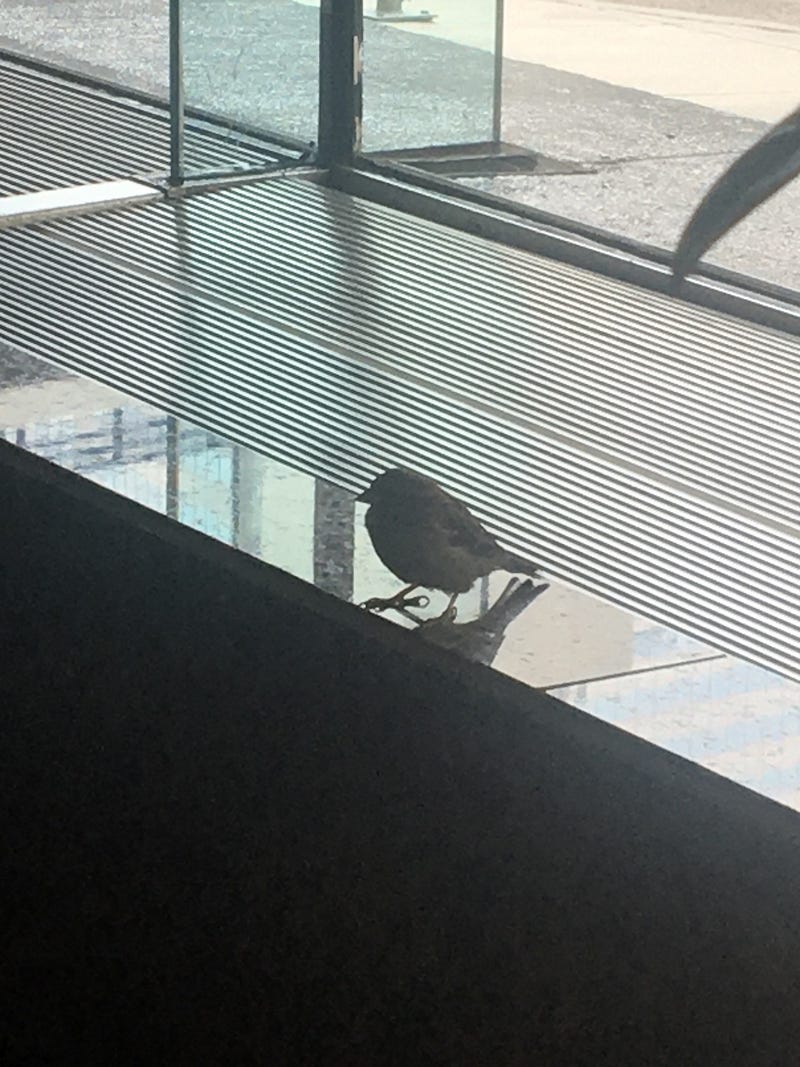
At earth level, I buy the biggest Tim’s double double they sell. With enough coffee in my paper cup to last the afternoon, I find an indoor bench and pull out my journal to write. Within minutes I am transfixed by a fluttering sparrow who has trapped herself inside the building. I pull out my phone and snap half a dozen photos of my new friend.
By 4:00 pm, the sparrow has moved on. I decide I cannot leave Calgary without strolling down Seventh Avenue and visiting to the Famous Five statue at Olympic Plaza.
As I walk through the plaza, I catch site of the Anglican Cathedral. I might have ventured inside if they had a service today, but it is shut down like this every other church in our Diocese. I might have blended in with the tourists at the Glenbow Museum, if the province was not in the grips of a Tsunami Wave of COVID-19. I most definitely would have ordered dinner at a sit down restaurant before I went home.
Today the dining rooms are closed. There are no tourists in the city. Even middle class office workers seem to have abandoned the downtown early. I hear a train on the next block and traffic rushing from the city core. I want to get out of here, too.
The pandemic is worse in Alberta than anywhere else, not just in Canada, but in all of North America. Yet, strident fringes of Alberta’s population continue to protest public health measures, including social distancing and mask wearing.
Many of these activists have attempted to turn renegade pastors who put their own congregations in jeopardy as heroes.The ringleaders portray the world in black and white, good versus evil. If they are good, those who disagree with them must be hell-bound. They pit freedom against health, science against faith, the economy against the lives of the sick and the weak. Neighbour against neighbour.
One diagnosis for a multitude of symptoms makes them seem more manageable, but it’s not always accurate. I am in town seeking answers about the autoimmunity that turns my own body against me. But it’s really PTSD playing havoc on my elevator rides that has hindered me most today.
After my husband attacked me in 2013, a church street ministry I’d once supported took him under their wing and proceeded to make my life a living hell. They even showed up in court to argue that he shouldn’t go to jail for attacking me. They suggested in court documents that I deserved to be whipped, choked, and attacked from behind with a metal object.
I couldn’t navigate the system. I stretched my thyroid medication and gathered pop bottles so that I could buy bread. Sometimes, I felt so hopeless that I wanted to jump off the high level bridge in Lethbridge. It took a year before I got the help I needed.
I was too poor to matter. And my brain injury and PTSD played havoc with the way I navigated the world. Above all, I felt betrayed.
Somehow, I stayed connected to the Anglican congregation I joined nearly 20 years ago. Even though some people still can’t understand what happened in my home, I have never doubted, for more than a few fleeting seconds, that they care about me.
I know what it is like to be unable to trust the people and systems assigned to take care of you. I get why our urban downtowns — filled with newcomers, the uprooted, and the marginalized — are fertile mission fields to street preachers. God knows, the people who live and work there need acceptance and hope. And our economic, justice, social service, and cultural systems do not always work in their favour.
That’s what makes political activists who target faith groups with conspiracy theories about COVID-19 or who stoke fear that public health measures are excuses to shut churches down permanently so reprehensible.
The people who will get sick from their mischief are often the poor, the uneducated, and those without community supports. Some will get sick because they believe that only non-believers die from COVID-19. Some will get sick because they believe that the pandemic is not real. And some will get sick because they believe it is better to risk death than follow public health measures or take a vaccine.
They are not much different than snake handling cult leaders in the Southern United States whose followers sometimes die after these ‘leaders’ parade venomous beasts into their services. They feed on division and misinformation.
They preach a false gospel. In other words, they twist the words of Jesus into something he would abhor.
Why do I say that? Because if you are a Christian, becoming like the Man from Nazareth means rejecting rebellion, rage, grudges, and above all, lies. To get there, you must embrace love. And when you do that, you will love yourself and your neighbour enough to protect your community from a pandemic.
I prayed for the young man on the way home. I hope he’s safe.


