
Pandemics: and why we should all wake up to the world of health
It’s too early to say what the legacy of this pandemic will be. It could be a narrative centred around anxiety and fear, or it could be one of hope and aspiration. Of life yet again triumphing over death.

—Image by Free-Photos from Pixabay
We are gripped in a global pandemic, the world as we know it has stood still, or at least broken stride. This virus kills people, and it does so quickly.
But is there more to the story than that?
Although the speed at which this has hit us all has been devastating we could yet see this a hard wake up call; as a chance to sit up and take stock. To stop, and think and peel back the layers of what this means for us all.
our health matters; it is the best protection there is
This article leads you through the story of how I came to this conclusion as I sought to reassure myself that my family was safe, and if not, what we could do to be as safe as we could.
Starting as always with a search for the relevant facts
Firstly the age profile of those dying from Covid 19, where the data tells a consistent story across every country.
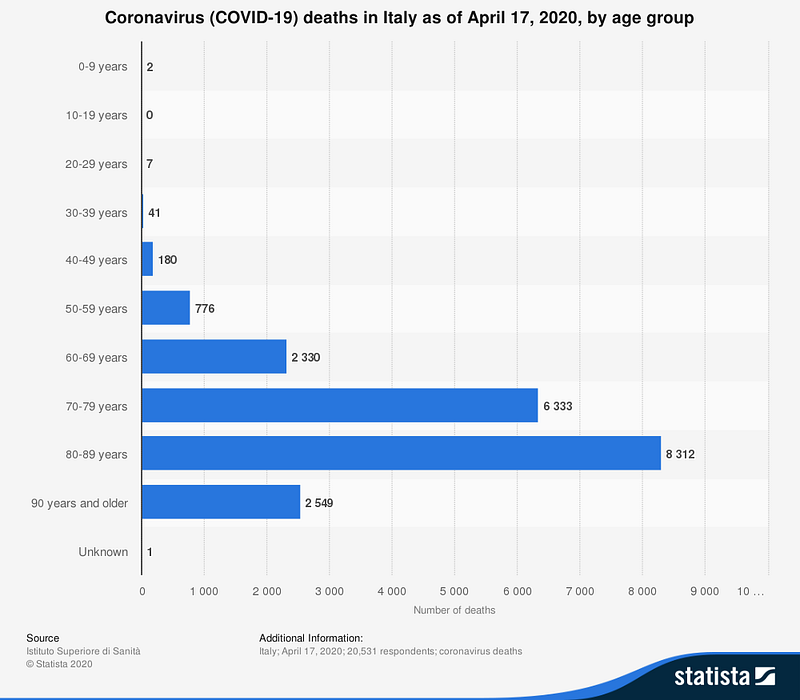
From the Italian data we can see that it’s true this pandemic can kill and it can kill anyone. But it is clearly skewed towards the more elderly in society. A consistent picture with that reported in China - where there was an underlying death rate of around 0.2% across all age bands, with escalating steps through the later age brackets before topping out at a staggering and frightening 14.8% in the over 80's.
So next we need to be able to explain why we see these step changes and what that reveals, because the story could be very different if we found that exposure differed significantly across age groups.
Starting with looking at life expectancy before the pandemic
We know that life expectancy increases over time. Improvements being driven by advancement in areas such as nutrition, hygiene, housing, sanitation, control of infectious terminal diseases, and personal factors such as smoking and exercise, etc.
We know too that life expectancy is on the increase as we (in the developed world) have addressed basic issues like sanitation and nutrition as well as making significant issues in other areas.
The result of all this is that average life expectancy in the UK is now standing at around 80, and we expect it to continue upwards as we get healthier as a society. We implicitly appreciate, as Veena Raleigh points out, that the average healthy life expectancy is lower than that.
Within the UK it’s closer to 64. So it’s clear that the average overall doesn’t tell the whole story.
Let’s consider Jack Bowden, a war hero and Britain’s oldest man to survive after being tested positive for a corona-virus, and Captain Tom Moore, the 99-year-old war veteran who has walked 100 laps of his garden to raise more than £13m for the NHS. What do they tell us about this average given they have clearly both lived long and healthy lives.
To appreciate this, consider the other end of the scale, those who have been less fortunate:
- perhaps they have tragically died early from cancer — a top 3 cause of the death of young women, or
- they died through being involved in a road traffic accident (the number one cause for many), or
- even suicide (particularly prevalent in men under 50, but an emerging trend across our youth and in women too).
The average consists of both of these groups and all those in between. Healthy people like Jack and Tom and me; unhealthy people, many of whom have died already, many more who are living with a disease or condition which will ultimately prove to be terminal or who do not yet appreciate the risks they take. And let’s not forget those unlucky people struck down before their time through accidents and incurable disease, and finally those most unfortunate of souls who were never given a fighting chance.
Life expectancy is the average of all such groups and on average we life to 80, even though in reality the spread is much wider than that.
Now let’s consider how Covid 19 kills
Covid19 affects our lungs. It is a respiratory disease, the primary causes of which as cited by the British Lung Foundation range from chronic obstructive pulmonary disease (COPD) to lung cancer, all of which are underpinned by a range of yet more factors; from genetic conditions, to the role of our diet and personal fitness, to the environment we live in in terms of overall air quality. ie Things we can control and things we can’ t — an important point in this overall story.
The impact of lung disease on life expectancy
So, sticking with the big picture, the British Lung Foundation’s figures tell us that in 2012 lung disease caused:
- 242 deaths in children age 0–14;
- a further 13,739 in people aged 15–65; and,
- a staggering 476,510 in the over 65s.
So it’s impact on average life expectancy is huge. It is a major reason why those over 60 don’t live long and happy lives like Jack and Tom. [note Alzeimers is the #1 cause in the >80s]
Pulling these two factors together with what we know about Covid 19.
What does that tell us?
- respiratory disease is indiscriminate, it kills people at all ages. Just like Covid 19.
- respiratory disease is more likely to be the cause of death if you are older. Just like Covid 19.
- most people, those in good health at whatever age, don’t die of respiratory disease. Just like Covid 19.
Overall, it paints the picture that Covid 19 is not the same killer we may have thought. It may have dealt the final blow, but its victim was most likely already carrying a black mark. [This will be cold comfort to those who have suffered and died under it’s hand but perhaps offering a ray of light that their passing does not have to be mourned in isolation]
It also suggests how, in time, we will be able to identify those most at risk and that, whilst developing vaccines is important, we can already take other steps to protect ourselves and to help those most at risk in society today, whilst allowing others to go on with their lives.
So, how does science support this theory?
Unsurprisingly science supports this narrative, as this great article by Shin Jie Yong demonstrates.
https://readmedium.com/meta-analyses-reveal-who-should-be-more-cautious-of-covid-19-9cbca0e9706d
The article’s focus is on those who should be most cautious in relation to Covid 19; within it he refers to researchers at Weifang Medical University who highlighted:
“COVID-19 patients with COPD had a 5.9-fold higher risk of progression than patients without COPD.”
Remember that COPD is a leading cause of death through respiratory disease.
Shin Jie Yong also points to work by researchers in London who conducted a similar study (yet to be peer reviewed) with similar findings:
So, the science supports the case, perhaps widens it when you consider the root cause of cardiovascular disease and hypertension.
It’s reassuring too to know that scientists across the globe (including China) are working through the data and sharing notes despite what we may read in the papers about overall relations between countries. I am not a scientist, and, whilst I read the studies, I was unclear as to the extent to which the top three causes of death in the over 65’s (heart, brain, lungs) overlap within the patients studied. I suspect to a fair degree — reinforcing my belief that general health is the real guardian angel hidden in plain sight.
A word on obesity
Another aspect of health that’s worth considering in the context of respiratory disease, and more generally, is obesity.
It’s a common problem in the developed world today. In the UK alone it’s estimated to affect around 1 in every 4 adults and around 1 in every 5 children aged 10 to 11.
Whilst national differences may exist, USA’s New York University had this to say on the subject.
So, and in conclusion
Putting all this together points to a clear understanding of the real issue hiding behind the face of this pandemic.
That our best defence against virus attacks, such as the one we are experiencing is to build our individual and collective health
Our immune system is the best protection we have, whilst drugs and surgery can help, in the end we heal ourselves.
It is possible that Covid 19 presents some residual risk to the ‘healthy’ population and this review suggests the addition risk is minimal.
So what next, what will be the legacy of this pandemic?
Only time will tell.
But, whilst we are in the midst of this crisis, understanding what is really going on, and the part we can all play in reducing our own exposure to future epidemics is vital.
A legacy of hope and aspiration is only one possible outcome. Such a legacy would perhaps include recognition that:
- prevention is better than cure;
- the best way to guard against viral epidemics is that we all take personal responsibility for improving our own health;
- we shouldn’t think about a pandemic in isolation, but in the context of our overall physiology and the world’s ecosystem;
- we gain from global co-operation and the sharing of information and ideas.
And a final word
The world has paused. The opportunity to create a positive legacy out of this crisis is real, the time to act is now.
Together, let’s seize the day.
Whilst this paper is at the heart of my work. It poses many questions and related issues which I may well return to in later work. For example:
An interesting aspect of this analysis is that it suggests that the impact of Covid 19 on the developing world may not be as bad as many predict. Their challenge remains huge however extending life expectancy often in the face of malnutrition, poor sanitation and diseases already under control in the developed world (in the same vein as Covid 19 is Tuberculosis which is thought to have killed 1.5m people in 2018 and in the words of the World Health Organisation is:
According to Wikipedia ‘about 80% of people in many Asian and African countries test positive while 5–10% of people in the United States population test positive by the tuberculin test’. The WHO are leading the fight on this on the world’s stage so it is perhaps a little surprising to hear that US is considering cutting their funding.