
Palestinian identity in the age of social media
Facebook, Instagram, and others are fighting it
Note: I’ll talk about Palestine in this post. Other social media platforms will immediately consider this hate speech. Let us hope Medium is different. I will not talk about the numerous times I was told “Palestine does not exist”.
Write down I’m an Arab
With this sentence, Mahmoud Darwish, a Palestinian poet and author, started his poem of the same title. People consider this poem a collection of the struggles Palestinians had to go through (and still go through) under the occupation.
The poem is known to every Palestinian. We heard it from our parents, and we believe every word in it.
Write down I’m an Arab. I’m a name without a tide. Patient in a country where everything lives in a burst of anger. My roots took hold before the birth of time, before burgeoning of the ages, before Cypees and olive trees, before the proliferation of weed.
Mahmoud Darwish used a poem to share his frustration. In the 1960s, there was no internet, and there were no social media platforms. Nowadays, Palestinians are taking to social media platforms to show their support of Palestine and to show how proud they are of being Palestinians. But social media platforms are censoring them.
Bella Hadid and Instagram
Bella Hadid posted a picture on Instagram of her Baba’s (Dad) old American passport. The place of birth on the passport said Palestine. Passport number and all sensitive information were blurred.
Nevertheless, Instagram (owned by Facebook) decided to delete the post because it violated “community guidelines on harassment or bullying.”
The supermodel responded:
“Are we not allowed to be Palestinian on Instagram? This, to me, is bullying. You can’t erase history by silencing people.”
Instagram apologized to the model and insisted that they deleted the post because Instagram doesn’t allow sharing sensitive information like passport numbers and social security numbers. However, as I mentioned before, the passport number was blurred in Hadid’s post.
For Palestinians, this was clear, Instagram was censoring Palestine. My initial thoughts were five words that resonated with me through life:
Write down I’m an Arab.
Google Maps, Apple Maps, and Palestine
I know that Palestine is not yet a sovereign state. But according to the UN, Palestine has a “de jure sovereign state” status. This means that the UN recognizes the Palestinian territories (West Bank and Gaza). Nevertheless, looking at either Google Maps or Apple Maps, it is clear that neither of them mentions Palestinian territories on their app.
At least google mentions the West Bank on its app. Apple Maps doesn’t even say “West Bank.”
Let us take it a step further. Search for the city of Nablus on Google Maps. The app will find the town. It will show you a picture of it. It will not write that this city belongs to the Palestinian territories.
Now do the same search on Apple Maps and see the results for yourself. Apple Maps will not even acknowledge the name of the city. It will just provide you with coordinates.
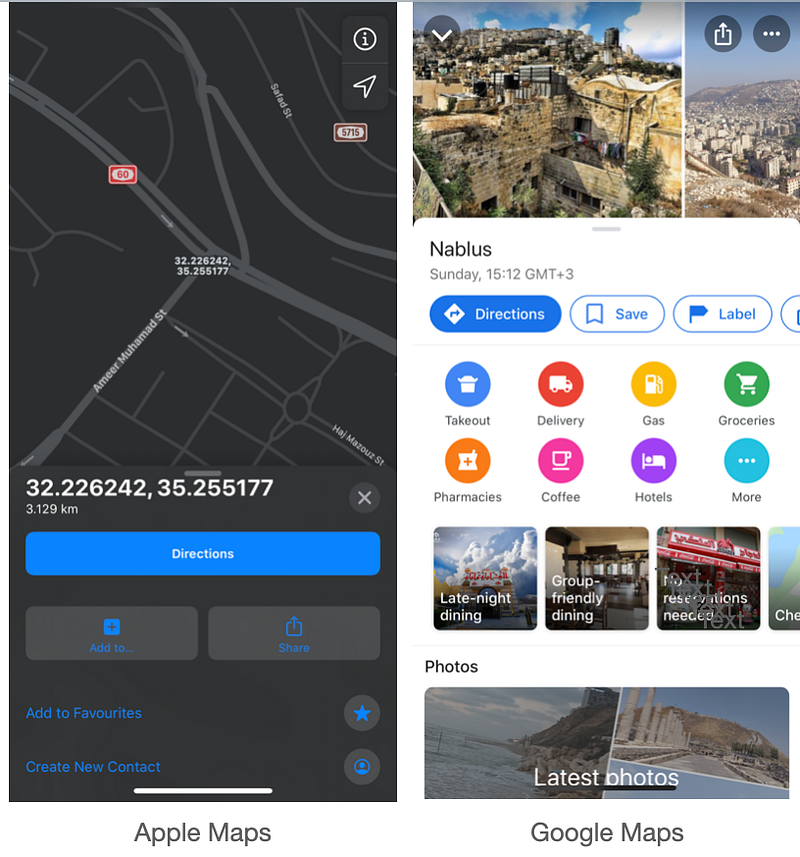
Apparently, the words Palestine or even Palestinian territories are considered “Harassment and bullying.”
Write down I’m an Arab
Facebook deactivated at least 52 accounts of Palestinian Journalists and activists.
On May 4th, 2020, Facebook deactivated at least 52 accounts of Palestinian journalists and activists. Without any pre-warning or an example, the pages were deactivated for “not following our Community Standards.”
These accounts shared videos and news about clashes happening in the occupied territories. The journalists were not stranger to Facebook censorship. A lot of the videos and images that they have shared (regular news) were taken down by Facebook. Facebook is systematically silencing journalists and activists from Palestine; they were already used to it. But in May of 2020, that was a new step. It is a new kind of censorship.
It seems that Facebook’s policy to protect free speech is only valid for some people. A regular post by a Palestinian journalist sharing news is “Harassment and bullying.”
Write down I’m an Arab
I am, like all other Palestinians, stubborn. When I notice that my identity is being censored, I’ll be more Palestinian than ever. So, I guess I should thank social media. Mahmoud Darwish finished his poem with:
Write down at the top of page one,
I don’t hate people,
I steal from no one,
and yet if I’m starved,
I’ll attack my suppressor,
Beware, beware of my starvation,
And my anger.
Write down I’m an Arab
These are hard words delivered by Darwish in the 1960s. To rephrase for 2020 and social media:
We hate no one. We steal from no one. We want to live like everyone with dignity. We will be vocal about our cause; we will not be censored. Write down; We are Arabs.
WAO is an engineer and project manager. I write about finance, self-development, and Arab related issues. To learn more about me please check the following post


