
Pain, Gaslighting, and the Voice in My Head
or why I’m struggling with my membrane tear diagnosis

When I was a kid, I was told I was prone to exaggeration. Every little thing was an issue. I was always scared I broke my arm if it hurt, and as likely to limp as not on any given day. My parents considered me a kid who cried wolf because of it. Over-sensitive. Maybe attention-seeking. Definitely lying.
When I was 26, I was in Disneyland with my family, including by this point my husband and my 9-month-old daughter. My family of origin takes Disney seriously. We’re talking 25,000 to 30,000 steps a day, park open to park close, seriously. While walking between parks — again — one day, my knee locked up. It had been bothering me off and on the whole week, but it simply sat down and noped. Wouldn’t bend. Couldn’t much get it to do anything else, either.
So I slowed down. Relied on the stroller we had. Limped. Bought a knee brace. Meanwhile my family… teased me about it. Laughed at how I walked. Told me to catch up. Remembered all the little injuries I used to pretend to have when I was a kid.
I was 33 when I learned that — almost certainly — I tore my meniscus on that trip.
Between an old gymnastics injury and the fact that I had tracking issues with my knee when walking, spending 12+ hours walking in the aftermath of giving birth, with already hypermobile joints before pregnancy made it worse, gave me a serious injury that I ignored for almost seven years. I put on a knee brace whenever I knew I’d be walking more than about 4,000 steps in one day and made do. Like I was taught.
Now, since I am straight-sized, when I finally did decide to address my knee, it happened quickly. No one in the medical field questioned that there were reasons for my pain. When I emailed asking for an appointment, my doctor scheduled one for two days later. At the appointment, I asked him why.
He said, “You told me about a concern you had. I’ve been working with you for seven years and you’ve never once complained about anything. So I believe you.”
It took all I had to not start crying right there in the office.
Now, I recognize how much privilege I have in not getting the “just lose weight and you won’t be in pain” spiel that so many of my fat friends have gotten about their own — equally legitimate — knee issues. But even though I had almost everything in my favor, I still didn’t trust myself.
After all, when I was a kid, all of my injuries were, I was told, fake or exaggerated.
My knee issue ended up being a combination of chronic stress from doing gymnastics (badly, but that’s another story) as a kid, hypermobility (a common comorbidity in neurodiverse people, it turns out), a torn and now healed meniscus, and a tracking issue with how I walked. I spent four weeks in physical therapy relearning how to walk, and six months strength training with a focus on my knee joint and overcoming its hypermobility. My problems all but disappeared.
In typical fashion for someone who’s been gaslit about her own pain levels her whole life, that made me think that the problems I had before must not have been real, or all that bad. They were fixed so quickly. Part of my brain insists that because I healed quickly, I didn’t need to heal at all.
Fast forward to August of this year. I was at gymnastics one Tuesday evening, as I often am. I was working on standing back handspring step-outs on a TumblTrak, and I was having trouble keeping my shoulders open — partially because I have a nagging shoulder injury it’s taken a year of training, massage, and chiropractic work to even make a dent in fixing.
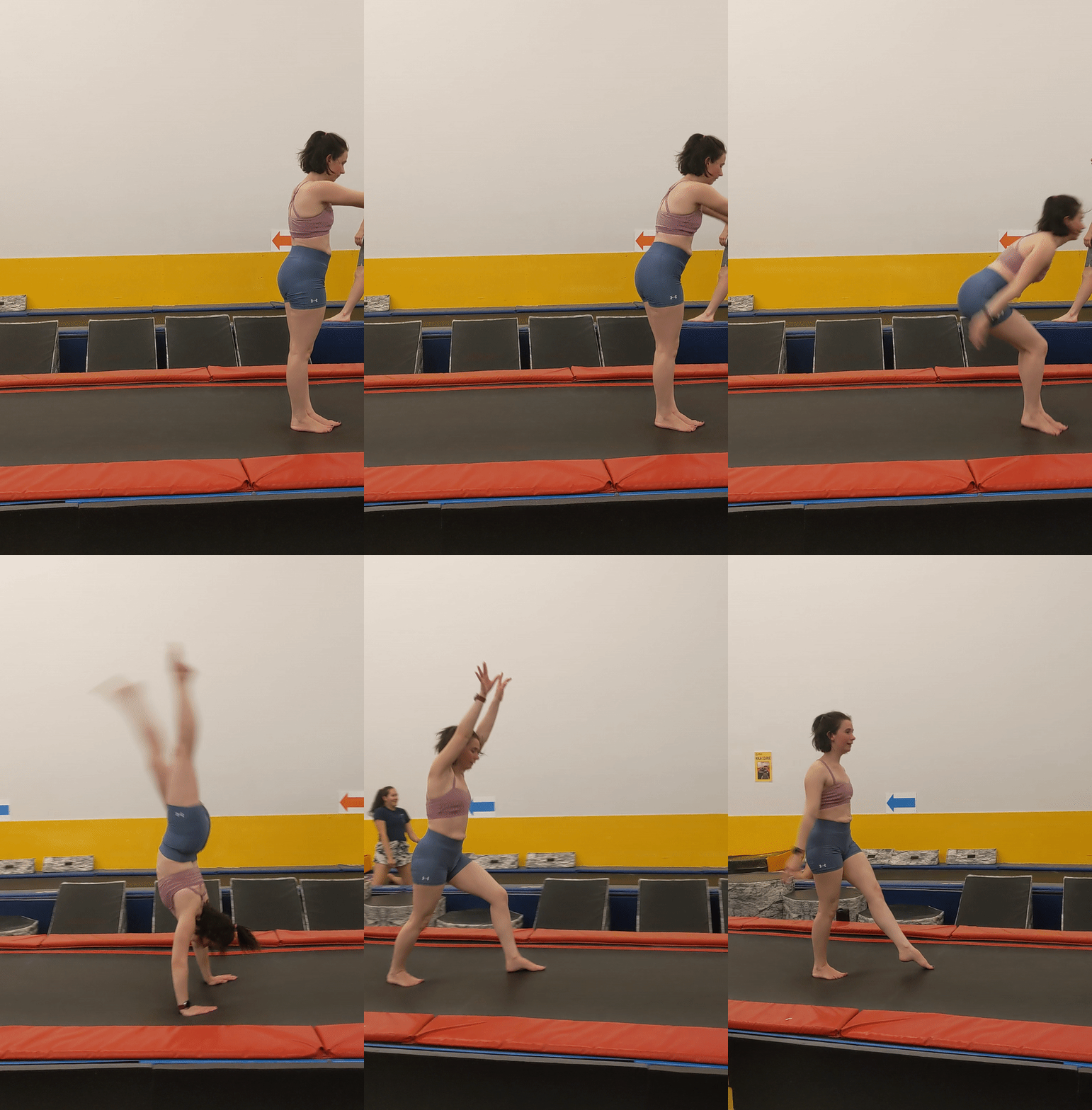
However, I was making some progress in my form, so getting that skill right became my focus for the evening. On one of my turns, I heard something snap (or crackle, or pop, not sure which of the Brothers Rice Krispie paid me a visit) in my right wrist. It didn’t feel super great. But the moment I didn’t have weight on it anymore, I didn’t have pain.
Coming back to gymnastics after Covid was always hardest on my wrists. When you’re sitting at home corralling kids and trying not to have existential crises, you don’t spend a lot of time with your wrists supporting your body weight in motion. Which is a lot of force, turns out. Way more than static handstands. Especially when you’re struggling with shoulder angle. It took a while post-quarantine (I came back to gymnastics in May 2021) before I could tumble without any pain as I got used to it again, so my wrist hurting a bit wasn’t exactly a surprise.
I did two more back handspring step-outs that evening so I didn’t end on a bad one.
When I came back to the gym on Thursday, my wrist still hurt enough that I couldn’t even do wrist stretches properly. This was unusual for me, but I figured time would heal it enough and I got back to work — although I skipped the back handsprings.
Three weeks later, I was at the chiropractor and, at the end of an appointment focused on my shoulder, I said, “Hey, three weeks ago I hurt my wrist and it’s still bugging me.”
He took a look, felt around the joint, declared it “crunchy,” and asked to see me again in a few weeks. I’d be in Asia then, so after ensuring my trip wouldn’t be, like, handstand walking through the Himalayas, we agreed to an appointment when I got back.
That appointment was last Thursday, and I asked him to start with my wrist. By now it’s been eight weeks since that crunchy back handspring, and I’m still unable to put weight on it the way I wish I could. He checked again. Spent more time on it. Compared it to my left wrist. And told me I’d torn the interosseous membrane. He also mentioned that this injury isn’t visible on an x-ray and it heals very slowly. Like, “you’re looking at six months of this” slowly.
“You’re hurt, it’s bad, I can’t prove it to you with diagnostic imaging, and the fact that your pain is close to zero if you’re not trying to bear weight on the joint doesn’t change its seriousness,” is, it turns out, a crisis of faith for someone who doesn’t believe her own pain. How am I supposed to believe it when there isn’t pain?
My shoulder hurts more than my wrist does, most of the time. But now I need compression in my wrist almost always, to switch to a left-handed mouse, and to avoid repetitive use of my wrist when possible.
If you haven’t read my about me… let me re-introduce myself.
My name is Rochelle. My job involves repeatedly clicking, selecting, and typing to change text. My hobbies are drawing, piano, video games, coloring, baking, hand writing in my journal, and gymnastics. I’m right-handed.
I’m losing my life — work and play alike — to an injury I can’t even feel most of the time.
I do get to go to gymnastics if I want to. But I’m not allowed to use my wrist at all. Flips, aerials, and turns are the extent of what I’m allowed. Probably can’t even flip into the foam pit since I have to bear weight on my wrist to get out. I haven’t decided yet if it’s worth $17 a class to be limited like this.
I can type as long as my wrist is braced, my mouse is left-handed, and I take breaks to ice it. But finding this out less than a week before NaNo, well, it fucking sucks. And I don’t swear in semi-professional places lightly.
My chiropractor mentioned part of the reason it takes so long to heal is because you can’t avoid using your wrist entirely. Getting dressed. Washing hands. Making dinner. Eating. The past week has involved a hyperawareness at everything wrists do. I’m trying to ask for help. I’m trying to rest. But I can’t figure out how to rest when everything that relaxes me is suddenly inadvisable.


