
Pablo Escobar’s Medellin and I
Loosely based on real-life events
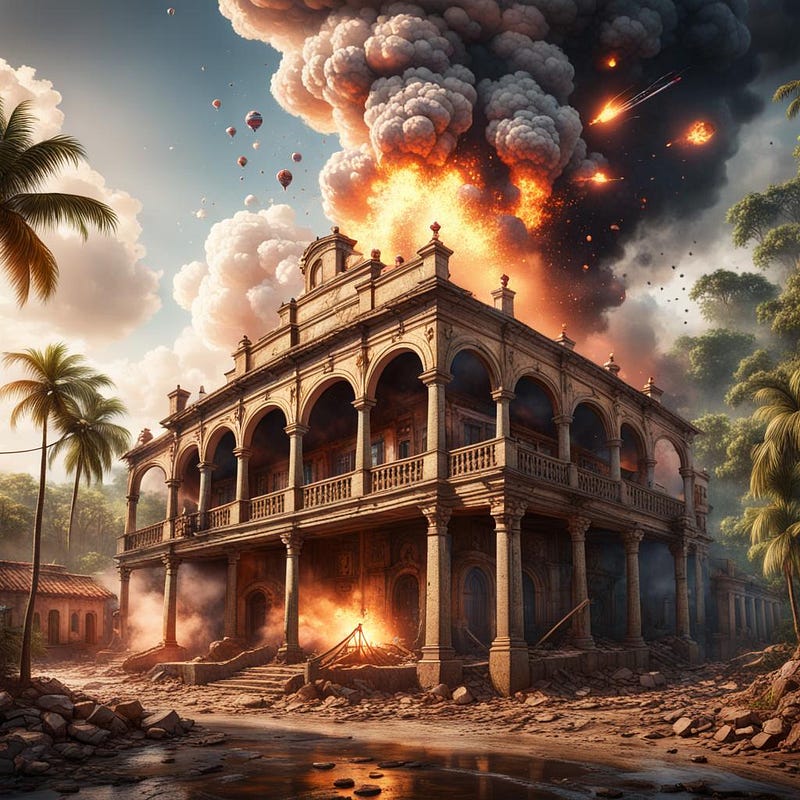
I’m an empath, which means that occasionally, I do crazy things like, for example, renting out — for free- one of my two bedrooms to a guy because he appeared to have nowhere to go. I met Nacho at the gym. He became my fitness instructor and then a tenant who did not pay rent and borrowed money from me. He always had a sad story, and I couldn’t resist believing him and helping out. After a few months, Nacho emptied his room and disappeared without saying goodbye or repaying his debts. Unexpectedly, I received Nacho’s invitation with a prepaid plane ticket to Medellin sometime later.
I emigrated to Aruba the previous year to live my dream, working and partying in the Caribbean paradise. I was a freshly graduated pharmacist, having my first well-paid job at Botica Santa Maria. Going to Medellin felt like a sweet bonus on my already delicious life.
I took a week free and flew to Colombia without telling anybody not to spoil the fun with concerns from my family and friends. In 1991, Medellin was considered the most dangerous city in the world. The infamous Pablo Escobar led the Medellin Cartel, and guerilla terrorized the country. Yet, I didn’t care about politics or whispers of reason. I was 30, fit, and adventurous. My Spanish vocabulary included approximately four words: “Hola, gracias, and por favor.” For younger readers, I must explain that traveling the world of the 90s was an unplugged version of today: no mobile phone, no Google translator or GPS — just me and the planet Earth.
In Medellin, Nacho brought me to his brother’s townhouse in an upper-class-gated community. Jose Ortega, Nacho’s older brother, was a middle-aged man with cold eyes and an aura of authority around him. Carmen, Jose’s second wife, was a young, hot-looking brunette with a brand new pair of breasts cup DD, popping out of her low-cut decollate. Nonetheless, sexy Carmen had to share Jose’s love with his dedication to tequila. Their household included three teenage maids. A row of jetskis, a few motorbikes, and five cars stood in the garage underneath. To my feministic dismay, Carmen and I were prohibited from leaving the premises without an armed bodyguard because of the high risk of kidnapping.
The next evening, Jose invited Nacho and me to a club. He and Carmen fought all day, and in the end, she sent us all to hell. Jose was in a terrible mood. Venting his frustrations, he stopped his truck on the sidewalk, blocking the restaurant entrance. Two beefy bouncers ran toward Jose’s vehicle and started a conversation in Spanish. Jose didn’t answer. He pulled his gun out and aimed at one of the guards. When the man glanced at him with fear, Jose swiftly redirected the gun toward the sky and fired. Nacho blasted his firearm as well from the other side of the truck. The guards retreated and pointed their weapons at the Ortega brothers. Everyone was shouting aggressively and the situation looked tense.
“What should I do?”Stay or get out?” I slowly exited the car and crunched behind the back wheel, observing what happened next. My heart was pounding. I was a foreigner, didn’t speak Spanish, and didn’t know my current location. A minute later Nacho called me: “Sandra, where are you?” he looked surprised when I rose from behind the truck. He was grinning with satisfaction: “You had to see their faces.” he pointed at the bouncers and added, laughing: “Everybody knows Don Jose here.” Relieved, I followed the brothers inside the crowded restaurant. It was a fancy place with well-dressed visitors sitting at round tables decorated with roses. The Mariachi ensemble on the podium played and sang Mexican songs. A club manager in a black suit ushered us to our VIP table near the stage, offering us drinks on the house. Time flew by. While listening to temperamental Mariachi music, I enjoyed Colombian dishes and tequila shots with salty lime wedges.
Without warning, at 2 a.m., heavily armed police raided the restaurant. A squad of armed men in blue uniforms stormed in, blocking all entrances. “Nadie se meuva!” “Nadie se mueva!” They shouted. Jose and Nacho didn’t move. “Stay quiet and look down,” Nacho instructed me in a low voice. Police brutally forced people to stand against the walls, demanding identification and weapons. Some got arrested; others were intimidated and hit. The barbarity of the events made me instantly feel sober. I was glad I always carried my passport, tickets, and wallet in my kangaroo bag. “In case I get arrested,” crossed my mind. A higher-ranking policeman approached Jose, and I peeked at them in anxious anticipation. The men exchanged a few words; Jose stood up and gestured at Nacho and me to follow him. In the corner of my eye, I saw the group of Mariachis hastily packing their musical instruments, ready to depart. To my surprise, Jose first walked to a young “candy” girl with red roses beside the bar. He grabbed the flowers and silently threw money into the empty basket. Then, at last, we walked to the entrance. A policeman opened the door for us, and the cool breeze touched my face. I took a deep breath of relief.
“Nacho, what happened there?” I asked, “Las-Tres-Letras got tipped.” he responded and added: “They are tearing the club apart looking for Popeye.” “Who?” I asked again. “the hitman, Don Pablo’s Cicario,” he explained shortly. “LasTres what? Who is looking for him?”I questioned, trying to understand. “DEA, the narco cops,” Nacho explained, looking at me like I was three years old, and gallantly opened the car door for me. Jose came nearer. He looked wasted, still sipping tequila from a bottle. I watched him swagger to the driver’s seat and start the engine. Miraculously, Jose managed to maneuver the car out of the parking lot without smashing anything. His drunken driving was maniacal. Shortly, we joined the ring road. Jose zigzagged back and forth on a six-lane highway from the outer right to the left. He was speeding through red lights and honking horns at every car appearing on the otherwise deserted road. In vain, I tried to hold onto something to remain seated as the madly swinging vehicle threw me all over the back seat. “We will die. “Let me out!” “Please, stop the car! “I screamed repeatedly but the men ignored me. The radio blared melancholic bachata at the maximum volume. The brothers sang along, looking undisturbed. After a few minutes of yelling, I felt silent with resignation, prepared to die. Yet I didn’t die. We arrived in one piece at the gated residence, followed by two other cars with mariachis. The private party at home was about to begin. For a short while, I stayed outside in the chill of the night to calm down after the wild ride. When I entered the house, Carmen descended the spiral staircase in her black silk nightgown. She looked gloomy. Downstairs, Mariachis stood ready in the hallway. The space was impressive, tiled with marble mosaic, and lightened by an elegant Venetian chandelier suspended from the high ceiling. The ensemble started to play a sad song. Jose was kneeling on the floor with an enormous bouquet of red roses. Carmen approached him and they began to quarrel loudly. Mariachis sang undisturbed, and Nacho listened to them serenely. “Please take me to a hotel,” I asked, exhausted, but Nacho refused. “Jose’s home is the safest place in Medellin,” he said. “It’s too dangerous for you to be anywhere else,” he added. The next day, everybody was chilling. The red roses decorated the table in the living room while Carmen and Jose looked happy in love again.
Two days later, the Ortega family and I left with a convoy of three trucks to their finca, a farm in the countryside. The spacious hacienda, designed with elegant archways, was built on a horse ranch surrounded by hills and tropical vegetation. Llaneros, Colombian cowboys, cared for the farm. The hacienda had a lush garden, attentive servants, ten luxurious guest rooms, a game room, a vast swimming pool, and horseback riding stalls. Besides, I saw exciting opportunities for hiking in nature. Unfortunately, Nacho demanded politely yet firmly that I stay in the hacienda. Guests started arriving to join the Ortega family for a few days. Soon, the country house was packed with their friends, allowing me to move around unnoticed. The following day, preparing for a small adventure, I put a compass in my waistbag and slipped into my walking shoes. When everybody was having drinks in the inner courtyard in the afternoon, I sneaked alone for a hike in the countryside.
I followed a narrow trail starting behind the hacienda and leading to a nearby hill. Unseen by the bodyguards, I quickly disappeared between lush forest foliage and began my climb. In less than 30 minutes, I stood atop the elevation, looking at the other side of the scope. The long stretch of the horse ranch was covered mainly with grass and low vegetation. In the distance, I noticed a wooden cottage with men walking around. Unlike cowboys, they were armed with heavy machine guns. Something drove my attention: Two men quickly loaded big boxes into the trunk of a car parked at the entrance to the building. After they finished, the vehicle moved swiftly away, and I watched it disappear in the distance. Suddenly, I heard the loud sound of an explosion, and the bright flits blinded me. The cottage shook from its foundation upwards and then crumbled in emerging flames, propelling the smoke and debris into the air. The blast spread sidewards and violently lifted the armed men in the air. Then, like poppets, they fell to the ground and remained motionless. I froze in terror. A few seconds later, I turned back to return to the hacienda as quickly as possible. I dashed through the forest, tripping over the roots and tearing my clothes with a thorny shrub. Sharp twigs hit my face and arms, leaving burning marks and bleeding scratches. BOOM! I heard another, even louder explosion coming from the direction of the hacienda. I paused in horror, looking franticly around to see if somebody was following me, but nobody was there. I decided to resume the descent with caution, moving slowly and staying low. 20 minutes later, I stopped at the bottom of the hill, hiding behind giant leaves of dense plantains. I peered carefully: At about 500m, I saw the hacienda burning with bright reddish flames, producing thick clouds of black smoke rising in swirls in the blue sky. Nobody was around; no guests, no guards, no cowboys. In suffocating fear, I sprinted around the burning building, stopping occasionally, desperately looking for survivors, but there were none. I didn’t hear any calls, screams, or cries. I only listened to the roaring fire swallowing the house and everything in it. The smell of burning matter sickened me.
“what next? what to do next?” I dashed towards the interior asphalt road connecting the hacienda with the front gate, the exit. Running in an open field was risky as I became an easy target, but I didn’t have a better plan. My goal was to leave the ranch, get to Medellin, and board a flight to Aruba. I ran. Three horse riding cowboys passed me at a distance, galloping in the opposite direction towards the smoldering ruins of the hacienda. They didn’t try to catch or kill me.
After reaching the entrance, I hastily exited the finca and walked in the sun setting down, following the road leading to the nearby village. I was exhausted, dehydrated, and trembling from distress. I must have looked like a crazy wanderer, with my clothes torn and bloody scratches everywhere. Yet I was alive, and every step brought me nearer to safety.
A bus stopped at the village bus station, and its door opened. “Yo voy a Medellin” “No hablo Espanol,”. I uttered in broken Spanish. “Step in,” somebody said in English. I stepped on the bus and saw an old, gray-haired woman smiling at me. “I’ll help you to get to Medellin,” she added and offered me a small water bottle. I thanked her and drank it greedily in one go. Then I sat on a worn-off seat and hid my face in my hands to conceal tears dripping down my cheeks — the tears of gratitude for being alive. But I also felt the tears of sorrow penetrating my soul to its core in the haunting memory of the lost lives on the ranch. The bus departed.


