
Nature
Ownership of Rossnos
Gondola to Rossnos — is it necessary, or just nice to have?
Background
Some investors and the municipal leadership in the new Ullensvang municipality (Odda, Norway) want to build a gondola lift from the center of Odda to the top of Rossnos. This project has started a heated debate.
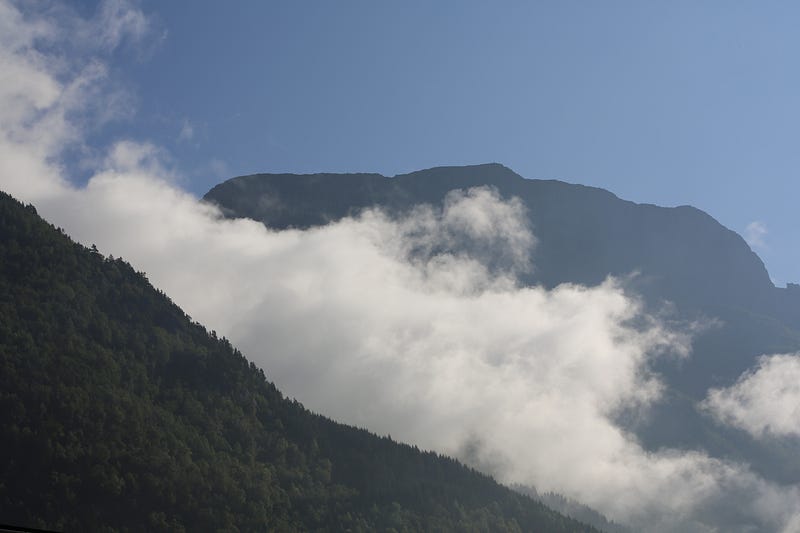
Rossnos
this majestic mountain that always stands there, steep and high above the town of Odda.
There is something big and powerful about Rossnos — the name means “horse mule” or “the horse’s nose” (ross = horse, nos = nose / mule). Rossnos, this mountain that stands there, which is always there, with clouds that sometimes hang like a veil in the high sky.
The mountain has been there for a long, very long time. Is it worth destroying this by building a gondola lift from the center of Odda and up there? Is not it the same as not looking beyond one’s own nose?
Earth — also called Gaia, Tellus — consists of land and sea, air and matter, biology, plant and animal life. And humans. Some have been here for a long time, like the mountain we are standing on. In southern Norway, the bedrock we walk on has been as it is now for 400 million years.
Man, the species of which you and I are members, has been here for the last 10-, 30-, 50- or 70 thousand years. — How long man has actually been here depends on how we define man, ie, when the human we know today was here.
“The lines of all modern humans can be exclusively traced back to East Africa 70,000 years ago. We are all ‘pure Sapiens’. (…) Over the last ten thousand years, homo sapiens has become so accustomed to being the only human species that it is difficult to understand that anything else could be possible. “ (Yuval Noah Harari in the book Sapiens. A Brief History of Humankind, pp. 16 and 20)
Man is the only one of all species capable of making his mark on Earth, and that is what we do for good.
We are world champions in influencing, expanding and changing the Earth’s surface, and we see this happening every single day.
We can look at pictures from NASA or Google that show us the face of the Earth, and how we are about to change it.
As I see it, it is an inalienable value we have in the mountain top Rossnos, and what it means for hikers and other people in Odda.
Rossnos — this high, mighty mountain top we see upwards towards every morning.
We look up, and we think about what the day will be like:
Today it’s snowing on top, another day there is fog or clouds hiding the top, a third day the sun comes a little in the morning, the first rays of the sun creep over the edge up there, and soon Odda bathes in the dazzling sunlight of a new day.
The question is simple: Do we want to change this iconic mountain top and the identity it gives to Odda?
Gondola to Rossnos — is it necessary, or just nice to have?
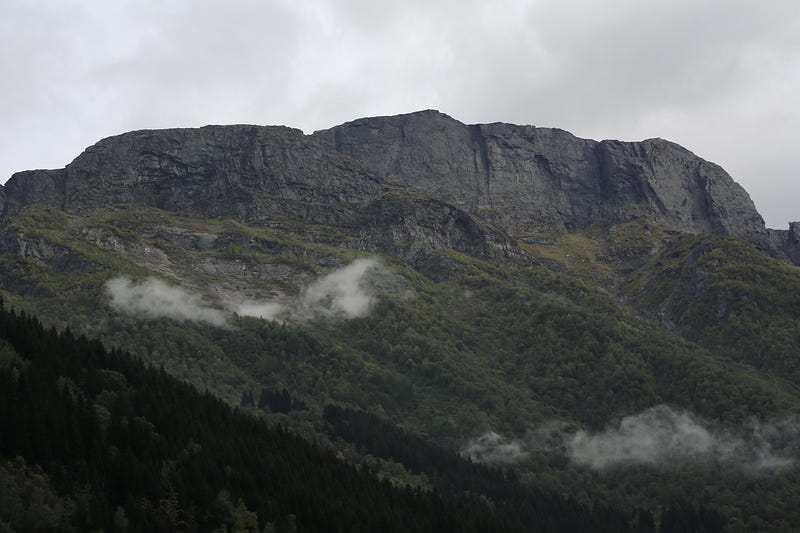
Who owns nature? — Who owns Rossnos?
In this perspective, I would like to look at some arguments for or against making a gondola lift for Rossnos.
The gondola lift project is something that will be implemented to satisfy some people’s desire to commercialize the mountain.
The only question is whether this is the best we can do in relation to the values at stake.
At the beginning of the 20th century, in 1906, the first smelter in Odda was built. It seized the finest agricultural area in the village. That this happened was probably justified by the fact that it was very important for the factory investors and factory owners to be able to build and start up the factory.
But more important was that in 1906 it was a socially very important project, something that posterity has also shown. For almost a hundred years, the factory lived on the river plain in Odda and provided work and income to several thousand workers and their families, up through the 20th century.
The gondola lift project is not a project with a correspondingly great social significance. The only clear common feature between the establishment of the smelter and a possible gondola lift is that both lead to major interventions in and destruction of irreplaceable landscape areas.
In 1906, the deterioration of the landscape was perhaps worse, because it was agricultural land that had been converted to industrial use. But we may still have to say that the encroachment on nature in 1906 was much less serious because the industry then came to the village and created thousands of jobs. It was an industrial adventure that lasted for a hundred years.
The gondola lift project barely reaches the industrial project up to the ankle when it comes to societal added value.
The gondola lift will — if it is built, at best create several tens of jobs in a limited period of perhaps only a few tens of years.
The gondola lift will — if it is built, at best create several tens of jobs in a limited period of perhaps only a few tens of years.
I have no doubt — the gondola to Rossnos must not be built!
All rights reserved. © Øivind H. Solheim , @oivind47, author of novels, poetry, articles, essays, short fiction and experimental writing. fiksjon@gmail.com


