
Owls & Airplanes
Where technology and nature collide
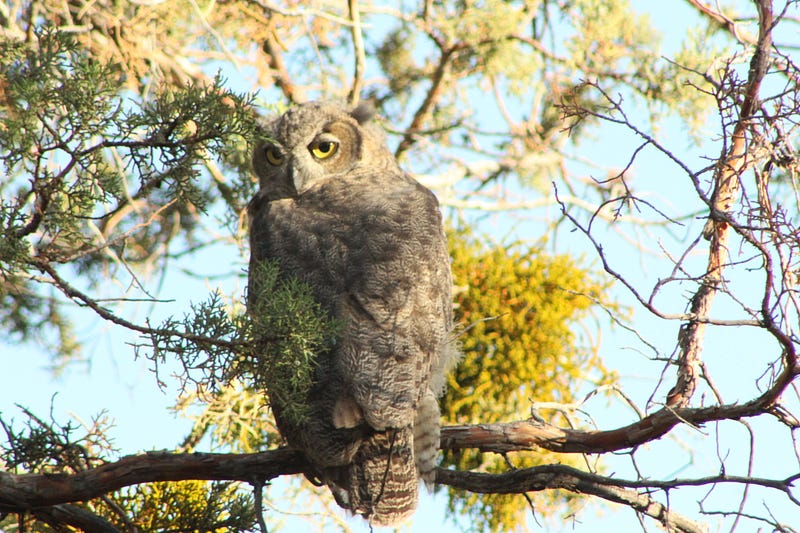
One July day, I found myself standing in the woods about 20 feet away from a 5 month old owl. This was not an unusual circumstance for me — as an owler, I often spend summer afternoons with these beautiful creatures. It’s a wonderful time of year to observe owlets, when they are shedding the last of their juvenile feathers and starting to look like an adult.
This particular owlet, I had named Moony, due to her mercurial temperament. She was in a fine mood that afternoon, companionable and curious, allowing me to sit near her and take pictures, and talk to her. (Yes, I talk to my owls.)
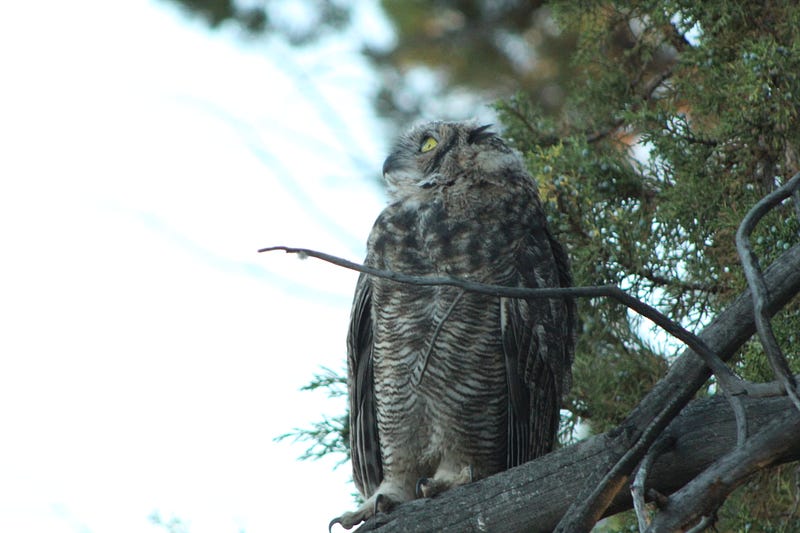
At one point, as I was snapping photographs, she looked up at the sky. Several seconds after she took notice of it, I realized an airplane was passing overhead. She watched it with huge, unblinking eyes, her pupils contracted to tiny dots, until the plane disappeared beyond the trees on the horizon.
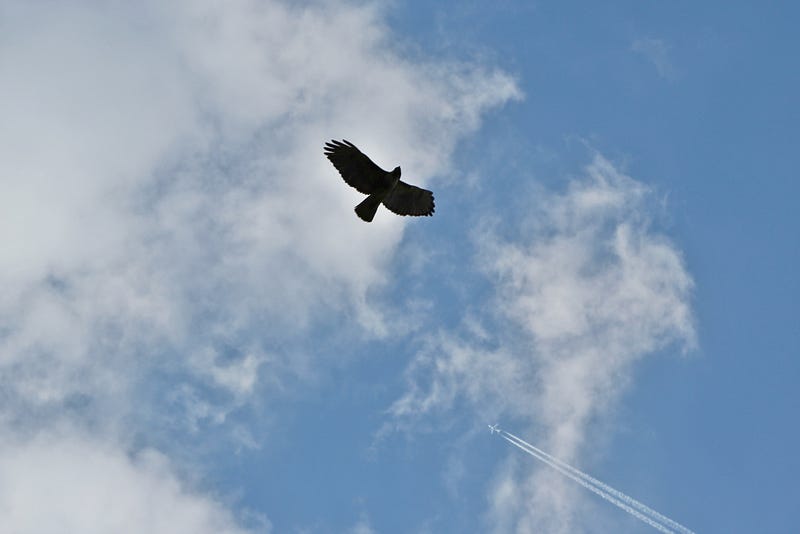
I had seen other owlets observe planes flying overhead before. I’d even observed a hawk circling above me as a plane circled above him.
What a disconcerting marriage of modern technology and the instinctual, ancient world. Owls have been on this earth for millions of years — some scientists believe up to 54 million years. They’ve been soaring through the sky for a very, very long time, whereas humans have only been flying for a little over a century.
What does an owlet, new to the world, think of these metal flying machines? Do they think airplanes are a distant cousin, perhaps — too far to discern that they are not living, breathing beings? Or do they perceive that these machines are metal and motor, and find themselves puzzled by their loud presence in the sky?
What is particularly fascinating to me is the fact that owls were actually instrumental in our journey into the skies. Engineers studied bird feathers — particularly those of the owl family — in order to improve airplane design.
Can you imagine if owls understood their own influence on our voyage into the world of flight? How magnificent to think that their presence on this earth, the brilliant design of their biology allowed us to achieve flight.
And yet, there is a shadow side to this. Is it fair to use them in such a manner? Do we have the right to copy the designs of nature for our own purposes when we don’t treat nature with the respect she deserves?
Of course, it makes perfect sense that we do this. Despite our culture’s general disdain of nature as “primitive,” and “simplistic,” nature is actually the most potent representative of the genius of creative design anywhere on this earth. Just look at the design of pine cones, flower petals, seed heads, and shells which are perfect examples of the Fibonacci series.
It’s human nature, perhaps, to observe these incredible aspects of the natural world and perhaps to see what we could do using that knowledge with the creative impulses of our own minds. However, we clearly do not respect nature. It doesn’t seem to me that we use what we learn with wisdom and humility. If we did, our natural world wouldn’t be in its current vulnerable state. If we did, we might ask less if we can do something and more if we should, to paraphrase my favorite character from the Jurassic Park movies.
As I observe these precious owlets year after year, the curiosity in their eyes as they watch these planes streaking across the sky, I wonder: Will we remember them? Will we preserve their space, their autonomy, their homes, as we continue to modernize this world?
Or will we continue to thoughtlessly press forward with modernization and technology until there is nothing left to sustain them? And if we do…where will that leave us? From where will we collect inspiration? Knowledge? Examples of the genius of the creator?
I don’t know what to do. There is a communal push toward the development of technology and pursuit of capitalism that is beyond any individual’s control. To some extent, it is fueled by our insatiable greed and maybe there’s nothing the average person can do to stop it.
Or…maybe spending a July afternoon with an owl is exactly the act that will slow that train down. Maybe wandering in the woods is exactly what we need to slow the world down and force it to ask the tough questions. To consider the environment around it, and all the beings within it. Maybe there is more power in the simple act of communion than we can imagine.
Whether or not there is, that is where you will find me. In the woods, watching my owls watching the airplanes. I will pour my love onto them and pray for their sovereignty in the skies. I will sit with them until the night comes and they fly away into the darkness, where I cannot follow.
© Yael Wolfe 2019