

Overwork May Indicate A Failing Business Model
Overwork is the modern version of the plague and our lives require us to trudge and struggle through with that sickness as a matter of normalcy.
If smoking represented a symbol of something that everyone knew was unhealthy but did anyways, then sleep deprivation is that new symbol as we step forward further into the 21st century and as we wrestle with and reconcile the nature of a perpetually active global marketplace.

And what an appropriate affliction for the 21st century, where the economic norm consists of implicit costs and reading the fine print rather than explicit costs. All of these costs seem to manifest out of our own inability as humans to keep up with the explosive growth that we ourselves have desired to create.
Simply put, we’ve put ourselves in a position where abstract concepts like the economy and the free market dominate our lifestyles and take priority over our biological needs. I’m sure you can think of a few cases off the top of your head where work dominates health such as becoming seriously ill after having already used up all your vacation days.
We forget to sleep, exercise, eat healthily, or maintain hygiene as the years drag on. The liabilities of overwork on the basis of insufficient sleep find themselves extensively documented by numerous experts from Harvard, among other research institutions:
- The demands and expectations of our modern society have placed increasing demands on our time, and more than ever people are making up for those demands by cutting back on sleep.
- The cost of poor sleep is much greater than many people think: it may have profound consequences for our long-term health.
- Research has revealed that people who consistently fail to get enough sleep are at an increased risk of chronic disease, and scientists are now beginning to understand why.
- Scientific research is revealing, for example, how sleep loss, and even poor-quality sleep, can lead to an increase in errors at the workplace, decreased productivity, and accidents that cost both lives and resources. Awareness can help you improve your sleep habits and in turn your safety.
The message is clear. Sleep is important and vital to the proper long term health and cognitive functioning of individuals. The eerie parallel to tobacco here is that this knowledge regarding the dysfunctions associated with sleep have been known for decades.
Let’s take a look at some of those older studies, such as this one by Timothy Monk and Julie Carrier (1997), where researchers tracked the ability of participants to perform mental processing tasks two hours at a time over a 36 hour interval. They were able to obtain clear results on how sleep impacted mental processing:
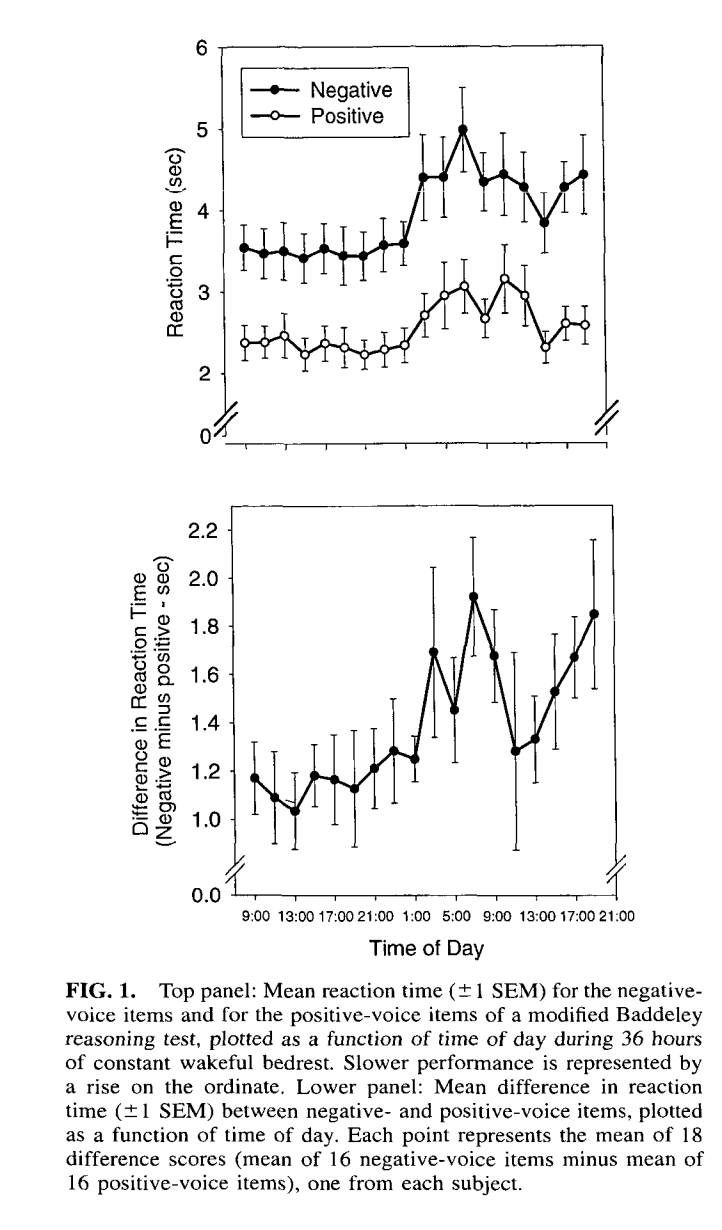
Again, it’s important to stress that these results were obtained from over two decades ago. We see from the data that there is a distinct relationship between sleep and cognitive function even for a simple task. Cognitive lapses and health detriments in general become more pronounced over time as sleep debt accrues.
Honestly, the evidence is compelling and there is a wide body of literature presented and compiled in one study published by the National Institute of Health (NIH) on the matter.
Check this table for a list of nearly 20 or so documented phenomena associated with sleep deprivation that resonate with Monk and Carrier (1997)’s results.
Yet, people seem too concerned with the hustle to care. Too concerned with making it and burning the both ends of the candlestick, sacrificing their long-term health for short term gains. Even if we realize it, what can we do to reverse a trend with such a large social scope, and a trend that our culture encourages?
Moreover, with the sorts of cognitive deficits that come with long-term sleep deprivation, it is probably not an exaggeration to say that a feedback loop of bad decision making will form as severely sleep-deprived individuals lack the initiative, focus, and awareness to change their habits.
We should make no mistake, societal health is definitely at risk. The CDC estimates that 1 in 3 American adults do not get adequate sleep on a regular basis.
Another preeminent example of how an obligatory work culture combined with heavy sleep deprivation can tax and push a society to its limits is Japan. In fact, the phenomenon of death from overwork happens so frequently in the country that Japanese even have a word for it: Karōshi (過労死).
As an extreme individual case that probably shows that sleep deprivation can kill, consider the Japanese reporter who simply died after working 159 hours straight on the job.

Now, as a reader, I don’t know what your personal record for pulling consecutive all-nighters is, but the one time that I’ve reached 53 hours I was essentially semi-conscious and drifting in between a dream-like state and reality simultaneously. By the way, that’s also not an experience that I want to repeat again, but that I feel will inevitably happen somewhere down the line.
The fact that some university students and workers around the world are being pushed to sacrifice critical hours of sleep when it comes to either their schoolwork or job obligations is something that the government should take firm policy actions towards curbing and mitigating.
Going back to the title of the piece, overwork is a sign of a failing business model. And I think it may be time to give some thought towards whether or not the current business model that dictates trade and work globally is failing due to increasing number of overworked individuals across the board.