
Writing|Challenge|Tourism|Inefficiency
Overtourism in Japan: Fake News?
Day Two of 15-Day Writing Challenge

Newsflash: Japan is sinking under the weight of foreign tourists.
It’s not news. Japan has always been a magnet for tourism.
As a Japanese national returning from a long teaching career overseas in mid-2021, I heard from other locals that this year is especially wild with the explosion of international tourists. But is it?
According to the Japan National Tourism Organization (JNTO), the estimated number of inbound travellers to Japan in January 2024 was 2,688,100, at the same level as pre-Covid-19. So, it’s back to normal. Sort of.
With pandemic restrictions, international visitors virtually dropped to zero by mid-March 2021. Japan’s tourism showed no pulse until July 2022 and stayed in a coma for another three months until Tokyo lifted travel restrictions.
Resorts, retailers, and restaurants, small and large, went bust one after another or limped in fiscal agony. I remember how the country was eagerly awaiting the first influx of foreign visitors. I recall my friends overseas texting me with emojis showing elation, salivating in anticipation of seeing the autumn leaves and feasting on their favourite Japanese food.
Japan’s honeymoon with tourism, however, fizzled like a sad shag by the summer of 2023. Local citizens and businesses started complaining about the rude or disruptive behaviour of international tourists.
For example, in Gion, the traditional entertainment quarter of Kyoto renowned for the maiko and geisha, swarms of paparazzi-like tourists would go as far as blocking their passage, harassing, and touching them, or worse. Littering and property damage are other sources of angst.
It’s not a new phenomenon. People forgot that the problem ever existed before 2020, like genital warts they might have had last season. The slightly cynical side of me thinks that Japan’s consumer-dependent businesses yearned for the sound of cash flow during the three pandemic years, and they were all too forgiving when the floodgates reopened. This observation is particularly true in my birthplace and current city of residence, the ancient capital of Kyoto.
However, the question remains: Is overtourism in Japan a real thing? Is it fair to look at foreign visitors as some plague?
To me, the obvious answer is a flat no. The term overtourism is a nuanced issue. It is too easy to become hostile at the risk of ruining business opportunities and cross-cultural understanding.
Xenophobia and bigotry are two trolls under their bridge just waiting for us to cross it.
‘There’s a risk of framing the debate in oppositional terms, which might impede progress. ‘Fight against overtourism’ is a common phrase, but can quickly slide into ‘anti-tourism’, thus anti-tourist sentiment; dangerous territory.” — Tim Fairhurst, Secretary General of the European Tourism Association
Visitors should not be scapegoats. Citizens should calm down.
Sure, there are inconsiderate, ignorant, arrogant, selfish, and overall unpleasant travellers, but they are everywhere regardless of race, nationality, religion, creed, gender, age, or sexual orientation.
But people are people. The best way, albeit time-consuming, is educating such people through timely information and clear instructions and lawfully dealing with unruly behaviour.
Let me cut to the chase. The problem is not one single issue.
Despite what people think about Japanese technological innovation and ingenuity, much of Japan is still living in the past in many respects. But that’s a whole other essay or book.
The mindset here about tourism is archaic and backward at best, where much of our country clutches on to the good old days that never were and are fearful of change. For example, many shops stubbornly stick to cash-only payments. They neither trust digital technology nor want to pay transaction fees if they can help it — my friends who run mom-and-pop shops in the food and hospitality industries have often admitted as much.
And watch out for the looming foreigner taxes designed to offset the growing stress of tourism.
Infrastructure and essential customer services are also significant issues that need urgent solutions if Japan has any remaining self-esteem and integrity.
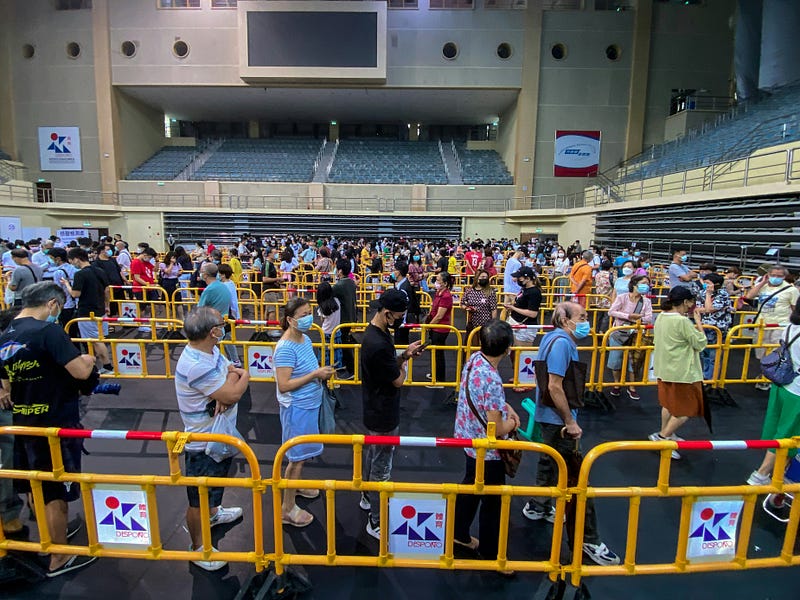
As I write this, my emigrant parents are visiting Japan and touring several cities. I always dread going to Kyoto Station with them to purchase train tickets on the bullet train (Shinkansen). My patience gets tested by the long queues, reminiscent of those at theme parks.
That isn’t even the crazy part.
Theme parks, like Tokyo Disneyland, have around a dozen ticket booths from memory. Kyoto Station — not too dissimilar to New York’s Grand Central in terms of importance as a major transportation hub — has only two.
What the Fuji.
In 2024, Japan Rail West, the once national rail company in the country, can only operate two ticket booths at one of the most crowded terminals, even during peak hours. I find myself only sympathizing with overworked and underpaid ticket counter staffers.
Imagine being the target of frustration and occasionally hate in multiple foreign languages. I would rather get hit head-on by a speeding bullet train.
Overtourism. So, is that a thing? In my not-humble opinion, it is a myopic and biased view of the thornier issue that divides people.
We may as well add the prefix over to everything we humans do.
How about over-queuing?
Thank you for reading without censorship.